Tuesday, July 14, 2015

Fresh Eyre everywhere

Day 3

As well as the potplant, Blossom, for a constant supply of very hot chillies, we carried an assortment of provisions, as one can when on a road trip. Our big wicker basket was full of Pimm s-making ingredients as well as coffee bags, bread, eggs and cheese and tomatoes

Hence, while I packed and laid out clothes for the day, Bruce leapt into action in the lovely modern Cowell kitchen to make us a stunning Spanish-style omelette before we hit the road.

And off we went, skimming south in the Toyota Rav my grandies like to call "The Red Beeper" because of her various beeping reprimands. This was her first road trip and she seemed to be enjoying it as much as we were.

There is nothing like that sensation of sublime freedom and curiosity one realises on the long, open road with huge skies and ever-changing landscapes and vegetation.

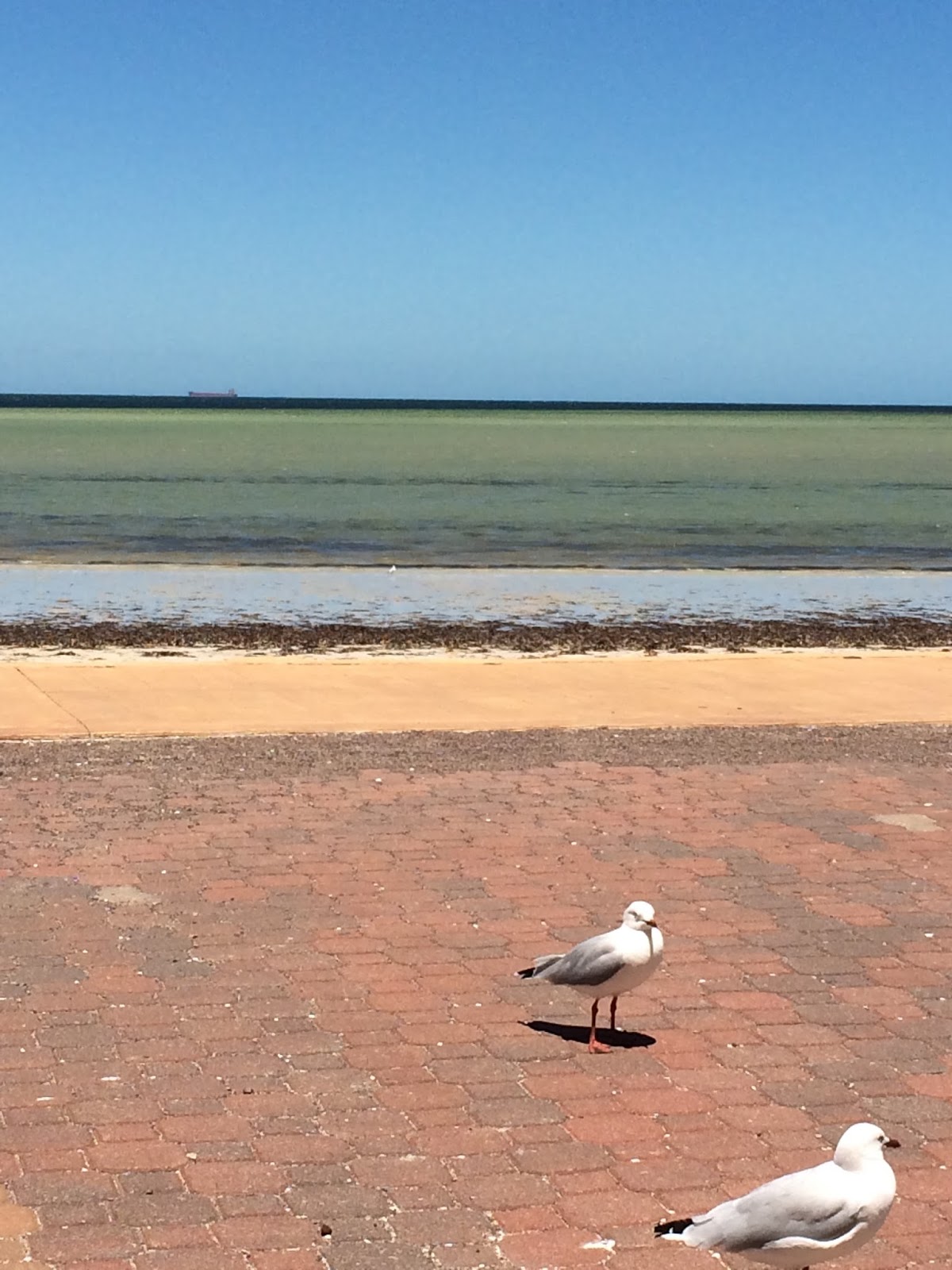
First stop, Arno Bay. It's a humble sort of old fishing town which has seen busier times. These days its glorious beaches attract holidaymakers and it has a splendid beachside caravan park on one side of its coastal core and a row of wonderful old shacks on the other. In the middle is a large turning and parking circle and an expanse of lawn on which a loo block takes proud prominence. I used that loo block and am here to report that it was the cleanest and best-kept public loo I have ever encountered. Its stainless steel sinks were spotless and its terrazzo floor shone with polish.

This was something I was to observe throughout this Australia Day pilgrimage. One country town after another had proudly-maintained and inviting public conveniences. Not only but also, a lot of them have been turned into works of art, covered in lavish murals. It is quite a phenomenon - and this was my first experience. I was so impressed that I took a photo. I took a photo of the loo floor.

We parked the Rav on the foreshore, the chilli plant on its bonnet to get the sun, while we wandered onto the beach for a while. There was a slow feeling. A couple of women sat under a pergola talking. They did not so much as turn to note our coming or going. We read the huge sign, topped by a sculptured king fish. It described today's Arno Bay fishing industry - a fabulous fish farm breeding kingfish and mulloway. Sustainable seafood. Yes. A couple of kilometres out to sea one could just spot signs of its location.

A pleasant retired couple came out of their shack when we went to read the sign on the long strip of green which stood between the shacks and the sand. "Used to be a running track," said the woman. "They had races here. And the loo block stands where the old captain's house used to be. We were sad when they bulldozed the captain's house. Sad to see history going. The older you get, the more you value history." The woman explained that she had a local background but that her husband was a Queenslander. They had bought the shack 40 years ago for $3000 and, had holidayed there with their 7 children. It had been built for the second captain, so they had never changed its appearance. But now retired and living there, they were working on doing up the interior while loving the life. How do they fill their days in this tiny settlement? "Don't know. They seem to go so fast." They invited us in for a cuppa - but we declined. More miles to cover.

The road south is a classic ribbon, made rather pleasant by surfaces striped in pink and charcoal hues. A pretty ribbon. And it just goes and goes straight ahead, an undulating single lane traversing bush and mallee, swamp and farmland. Now and then there's a bend. Then another straight ribbon, as far as the eye can see. These are dangerous roads. People tend to put the foot down. Others pop the car onto cruise control at the 110k limit and steer. A drowsy moment or an in-car distraction, and the car can drift into the path of oncoming traffic. Three people, a Port Augusta father and his twin sons, were killed by that very thing - drifting into the path of an oncoming road train- just an hour or so after we left Whyalla.

Next stop, Tumby Bay.

Everyone loves Tumby Bay. We did, too. Glorious sweeping white beach, wonderful for walking and good for swimming.

A massive sheltered bay. Calm waters. A pontoon close to shore near the populated area was rocking with a happy holidaying family. Someone was cruising about in a kayak. A pelican watched from a lamp post. It was not busy.

We settled in the lovely little Ritz Cafe on the foreshore for lunch. I had grilled yellowfin whiting, a local fish. I'd not had it before. It was fresh and good. Not in the class of King George Whiting but good by its absolute freshness. Bruce had a toasted sandwich. He is not on a mission to eat local seafood for every meal. I am.

We stream down more ribbons of road. Cleared land becomes more common beyond verges of scrub. And then, there is our day's destination: vivid aquamarine sea, islands, signs of occupation, and suddenly here we are in Port Lincoln. The Port Lincoln Hotel was not hard to find. It is the biggest building in the town, if you don't count the massive white Viterra grain silos which feed wheat out along the jetty onto waiting cargo boats. The Port Lincoln Hotel is the top place in town, owned by one of Lincoln's tuna barons, a man named Sarin. The hotel restaurant is named after him.

The hotel licensees are Peter Hurley and a former footballer called Mark Riccuittio. They are not just hotel folk but Crows people. That is a South Australian football team. "The" football team, if you ask me. There is a fair bit of acrimonious competition between the Crows and a team called Port Power. And that explains the negative reports I had heard about the hotel. it is a gorgeous, classy place. We were in a corner room on the 4th floor with a corner balcony giving us a dream view of Boston Bay in two directions - one towards the town and the other along the coast. The chilli plant took the best real estate, right in the corner of the little balcony. Fresh air, sunshine, fresh water and a view. What more can a chilli plant want?

The downside of this marvellous hotel and this heavenly room was the internet service. We could not get online. The free wireless simply did not download anything. We tried and tried, called the desk and soon became the mission of a staffer called Sarah. A bright girl from Perth, she has become the hotel tech trouble-shooter and our iPads not to mention my MacBook Air were weird casualties of a not-great wireless facility. Dear girl worked like fury on every logical solution. She even brought us a bottle of complimentary red wine for our disappointments - but could not get us working properly. I managed to download some email - but only by placing my iPad on the floor at a weird angle leaning into the door to the adjoining suite. Even then, the email came sans content. I knew who it was from but not what they were saying.

I had some pressure things on the go from Women In Media. I attempted, laboriously, to iPad out some responses and communications, but next morning I discovered that they had not managed to send and were sitting in limbo. Unaware of this, thinking I had at least kept the communications show on the road, I hit the lovely swimming pool. Ooh, cold. But, despite some pretty boorish teenage girls hogging the water, I had a divine swim, pleasantly interrupted by the arrival of an African American fellow who had flown from Sydney especially to swim with the sharks in Port Lincoln. It's a big attraction here. He was excited but very nervous about this booking first thing in the morning. He was glad to find American conversation but not perhaps as glad as Bruce whose devotion to the New England Patriots along with the hours dedicated to watching their victories on American football telecasts have been frustrated by the absolute lack of people with whom to share the love of the games and the results therein. At last he had someone who knew what he was on about.

For me, there was the sheer bliss of an outdoor pool with a view of the sea and boats - not just the cargo boats loading at the grain dock, but, look, the One and All under full sail! A taste of another era on the sea. One can rest one's elbows on the side of the pool and gaze through the glass windbreaks at this vista. Now there is a tug boat leading a cargo boat back to the ocean. This has to be one of the most interestingly-located swimming pools in the country. Pity it has such awkward sunbeds. We lolled for a while, but the mattresses on the sunbeds just slither about. Oh well. I loved it anyway.

Bruce and I dined in the Sarin restaurant in the hotel. I had oysters, of course. Half a dozen natural and half in a quandong/ tomato treatment.

They were small oysters. It is out of season. Two were a bit rank and I sidelined them. The others were good, but not knee-trembler good. The chef sent out two more, learning I had rejected two. They were better than all the others. Thereafter I had bluefin tuna, another local specialty. It was sesame-coated, seared and and presented in a delicate Asian curry sauce on top of a nori roll and surrounded by tofu and lightly cooked Asian vegetables. It was stunning. Bruce had pork.

I fell into a food coma the moment I hit the bed. Dinner had been just a bit rich. It was, consequently, a rather broken night.

Monday, July 13, 2015

Where Eyre We Roam

Day 2.

Soft rain and grey skies greeted us on Wednesday morning. The pet chilli plant was able to feel the elements for a while and I went for a swim in the lovely motel pool before we packed the car, went shopping for things we had forgotten to bring, such as straws for our Pimms, and then meandered out to the Arid Botanic Gardens for lunch and a walk amid the plants. We love this place.

Everyone does. It is special - spread out in the red sandy soil with the Flinders Ranges as a breathtaking landscape backdrop, blue against a bluer sky. We gazed upon this beauty and brunched at the Garden Cafe - upon an Aussie burger which was flavoured with bush herbs of some sort and utterly delectable, Bruce upon a toasted sandwich. We drank in the pristine desert air, examined the seemingly inexhaustible variety of eremophilas, pored over the industry of bull ants, and marvelled at the sweet scent of the witchetty acacia.

And then it was back on the road and south down Eyre Peninsular to the steel town of Whyalla. It was a mighty mecca in its day and it is still a really striking place, its red-roofed industry juxtaposed against a vivid azure sea.

The town has some lovely old architecture and it features Hummock Hill, a vertiginous winding trail up which one drives to lookouts which showcase the town in all directions. And there is the shallow bay - pale swirling greens and yellows against white sands and deep aquamarine seas. Cargo ships dotted the horizon. A busy marina lies in one foreground and industrial buildings in another.

The shallow bay lured us down for closer examination: those colours like nowhere and nothing else; a well-tended foreshore, perhaps too much so; a lot of cement paving and strange zig-zagging roadways onto the beach; playground and exercise machines; an elaborate sculpture of a diver beneath a school of fish; a white sandy strand with moderate seagrass; indifferent seagulls. We ordered a cup of tea at the cafe and sat in the brisk breeze enjoying this very different view before using spotless loos and and resuming our drive, noting as we went the darling old workers' cottages.

There followed a long, straightish drive down a beautiful road through undulating scrublands with the plan to hit Cowell with plenty of daylight.

My friend Janice Madden had organised accommodation for us. I thought it was going to be at the dear old Commercial hotel in Cowell's main street which I remembered fondly having stayed there years ago when visiting Cowell on a newspaper assignment. But, no, it turned out to be around the corner in a very modern two-storey holiday house which is an adjunct to the hotel.
Blossom, the pet chilli plant, took the sun on the bonnet of the car as we explored these swanky digs. There was a lovely little balcony where we could put her out in the fresh air and where, once unpacked and organised, we sat and relished a Pimms, looking out on a strange wasteland vista which seemed to separate the township of Cowell from a section of burbs.

Cowell's great claim to fame is as an oyster-producer. It used to be a major grain port but times have changed and now its exquisite, pristine waters are home to big, beautiful, delicate oysters - knee-tremblers, if you are an oyster-lover of my ilk.

We booked a table in the pub for dinner and went off for an exploratory walk down to the jetty, looking out to where the oyster beds sit in the clear sea, finding a lovely mangrove boardwalk. It was a pleasant walk which gave us a strong sense of the place.

The feeling was very laid-back and quiet and yet the caravan park was crowded and the town's other pub was rocking with merry tourist business as we walked past.

Funnily enough, our pub was very, very quiet indeed. It would seem to be out of fashion, patronised more by locals than tourists. We ate at a side table in the dining room, fascinated by the quaint old salad bar with its lace-motif plastic flaps to protect the food from the famous Aussie flies.

I had Cowell oysters, of course. A dozen. Presented in four different ways; specialty of the house. The food was not gastronomically remarkable. It was strictly country-pub. And off we trotted to our great big house to stretch out in the upstairs living room and watch the telly.

Road trip - where Eyre we care.

It's a road trip.

Destination: Elliston on Australia's Eyre Peninsula.

Day 1.

The red Rav hummed north up the Port Wakefield Road out of Adelaide. Dense traffic gave way to a steady flow of road trains and oversized trucks carrying mysterious construction objects. It had been a fast and frazzling time clearing the desk of last-minute bills and Women In Media communications to take the long-scheduled break away from the city. The thinning traffic heralded that relief of freedom - but the true spirit of getaway has to be expressed by a stop at a Port Wakefield Roadhouse.

There amid the lineup of truckstops was Pope's, as it always had been, a simple Aussie cafe: pies and pasties, fish and chips, sandwiches. We sat at outside tables under the expectant gaze of a solitary seagull. Bruce chomped a succulent chicken pie and I had a cheese, tomato and mustard sandwich toasted thin, crisp and gorgeous. Oh, and a nice cup of tea as the trucks, caravans, boats, horse trailers, and cars streamed steadily north.

Our destination was Port Augusta, a large town at the head of Spencer Gulf whence comes South Australia's coal-fired power. These days, the aesthetic of long strands of hilltop windmills symbolises the change in power generation.

From market gardens, past the spectacular pink lakes of Lochiel, the road narrows to a single lane interspersed with passing lanes. An hour or so north, the ridges of the Flinders Ranges rise to the right. Beautiful.

Entering Port Augusta, one crosses bridges, swampy and a bit sulphurous on one side, but blue and deep on the other. We are crossing the upper reaches of Spencer Gulf. We swiftly found our Majestic Oasis motel beside its grassy shores. The high security of the motel compound surprised us - high fences and high electric gates. But the staff was chirpy and welcoming. Palm trees and murals adorned the parking areas and the two-story accommodation units were named after Aboriginal Elders.

Our room 15, with a nice little outside deck, looked out onto the water and a bridge, the view interrupted by fences and palms. The pool was a couple of metres away. I put our travelling chilli plant outside for some fresh air and made us glorious happy-hour welcome-to-Port-Augusta Pimms cups.

My old colleague Paul Lloyd and wife Roseanne rocked up to take us out to dinner. "Mostly pub food in Port Augusta," said Paul - and then they drove us to the Standpipe Hotel wherein, belying everything they had said about P.A. cuisine, we were served a range of authentic curries of exquisite quality. And we drank a little wine and exchanged accounts of where life had taken us. Paul, an erudite and talented writer in his era as a journalist, now calls himself a hermit immersed in botany and music while his magistrate wife is engaged in Aboriginal life and welfare. They are both interesting and engaging individuals, and it was an enriching time.

Roseanne presented me with a tub of eremophila hand cream, a traditional Aboriginal unguent made by an Aboriginal friend of hers. It is pea-soup green and oddly pungent, almost repulsive at first, but once rubbed into the hands its aroma mellows out while the skin turns utterly silky. Roseanne told of how the unguent, believed to have healing properties, used always to be made with emu oil and hence could only be made by the women when the men had killed an emu. These days, the men no longer are hunters and processed emu oil is expensive, so the women pop into the supermarket and buy olive or canola oil as the cream's base. The loss of men's roles as hunters has been a root issue beneath the disintegration of Aboriginal society, Roseanne lamented.

Later Roseanne took us on an interesting night tour of the back blocks of P.A. along a dirt road which touches on the very top of Spencer Gulf meaning that one second one is on York Peninsula and then next, Eyre Peninsula. It was a moonless, black night and it was a surreal tour.

Friday, September 19, 2014

Oh, to be in Scotland

Oh to be in Scotland, now the vote is here.

I used to live there.

Oddly enough, I was first female taken on as a general reporter by The Evening News in Edinburgh. The paper was in its North Bridge offices back in those days, with Fleshmarket Close beside and Jinglin Georgies the place where all the journos hung out. I was a bit of a hippie but the gruff News Editor, Max McAuslane, called me "hen" and took me on without hesitation. I soon learned that he had a special claim to fame as the young journalist who had the international scoop on the discovery of Rudolph Hess's parachute landing in Scotland in 1941.

I worked among some wonderful journos, Jim Gilheany I recall and the jovial Jimmy Scott. As a footloose Australian, I was always fascinated that so many journalists had never left Scotland.

I loved Scotland and the Scots - as well I may, carrying my family name of Scott as a middle name.

In those days working on the Evening News, I could walk to work from our little 10/- a week top floor digs on The Pleasance and its view of the Salisbury Crags out the window made up for the fact that the loo was down on the stair and there was no bathroom.

Winter days in Edinburgh meant one walked to and from work in the dark, cobblestone streets often glistening in the rain and shops glowing yellow light. Summer days were long and softly bright - presenting dusk skies of the most magical orange and amethyst hues.

The Evening News was a good way to get to know a city. Having admired Edinburgh from afar as a really important historical big city, the surprise was to find that it was also a very provincial city. The stories I was assigned on the paper seemed very parochial and lightweight compared to what I had been doing in Australia, let alone on AAP/Reuter in Fleet Street. Once I was sent out to report on a burst water pipe.

Then again, as a newbie in Scotland, I had a bad start. On one of my first days I suffered the great embarrassment of coming back from the law courts with no story. Not yet tuned in to the dense Scots brogue, I simply could not understand what the protagonists were saying. "N'argh branergh, ach ey'n nicht bleet..." My pencil poised over my notepad, a sense of panic descending...

A few weeks later, this would not have happened. I soon spoke the language.

When I did present with a big exclusive I had lucked upon due to my association with the Royal Medical Society, the aforementioned News Editor announced that it was too important for a woman and he brought in his senior male reporter. As much as I argued that, according to the rules as I knew them, the journalist who gets the scoop also writes the scoop, sexism ruled the day and the times. As the first woman, I was decidedly token. My ire ran deep. When my working visa ran out, I did not try to stay. I went travelling again and, on return to Edinburgh, wrote for underground arts magazines, moved to the New Town, married my young doctor, gave birth to my first son and then, heaven forfend, moved to Aberdeen.

Five years of my life belonged to Scotland all told. I loved it deeply. I loved the Scots. Back then, they were talking devolution. It was a deep-rooted yearning I thought a bit impractical.

But their history was long and violent.

They had the tribal memory of Culloden. They saw "the borders" very strongly as just that. They spoke dismissively of Sassenachs. They had a strong sense of their feisty independent Highlander identity.

And, once in their midst, sharing stairs and sometimes poached eggs with them, I could only love them.

As passionate, sweet patriots, their place is secure in my heart - and, let's not forget, in my genes.

I tips me cap to their quest for independence and imagine that, despite the no of now, they will not give up.

Monday, August 25, 2014

Thoughts on Writers' Festivals

The interesting thing about writers' festivals is their sudden ubiquity. There are so many festivals, it is amazing the writers have time to write at all.

Once upon a time, writers were for reading. They were not expected to be performing seals. Instead, they did a series of carefully-placed media interviews and the rest of the book tour was in signings.

Gradually, the cult of the author has been growing and authors are marketed along with their books.

Authors have to be vivacious and entertaining. A good Writers' Festival appearance can boost sales. A tepid appearance may leave their books on the table.

Then there are the publishers' marketing people and minders who have to schmooze the festivals.

Who pays for what?

If the festivals pay to bring the writers, then they need the revenue from ticket sales.

One would have to ask the publishers how they make it viable to have travelling reps on the ground at events in these testing times.

We should not quibble, though. One thing is good and clear. Book festivals are big business in themselves. They are a sign of a curious and sentient literary market. Maybe a boom of Boomers.

I'm not complaining.

Friday, April 25, 2014

The Face(book) of progress

Who dreams up these nonsensical questionnaires?

What rock band are you? What era should you have been born in? How English are you? What flower are you? What is your spirit bird? What sort of wine are you? What superhero should you be? Are you a proper snob? What flavor of jam are you? To find out, one is presented with some quaint choice questions with pictures and - ta-da! You're very 60s, you have an owl, you're Batman, you're tart quince...

You are a Facebook lemming! We all are. I fall for this brain fluff, too.

This current epidemic of question content is part of the Buzzfeed market grab, social media marketing. It is the current thing.

It arrives in our Facebook faces beside conventional news sources which now, instead of factual breaking news headlines, offer:

Amazing video of what Russians are doing in the Ukraine

11 faults politicians would like to have

Who went faster? The cops or the robbers?

15 ways not to use energy

Tony Abbott upset the palace. What did he do?

500 ways celebrity cult gossip dominates the news

A $5m credit card bill. Why?

10 things that will make you laugh.

Best-ever recipe for boiled egg. Etc etc.

All this is the result of a lot of desperate enterprises to grab a market in new media. All of them are under the impression that the social media target market is pretty damned dumb and can only be lured to information if the information is promised in the form of trivia.

And so we discover our information revolution is upon us as a tidal wave of infotainment tid-bits.

Let's not forget cat videos. They have been beloved since the Internet was a kitten. They're a running joke, very funny and good for the soul. So, the social media information purveyors have grabbed them like a fist full of dollars and re-presented them to the world as their very own viral phenomenon and a magnet to their ad-laden sites.

They stop at nothing.

And they have a marketplace of wide-eyed and willing players who are having too much fun to notice the cynical game afoot which promises to turn our computers into a spamland of endless sales, promotion and greed.

And to think that, just a couple of decades ago, when the Internet was being explored by the scientists, academics and geeks, the excitement flowed from the idea that it could be the great free sharing of knowledge. It was for a while. Until the men in suits found it.

Saturday, October 26, 2013

VIT - and proud of it

Very Important Tweeps have trounced the grand old status of the Very Important Person.

Now, suddenly, smart social media marketers have clued up to the fact that the Twitterati are the communicators of the moment. We are not simply as good as our follower figures in spreading the world, but have limitless exponential potential according to the powers of the ReTweet.

It was the marketing person for the Cavalia horse spectacular, which is some offshoot of the Cirque du Soleil mob, who first called me a VIT. She was inviting me, in that capacity, to a free night of the horse experience.

The idea was to bring the VITs together and have them ecstatically Tweeting en masse.

That is a great idea.

As cruel irony would have it, when this invitation arrived, I was suffering the rare indignation of being muted on Twitter. Poor me.

I was overseas in the ricefields of Bali. The invitation leaked slowly down a third world internet connection which optimistically called itself 'wireless".

We VITs have a frustrating time when we're denied instant communications. We're VITs because we're communication addicts. I've been at it since before day one, so I can remember back to the early days of dialup. I never want to go back.

More prestigious by far than being a VIP is being a VIT.

But out there amid farmer women hand-threshing the rice crops in the field, one feels churlish about complaining that your spam is at a trickle, your email is queued and that your Telco has extortionate roaming fees which forces one to keep the phone off. I did the enlightened thing. I let go of the First World.

So I did not even try to RSVP to this wonderful invitation.

But I certainly thought about it.

Way to go, I thought.

Zeitgeist, I thought.

Once, as a newspaper theatre critic, I represented the immense power of mainstream print. Those were the days when people were eager for newspapers to come out with the precious first reviews of new shows. Now those are the olden days. Print media is shrinking. At the same time, the public is wary of paying for online subscriptions. And no one wants to wait for anything.

Social media has stepped up and usurped the old publicity machinations. Instant gratification meets the global parish pump.

And, I'd better Tweet this before it goes out of date.

Friday, August 16, 2013

Don't put your daughter on the stage...

The ire is roused by the sudden discussion on Adelaide's ABC 891 radio about a student actor turning down a semi-nude scene in a student production.

The girl's mother has come onto the radio to report anonymously under the name of Mary. Not once, but twice now.

She is in some degree of indignation that her first year drama student daughter, who also is to be anonymous, had been asked to perform in any way disrobed. Mother Mary said that the daughter was turning down a "plum role" in refusing to show her flesh. It sounded as if she thought the girl should have had the role regardless. She said her daughter feared she would not get "plum" roles because she had said no to nudity. She went on a bit about "plum roles" for her daughter.

That term, in itself, raises my hackles. Clearly the woman means "lead" or "principal" roles. "Plum" makes me think of casting couches and greed. It is not a term which sings "merit". But this is just me and my mindset.

Mother Mary, outspoken and protective as she is, seems not to be of thespian ilk. If she were, this tempest in a teacup likely would not be happening. A thespian mother would have told her daughter that she was quite right to turn down the nude scene if it made her feel uncomfortable. There are plenty of other roles.

I understand from the radio reports that the role the girl rejected was in a play called "Trojan Barbie". It was last year's student production. I wonder why Mother Mary waited until now to bring her indignation forth.

This year, the student play is "Don's Party". I've seen it quite a few times and, while it is about drunks and boors and cheats, it usually features no nude roles, let alone "plum" ones for girls.

Theatre is not about "plum" roles, in my view. It is about all roles. It is about actors embodying other people, sometimes even showing bits of the body. Some of the world's great actors have shown flesh in the name of the play. I remember Diana Rigg completely pristine in the West End production of "Abelard and Heloise", playing against the great Keith Michell. I vaguely recall the lovely Katy Manning, hot from the side of Dr Who, playing a part deshabille in a 70s Edinburgh Fringe show in the round at The Travers. Since the 60s, nude scenes have been unremarkable in the theatre and cinema. Think of "Hair" without its nude scene. My own son wore nothing but a policeman's helmet in a State Theatre production of "What the Butler Saw". Nude is part of the human condition and, in drama, it conveys vulnerability, sensuality and comedy.

Gratuitous nudity is another matter. Compulsory nudity yet another. Neither is at issue here.

That drama students be asked to confront the idea of nudity onstage seems reasonable. They can say "no", as this girl did.

Now the poor thing is notorious for it, albeit anonymously. And her Mother Mary has pushed the issue as one of propriety and of discrimination right through the media. This is where it gets into the headlines, onto the talk shows and up the noses of arts people. It's an issue in the public arena. It's gone national!

All from an anonymous phone call from a conservative mother who thinks first year drama students should not be exposed to such realities of the theatre.

It is my opinion that Mother Mary's views are at odds with the whole ethos of a university. I'd pop them gently in a church hall where they would sit comfortably within a censorious world view. If Mother Mary did not want her little girl exposed to the ever-controversial perspectives of the theatre and the issues it embraces, she should have recommended a convent for her.

In drama studies, that modest girl will be exposed to scandals of every form - from war, violence, murder, and cruelty through to questions of gender and under-age sex. And that's just Shakespeare.

"Oedipus Rex" deals with incest.

Beware the classics, children!

Oh, dear. Wasn't "Trojan Barbie" based on Euripides?

Monday, April 08, 2013

The Great Chili Cook-Off.

Enough with cooking competitions on the television. Sage Adelaide journalist Helen Covernton (below right) whisked Masterchef off the screens and into the domestic dining room to create the last, or first, word in fine, fun dining. The dinner party Cook-Off.

And so it came to pass that two of Adelaide's high-achiever Americans were pitted to showcase their mastery of their native gastronomic classics - Chili.

Chili Con Carne, generally known just as Chili, is an ubiquitious dish in the US. No diner worth its name has a menu without chili either as a main or side dish. Family restaurants, also. And, there are a gazillion of them in the US. Even the beloved hot dog often gets a garnish of chili. The dish has moved up from its Latin roots in Mexico, through southwestern America's Mexican cuisine and into the realm of culinary domestica.

Many are the expatriate Americans who quietly grieve for a fix of classic chili - just as Aussies abroad may yearn for a pie and sauce.

Helen Covernton knows two of them and set up the challenge for them to showcase that iconic dish in a cook-off.

Gale Carnes is an environmental scientist.

Bruce Blackwell is a physicist-cum-space engineer.

Both are chili cooks.

Helen Covernton laid down the rules. As many variations of chili as they wished could be prepared by the two cooks. There would be three judges. Herself. Arts supremo Cate Fowler. Food writer and critic, Samela Harris. The chili would be marked on Presentation, Discernible Ingredients, Chili levels, Flavour.

The competitors would be called upon to explain and background each sample.

The competing chilis were three.

The Cincinnati Chili - Carnes

TexMex Chili - Carnes

Classic Chili - Blackwell

Cincinnati Chili was presented on pasta with grated cheddar cheese. Carnes explained that this was the chili of her childhood, the common Cincinnati take-away, a strong cult version typical to Cincinnati only.

The judges found the pasta perfectly cooked and the cheese a nice complement. The flavours of the chili had them mystified. There seemed to be no tomato in this version. Nor beans. Red or black beans are traditional but this chili was dark and dense ground beef. Its level of chili heat was moderate. The judges found it pleasant. But they tasted the dish repeatedly to discern the other ingredients. There was a mysterious musky flavour. Very agreeable. But was it herb or spice? The more they ate, the more they liked it. Cloves?

They could not categorise it. They decided it must stand in another class of chili.

Classic Chili was presented on white Basmati rice with a dob of sour cream on top and a light sprinkle of fresh onion.

Blackwell introduced the dish as a derivation of the authentic south-of-the-border tradition, rich in soaked and pre-cooked red beans, its chili flavours achieved by layers of different varieties of fresh chilis and capsicum. This dish was beautifully-balanced with the chili flavors emerging both as an instant sensation and then a good, slow after-burn. "Deep chili", as it is known. There was also a light, healthy sense of vegetables with the fresh tomato base and the perfectly-textured beans. It was moist, the sour cream adding a smooth, luxurious further favour and textures. The meat also was light, being pork and veal. And the tiny, fresh crunch of the onion brought forth exclamations of delight. The judges were rhapsodic.

TexMex Chili was presented straight with nachos on the side and a sprinkle of cheese. Carnes explained that this was a more conventional variation, one she had learned while living in New Mexico. It contained kidney beans and tomato.

It was rich and dense with a very good level of chili fire - softer than the classic, but good with aftertaste. It was more a cayenne than habanero flavor. The nachos were crisp and novel accompaniments giving a very Mex culture and a very hands-on character to the dish. The kidney beans were fairly sparse and nicely textured. The judges could not stop eating it.

The judges repaired to the balcony to compare notes while the cooks re-arranged the table for an ensuing chili dinner for all.

The judges then delivered their verdict.

Cincinatti, it was agreed, required a category all of its own. Quizzed on the elusive flavours, Carnes acknowledged that clove was one of them and also a little Allspice. But the big secret ingredient and that which made it so dense and dark and delicious was chocolate.

The two more traditional varieties, the TexMex and Classic had scored 9/10 from all the judges. Both came first. Both cooks were awarded chocolate Bilbies. There might have been a third chocolate Bilbie to acknowledge the stand-alone winning qualities of the Cincinnati Chili - but it seems that it had already gone into the dish.

Saturday, January 19, 2013

Choosing choices

Choice.

It is a terrible thing to undermine our ability to choose - whether it be clothes, political views or groceries.

Hence, the big two supermarket chains of Australia are performing a profound disservice to the people with their campaign to swamp their shelves with own-brand.

It not only threatens the viability of smaller producers and manufacturers but also removes choice for the customer.

Already it has become hard to find Australian-produced canola oil. The globals are in ascent and with them, more and more foods and cosmetics prepared in China. In itself, this is scary, given China's history of contamination and corruption. I was very impressed with Woolworths when it led the way in trying to remove trans fats from its stores, starting with its home brand but, its marketing man in Singapore once told me, setting an example to all food manufacturers.

That fine stance looks a bit wobbly a decade later. I see China-produced confections for children clearly labelled as containing partially-hydrogenated vegetable oil. Lovely, tempting, delicious treats for Australian children - loaded with potentially damaging trans fats.

My respect for and loyalty towards Woolies now wavers. It has removed Evian water from its stock - never bothering to so much as answer my letter on the subject.

The water choices diminish - like all the stock choices.

Coles aisles, similarly, are less stimulating to peruse. The big excitement is seeing how many more varieties are turning up under their own label. There are knock-offs of everything. Just look at the growing range of own-brand flavoured tunas - which are the chic snack de jour - sitting there competing with the brands who may have brought such ideas onto the market in the first place but can't market it as cheaply. Long-term prognosis would have the cheaper brand killing off the original more expensive brand - and the choices declining.

America manages to run supermarkets where the choices are utterly daunting in their scale.

The first time I walked into an American supermarket the impression was definitely "super" everything. Even in small town outposts of New Hampshire or North Georgia, the supermarkets are consumer paradises of choice, variety and invention.

And nothing prepares one for Fairway, the supermarket to end all supermarkets. Like Niagra Falls, nothing can prepare one for its towering scale, its brilliant management, its endless variations on all themes, its fantastic hot and cold food prepared on the spot.

I found it in a rather dowdy old semi-industrial backstreet of Stamford, Connecticut.

Stamford, with its slogan "The city that works!", is not a huge city. With about 123,000 in population, it is only 8th largest in New England. It is an important rail hub servicing New York.

Fairway is a regional supermarket chain - there are other stores around New York. It's slogan is "Like No Other Market". How true.

One can design and have gourmet salads made to eat on the spot or take home for dinner. The supermarket has a cafe - in which I had what may have been the best clam chowder in the USA. Move over Legal Seafoods. The store describes its nearly 85,000 wonderful square feet of pure gastronomic joy as "an amusement park of food".

The aisles were so broad with such beautiful, well-stocked and maintained arrays of goods that one went almost into overload. But staff were on hand to assist and advise. Real, live, helpful, employed humans. "Service".

This is not to say that Woolies and Coles don't have fabulous, well-informed and helpful staff. The staff is one of the very best things about them.

But we Australian shoppers are being short-changed by their corporate policies and we need to stand up - or at least, walk away to Foodland and IGA.

They don't have the scale of Fairway but they give small companies a fair exposure to the consumer. They enable access to our gourmet producers, specialist products both local and imported.

They also listen to their customers and will endeavour to stock things which are requested.

We can't do things on the scale of the American model. But we can look at what the American model offers. And it is all about choice.

Monday, January 07, 2013

Twitter, you had parents, you know.

It is almost 20 years now since first I heard the ricochet tinkles of modem connecting to the Internet.

It was love at first flickering light, so to speak. From my desk in suburban Adelaide, I found myself meeting and greeting the world of invisible far-away people on Internet Relay Chat. And thus, instantly hooked, I fell into a crowd - one of the small groups of pioneer netizens, burning the midnight oil, fuelled by Jolt. Making friends, chatting, life-sharing, laughing.

Many of these people remain part of my life today, no longer on IRC but in retained fellowships on Facebook or Yahoo.

In the 90s, few people around me could comprehend what the hell I was doing. I had to explain the IRC and the Internet - which I did with missionary zeal.

Oh the dark and dangerous perils of it all. There were bots and baddies. There were predators. And porn. How swiftly they materialised.

But there were the good and outgoing folk, convivial and lively times. There were people who asserted themselves in ways their normal lives may never have allowed, arriving faceless online under a chosen nick. They assumed Ops, a status as channel operator, would throw their weight around, dominate the evolving communities on their channels. First "virtual communities" they were, drawn together by interests but not location. The borderless world had opened up. Out of Finland, believe it or not. And it was to explode exponentially.

There was Efnet at first and IRCnet - and then DAlnet arrived the Undernet appeared. We explored, regrouped. We hitched in through servers at universities in exotic places.

I navigated my way through the lists and lists of channels to some defined by age. Firstly #30plus, then #40 plus, then #41plus. They changed by breakaway movements. One could open any channel one wanted. With a friend, I created #Ageless and, later, #Greymatter.

Yep. #

Twitter thinks it invented the use of the hashtag.

Wrong.

IRC was your parent, Tweetipies.

Tuesday, December 11, 2012

Remember when smoking was an ice-breaker?

Something precious was lost when the world stopped smoking.

A tradition of "offering" was stolen from the tentative processes of social overtures.

The proffering of a cigarette packet, one ciggie thoughtfully pulled forth, and the single question "cigarette?" could break the ice in countless contexts. Once upon a time.

It was an excuse to start a conversation, a way to bring an outsider into a circle, a pick-up line, an outreach, a kindness...

It had partner contact lines in "do you have a light?" or "care for a light?" - the swish of a match on red phosphorus, the classy click of a Zippo, the sharing of a living flame. And people came together, initiating further exchanges under an ease of inhaled smoke.

Those were the days.

People could express themselves with their style of smoking - assert an urbane charm or myriad elements of mood and character. A flourish. A toss of the head. An agitated ashing.

Now we are all clean smoke-free, we have forgotten about the old mores.

The anti-smoking fanatics have gone so far as to erase cigarettes from photos and films, even from the period flavor of celebrated theatre pieces. Noel Coward plays lose a lot when the nuance of smoking is cut from the action - since it IS the action. Suddenly, where a character smoked, the character now does nothing. In one production, I noted he was provided with chewing gum in lieu of a cigarette. Hardly Noel Coward, darlings.

And when they do make token efforts to incorporate the culture of the cigarette into period theatre pieces, the tender little actors will light a cigarette, take a lightning-fast suck, not inhaling but blowing fast in a desperate puff and then stubbing the cigarette out furiously. Token smokin'. It is poor form since it does not represent the history or the character. And, for heaven's sake, no true smoker would ever butt out a freshly-lit cigarette.

But there it all is. History sabotaged by reformist zeal.

Meanwhile, what is there to replace the old social icebreaker of the cigarette? One television program introduced an eccentric character offering Nicorettes to people. Nice comment on the lost custom. I wonder how many viewers saw the irony? Too few, since we fast are entering the "before my time" generation made up of those who have only ever seen deadbeats and villains with a smoke in hand. That image has been elevated as part of the anti-smoking propaganda.

Not that I am espousing smoking. I am among the sturdy formers who can't stand the smell or taste.

I am simply reflecting on a social crutch of yore. It was an invidious habit, but it burned the flame of friendship and conviviality and was a shared ritual which has found no peer.

May I offer you a toothpick?

Monday, September 03, 2012

Being aware of consciousness

Anyone working with animals could have told them aeons ago. And did. But today, finally, the massed wisdom of science has acknowledged that animals have consciousness, just like man. Cross-species there always was a communication issue. But, people who have looked into the eye of the whale say that their lives somehow are changed. Indeed, anyone who has looked into the eye of a crocodile has felt a shift in the status quo. They have felt contact. I certainly did. To my amazement, meeting eyes with an old croc in the Northern Territory was a beautiful experience. It was a focused connection, a real hello. I was not expecting it. But I have changed my tune with those ancient reptiles.
Our relationship with cats and dogs, sheep and goats is based on mutual awareness and co-operation. It has been had to accept that the animals we kill for food have that astute conscious understanding of their fates. The smell of fear in the abattoirs. We shut off our knowledge to cope with the guilt - and the hunger. I am among those who has had a pet sheep, which followed one everywhere and recognised one years later when said sheep was retired to the country. There was no doubt about his consciousness. Then the two goats I milked each day in my farming years - smart, interesting, delightful and strongly bonding animals. Now the scientists have allowed us to go a step further and accept that octopus and squid are animals also with the mystery of consciousness. Perhaps even sense of self.
The dark mystery of the cleverness of cephalopods is their short-life span. But just look at the name. Cephalo means head foot. They are mobile brains. I have looked these creatures in the eye - and felt a connection. I also have eaten them. The emotions grow complex and the denial rises to protect one from the self-interest of comfort and survival - not to mention the decadent luxury and artistry of cuisine. I've witnessed hens dealing with threat. They are deemed pretty stupid animals against the Einstens of the parrot world. But they are intelligent and, damn it, clearly conscious. They establish relationships of love. Interspecies love. The scientists have put it down formally. Thank heavens. Here's the official edict.

Birds appear to offer, in their behavior, neurophysiology, and neuroanatomy a striking case of parallel evolution of consciousness. Evidence of near human-like levels of consciousness has been most dramatically observed in African grey parrots. Mammalian and avian emotional networks and cognitive microcircuitries appear to be far more homologous than previously thought. Moreover, certain species of birds have been found to exhibit neural sleep patterns similar to those of mammals, including REM sleep and, as was demonstrated in zebra finches, neurophysiological patterns, previously thought to require a mammalian neocortex. Magpies in articular have been shown to exhibit striking similarities to humans, great apes, dolphins, and elephants in studies of mirror self-recognition.

What difference these "findings" will make to the top dog arrogance of humans remains to be seen.

Perhaps science will evolve a way species can speak to each other. Perhaps they will move on to other things - for just imagine if the slaughterhouse sheep could speak forth.

Friday, May 04, 2012

Unmigrated Legacy Blogger - huh?

Google, what are you doing to me? To others? It was you, wasn't it? Sent the email warning that "legacy" blogs were endangered and required to be moved.

You are receiving this message because your email address is associated with an unmigrated legacy Blogger account. As we announced in April of last year, legacy accounts will no longer be accessible after May 30th, 2012 unless they are updated to the Google Account system. Any blog content associated with this account will also be unmodifiable after that date.

To transfer your blog to the Google Account system you need to visit the Legacy Migration page at http://www.google.com/appserve/mkt/NQQ3dQolv1dns1 right now to make sure that your account and associated blogs are claimed. If you’ve forgotten the Blogger password that is associated with this email address, you can use our Account Recovery page at http://www.google.com/appserve/mkt/PPo3H8hLB9iHIK to request password information to be sent via email.

For more information, please see our initial announcement we posted to our blog at http://www.google.com/appserve/mkt/STvPY7lCij04Of . If you have questions, please visit our Help Forum at http://www.google.com/appserve/mkt/jW60wlPTgtyRtX and create a message with [Legacy Account] in the subject line.

Regards,

The Blogger Team Google 1600 Amphitheatre Parkway Mountain View, CA 94043 ---- This e-mail is being sent to notify you of important changes to your Blogger account.

So, I obeyed. My old Blogger password was not accepted. I had to make a new one. Have I have conned? Hacked? What is this all about? It is now harder to get to Blogger. The pages seem to want me to get Chrome. I already have it/

Really - things don't get easier. One wastes an immense amount of time, STILL, fiddling with technicalities and mysterious tech requests. Or, please, someone tell me, have I just be done like a dog's dinner?

Oh, and since when did Blogger stop formatting? Why is everything running together these days? Do I have to do a refresher course in HTML?