Showing posts with label tourism. Show all posts

Monday, February 01, 2016

Australia Day 2016

Australia Day 2016

Coorong District Council

Every year Australia Day Ambassadors are shared out across the land at the behest of urban and regional councils.

This year my invitation came from the Coorong Council which covers a vast area 100k directly to the south of Adelaide. It is one of the biggest gigs on the Ambassador program because it celebrates Australia Day with ceremonies and citizenship awards in three separate towns - three very different towns, as it happens.

The Council's Executive Officer, Ben Jarvis, booked an overnight at stay Tailem Bend so that I was on the spot for an early start. That was a good idea since, if I was to drive up from Adelaide in time to start the Australia Day events program, I would have had to rise at 4am - and it gave my husband and I the sheer pleasure of experiencing Lyrabend Farmstay, which is set in the countryside just a few miles out of Tailem Bend.

On January 25, we drove up to Tailem Bend, popping in on Murray Bridge for the best chocolates in the world - handmade at the Chocolate Box.

These handmade chocolates can't be found elsewhere. They are a well-kept secret and worth a pilgrimage. Some have exotic, almost Oriental centres - and look how beautiful they are, like jewels.

But I digress.

Tailem Bend is a broad silo town situated on a bend in the Murray River. Its river location is extremely beautiful but, oddly, the main part of the town itself is set away from the river with the interstate highway in between.

The Council building is in the sparse main CBD street opposite a pleasant park with towering gums. The building is new and handsome with a lifesized pelican statue standing welcome at the door.

Ben is a tall and lean young man with a disarmingly willing and good-natured disposition. He provided all the background information I sought to play my part on Australia Day as well as directions to Lyrabend.

I could not leave without perusing an art exhibition arrayed on the walls of the council building. A splendid cross-platform art show which evoked smiles and admiration and gave me a sense of the sort of progressive council which was hosting me.

And thus to Lyrabend which was out of town and a few klicks down a dirt road, way out in the plains of stubble under the big, big sky.

The farmstay has new owners, Michelle and Michael, originally from Mildura, who are settling in with their four children.

Our log cabin was set down a curve of dirt drive and a rough desert garden of stunted trees separated it from the homestead. Everything was dry.

Several goats foraged in a paddock nearby. Sheep happily flicking undocked tails were guarded by a couple of very nervous alpacas in another large field, and there was a shetland pony grazing on a massive haybale near some farm sheds.

The cabin was lovely. Spic and span, well-equipped, very welcoming. We adored it on sight. The kitchen window looked out past a gum tree to a vast flat expanse of pure rural Australiana. A breathtaking aspect.

I poured a glass of cold Savvy and repaired to the bench on the front verandah whence I studied all the local background and news material Ben had provided.

It was a calm, warm late afternoon and the sense of space did my soul good. The shadows were lengthening and I could see the children playing out the back of their house under a massive eucalypt from which hung the longest country swing I've seen.

There was a broken trampoline in the yard and other play equipment all upon an expanse of powdery, dry brown earth.

Watching the little girl called Tenisha in her thin cotton summer frock playing barefooted in the dust in this isolated piece of rural domestica, I fell into an intense Patrick White reverie. This world truly evoked that which he created in Season in Sarsaparilla and that story Down at the Dump. His imagery was still fresh in my mind from the vivid Brink production, The Aspirations of Daisy Morrow.

I loved White at that moment and I loved the Australia Day Council for giving me such moments of national and cultural identity.

Scents of steak wafted from inside the cabin. Bruce was thriving at the challenge of cooking in a new place. We had a delicious dinner and then took off down the rocky farm track for a walk in the country - down a long, flat straight, potholed dirt road with paddocks of stubble stretched out under the big blue canopy of sky. Odd things one sees in the country, Two huge square rocks one on top of the other in a field.

A sandy embankment tightly grown with bamboos, signs of dirt bikes and rabbits in the red dirt mounds around it, but no hint as to why it had been planted. Two cars went down the road as we walked. One waved in the characteristic country way. The other, a black ute with odd equipment and a huge black barrel on the back, slowed down and looked us over. It was a bit weird. We thought of Wolf Creek and quickened our steps.

A lovely sunset followed by an almost full moon. It dazzled between the trees when I ventured onto the verandah before bed. The Southern Cross was pale in its light night sky. 'Twas a good bed in that little cabin. We slept well and were up at 5.30 to be ready for our hosts Ben along with the Coorong District Mayor, Neville Jaensch, who arrived promptly at 6.50. I liked the Mayor immediately and, as the day wore on, just liked him more.

We drove in convoy to Tintinara, about 90k south. It is an historic agricultural town on the edge of the fabulous South East region and it is gateway to the wonderful parks such as Noonameena of the Coorong. Limestone Coast country.

The Tintinara Community Hall is a large, airy and extremely well-appointed. It was packed. All the tables were adorned with coke cans topped with Aussie flags. The Lions Club was serving Australia Day breakfasts - mountains of barbequed sausages, eggs and white toast. Everyone was tucking in. The mayor made a push-in place to get us fed ready for speaking. The people obliged in good humour.

I don't know why those barbie fried eggs are so especially good. Somehow those country volunteers have a knack with then - old hands on a barbie. As for those country snags. They just do the trick on OzDay. It is not high cuisine but it is trad tucker and we love it.

Well fed, the large crowd settled down for formalities. Even the standing room was full. People lined the walls. It was a fabulous turnout of really nice people I beheld.

The national anthem was played. There was no soloist so the crowd softly sang along. It was rather pretty. And then the speeches and the presentations. Brenton Jones was the man of the moment, a vigorous community volunteer described rather nicely, I thought, as "a well-rounded citizen". It was clear he was very popular.

My speech was well received. I kept it short because no one has ever complained about a short speech. I spoke of "Tinty" as a community and of the special characteristics of country people. I spoke of Australia Day and its history. The audience response was warm.

People were coming to introduce themselves and chat to me afterwards but the Ben and the Mayor had to hustle us out because we made more driving to do and another town ceremony to attend. We were on the clock.

Mengingie is a town I have always liked a lot. It is on the shores of Lake Albert, the lesser-known great shallow lake of the area. Lake Alexandrina is its sister. It is a world of pelicans and famous Coorong mullet. It is an historic traveller's watering hole and it has pleasant little shops, a dear old country pub and my favourite motel which, while not flash, is one of the most stunning places I have ever stayed. The lake water is so close to the window that one could almost reach out and stick a finger in.

There is a lot of trouble and controversy in the area just now with seals invading the Coorong waters and devouring the precious Coorong mullet - and even killing pelicans. The call is for a seal cull. There are strident objections from city nature-lovers. I'm afraid I'm with the fishermen and locals. The seals are recent invaders.

But there also is good news arising as this close and clever community rises to the celebrations of the town's sesquicentary - not the least of things being the uplifting of the most extraordinary piece of folk history in the country, the tale of the Birdman Bushranger. I had happened upon it when researching for my speech and I was astounded, incredulous, amazed, thrilled and generally awed by this tale so outrageous, so colourful and so bizarre... How come I had never heard of John Peggoty, the quaint little gold-festooned lakeside bushranger who terrorised travellers from the back of an ostrich? This tale is being lifted to the national awareness it deserves, being recognised as a long-overdue tourist attraction and, to this end, a statue of an ostrich has been erected on the shores of Lake Albert where that funny, tiny man, bedecked in gold chains, used to do his devilry.

Meningie's crowd was spread out around under marquee shelters along the rails of the town oval. The speaking and catering areas were under verandahs outside the club buildings. There were a lot of people. They were the town's second Australia Day wave. About 200 had taken part in a long funrun earlier in the morning. Everyone seemed well settled in and comfortable in rows of chairs and the atmosphere was very welcoming.

The Council's Ben Jarvis sat in the front row with my husband, Bruce. I could see him on Ben iPad recording the proceedings for the Council's official record.

A member of the community, one Miss Cartledge, sang the national anthem in a voice clear and pure, beautiful and confident. It was downright perfect.

The Mayor called me up straight afterwards and what I lovely audience I had. They were with e for every nuance. They laughed at my punchlines and everyone seemed well pleased that I was up to speed with their Birdman Bushranger. The Meningie citizen awards were wonderful. Two outstanding and special people who were nominated and spoken for by two other outstanding and special people.

Denice Mason was one, a teacher and craftsperson who, it turns out, has been spearheading the promotion of the Birdman Bushranger.

Bob Lewis also was recognised. He's a Viet Vet struck by PTSD whose community generosity has made him simply beloved. Oh, yes. Love was in the air at Meningie - and positivity.

There were lots of people to meet after the speeches. I was quite swamped and I wanted to talk properly to all of them. But, yet again, we were on the clock. We had to head off and cover some more territory to get to the final town.

Tailem Bend.

The town in which we started early in the morning. It was now lunchtime.

It is not only Coorong Council's HQ and a watering hole for travellers but also, most recently, the chosen location for a planned race car track. This promises to be a massive development which doubtless will change much about life and style at this dreamy river bend location.

A rather good band was playing 70s Aussie pop song covers when we arrived . They were under trees at once side of a park and on the other side, with a wide stretch of lawn in between, people lolled on camp chairs in rows. The weather was heavenly.

Balloons bumped each other from hanging spots. Marquees shaded refreshment options. In one corner of the green, a giant chequers board was laid out for children to play upon.

The Mayor found a couple of chairs and I got busy Tweeting as we waited beneath the trees while the band played another two rousing old 70s hit song or two - and then I was called up to speak, with a music stand provided as improvised lectern.

The crowd seemed a long way away and was not as easy to read as the others.

Talk about improvising, I looked down at the wrong speech notes, so I, also had to improvise. Lucky I had my car racing history to draw upon. Having been a marshal in Grand Prix races and having participated in Classic Car rallies and Variety Bush Bashes, I claimed a certain expertise about the petrol-head world - and the authority to assure the Tailem Bend people that they tended to be beaut people.

I realised later that they had been there for quite a long time and they were having to wait for all of us to do our speaking before they could have their Australia Day BBQ lunch. They were hungry.

But they had some fabulous Australia Day citizens to recognise.

Peter Verrall is another man who has been a success story while battling PTSD. He's a power in the Tailem Bend RSL and conducts the town's Anzac services. The Mayor also presented an award to Trevor Gordon, a former local government official who eschewed retirement to work tirelessly for the community.

Two brilliant pre-teen girls stood up and sang the national anthem, all of it, in the most exquisite harmony. They were simply Breathtaking.

The proceedings finished with the cutting of a glorious Australia Day cake

I was presented with a huge hamper of beautiful fruits and treats - and it was all over, except the long drive home.

But I took away memories of marvellous new people and the community spirit of three great and very different Australian country towns.

Tuesday, July 14, 2015

Eyre apparent

Day 5 - SAT 24 January

Port Lincoln

Next morning, Kim Callaghan came calling with his grandson, Tyreece. I made us cups of tea and entertained them in our heavenly hotel room with its glorious sea vista. Blossom, the travell

ing chilli plant, seemed to be thriving in the fresh air on the little balcony.

Kim is the Mayor of Elliston and my host for the Australia Day Awards. He's a small, talkative man whose life has undulated with interesting jobs and bad luck. Since his daughter committed suicide seven years ago, he and his wife, Robyn, have raised their grandsons on their little property at Sheringa.

Tyreece is a handsome boy, very bright and extroverted. He was quick to introduce himself as a star of Peter Goers Kids' Quiz. He's a coin collector. He has lots to say for himself, very engaging, but his grandfather keeps him in check for he, too, has lots to say to give this guest a rundown on the district and the Australia Day events.

It was a convivial and information-laden meeting. Instinctively, liked Kim and his grandson. Kim, a lifelong Leftie, is not the usual cut of a Mayor.

We didn't stop talking until we got to his car in the carpark. Still talking, it seemed, we waved goodbye, our plans settled for the next day. I had done quite a bit of research on Elliston and, fired up by the stories of the writer Ellen Liston, I was excited about going there but and also Lock which is an hour inland in that huge Council District and was where, Kim explained, the core of our Australia Day events were to take place.

Meanwhile, it was Tunarama time in Port Lincoln, a festival of the region's agri- and aqua- cultural economy - and it features a large pageant. The festival is quite a tourist drawcard. I'd always wanted to be there for one. I am one of those people who loves a pageant. I wasn't going to miss it.

We walked down the main drag and found a place to watch it all, chatting amiably to a slightly simple chap who said he was a professional photographer. I adored the parade. Many may call it hokey but I think it is a regional joy. Oh, for the old tractors, the many old tractors one after another, ancient puffing, rumbling things lovingly maintained by ruddy-faced farmers. And the faces of the farmers driving their machines. Something about the rugged dependence on the elements gives these men wise, weathered, and good-natured faces.

Of course there were tuna floats and boats, sea rescue, old cars, clubs, bands, marching girls, kids in costumes... It was a major parade as thousands of locals lined the street to see it and to wave to their friends and rellies. It went on and on and on.

Consequently, the town was swarming. The restaurants were packed and my new fav place, the Peacock, was closed. We repaired to the hotel and ordered room service. It took a while to come, but were comfortable in our lovely room, reading in the window corner with the rooftops and sea craft of Lincoln in expansive view - and the food was good.

Bruce had been fascinated by the Tunarama tuna toss competiton so we headed back to the shorefront park to find a place to watch it.

En route we came upon a fabulous art exhibition in a huge old hall, maybe the town's theatre. There was some wonderful work and, with Bruce hanging around outside, I revelled in it.

And on to the Tuna Toss. They used to use frozen tuna but now it is a big fake tuna. It was amusing with the various tourists and locals having a go to do a whizzy hammer throw technique tuna throw. Some of them almost went with the tuna. Bruce was not much impressed. He reckons he could ace it. He wants to come back and show 'em after a bit of practice. The general hubbub in the town was pleasant and we ambled about. I actually did some rather good bargain shopping. We managed to get a dinner at the Peacock that night. It was not as impressive as the first experience. So it goes.

Monday, July 13, 2015

Where Eyre We Roam

Day 2.

Soft rain and grey skies greeted us on Wednesday morning. The pet chilli plant was able to feel the elements for a while and I went for a swim in the lovely motel pool before we packed the car, went shopping for things we had forgotten to bring, such as straws for our Pimms, and then meandered out to the Arid Botanic Gardens for lunch and a walk amid the plants. We love this place.

Everyone does. It is special - spread out in the red sandy soil with the Flinders Ranges as a breathtaking landscape backdrop, blue against a bluer sky. We gazed upon this beauty and brunched at the Garden Cafe - upon an Aussie burger which was flavoured with bush herbs of some sort and utterly delectable, Bruce upon a toasted sandwich. We drank in the pristine desert air, examined the seemingly inexhaustible variety of eremophilas, pored over the industry of bull ants, and marvelled at the sweet scent of the witchetty acacia.

And then it was back on the road and south down Eyre Peninsular to the steel town of Whyalla. It was a mighty mecca in its day and it is still a really striking place, its red-roofed industry juxtaposed against a vivid azure sea.

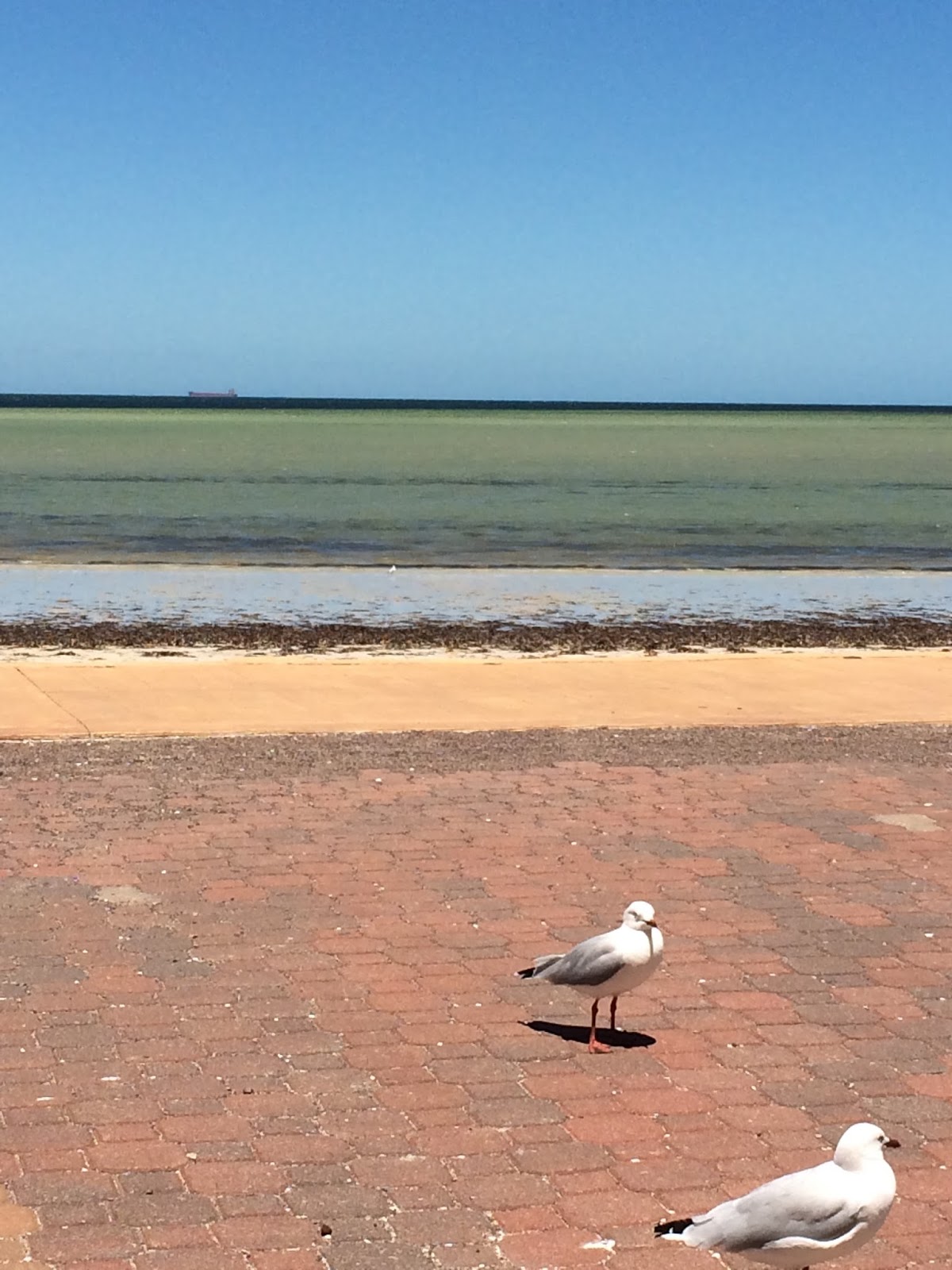
The town has some lovely old architecture and it features Hummock Hill, a vertiginous winding trail up which one drives to lookouts which showcase the town in all directions. And there is the shallow bay - pale swirling greens and yellows against white sands and deep aquamarine seas. Cargo ships dotted the horizon. A busy marina lies in one foreground and industrial buildings in another.

The shallow bay lured us down for closer examination: those colours like nowhere and nothing else; a well-tended foreshore, perhaps too much so; a lot of cement paving and strange zig-zagging roadways onto the beach; playground and exercise machines; an elaborate sculpture of a diver beneath a school of fish; a white sandy strand with moderate seagrass; indifferent seagulls. We ordered a cup of tea at the cafe and sat in the brisk breeze enjoying this very different view before using spotless loos and and resuming our drive, noting as we went the darling old workers' cottages.

There followed a long, straightish drive down a beautiful road through undulating scrublands with the plan to hit Cowell with plenty of daylight.

My friend Janice Madden had organised accommodation for us. I thought it was going to be at the dear old Commercial hotel in Cowell's main street which I remembered fondly having stayed there years ago when visiting Cowell on a newspaper assignment. But, no, it turned out to be around the corner in a very modern two-storey holiday house which is an adjunct to the hotel.
Blossom, the pet chilli plant, took the sun on the bonnet of the car as we explored these swanky digs. There was a lovely little balcony where we could put her out in the fresh air and where, once unpacked and organised, we sat and relished a Pimms, looking out on a strange wasteland vista which seemed to separate the township of Cowell from a section of burbs.

Cowell's great claim to fame is as an oyster-producer. It used to be a major grain port but times have changed and now its exquisite, pristine waters are home to big, beautiful, delicate oysters - knee-tremblers, if you are an oyster-lover of my ilk.

We booked a table in the pub for dinner and went off for an exploratory walk down to the jetty, looking out to where the oyster beds sit in the clear sea, finding a lovely mangrove boardwalk. It was a pleasant walk which gave us a strong sense of the place.

The feeling was very laid-back and quiet and yet the caravan park was crowded and the town's other pub was rocking with merry tourist business as we walked past.

Funnily enough, our pub was very, very quiet indeed. It would seem to be out of fashion, patronised more by locals than tourists. We ate at a side table in the dining room, fascinated by the quaint old salad bar with its lace-motif plastic flaps to protect the food from the famous Aussie flies.

I had Cowell oysters, of course. A dozen. Presented in four different ways; specialty of the house. The food was not gastronomically remarkable. It was strictly country-pub. And off we trotted to our great big house to stretch out in the upstairs living room and watch the telly.

Sunday, January 18, 2009

Exploring Yorke Peninsula - a travelogue


Thanks to a work assignment, a weekend on South Australia's Yorke Peninusula.
Moonta is an old copper town, part of South Australia's Copper Triangle. It is a popular holiday town on the quiet waters of Spencer Gulf. It is about two hours north of Adelaide - not the most pleasant of drives. One sets out amid heavy transports and rather scatty and impatient traffic which gradually branches off to rural destinations or interstate highways, until one is almost alone on the scrub-lined country road.
Moonta is a very neat country town which treasures its copper history with a tourism focus but it soon becomes apparent that the intervening generations have lacked forward thought and an astonishing percentage of the cottage-dense historic areas is simply gone, the land reclaimed by scrub creeping around rock piles and scattered shards of glass and china. This, apparently, is legacy of the dominance of the mining companies which owned all the land upon which the miners built their solid little stone cottages. When the mines closed, they lost not only jobs but the right to live on the land. Some exceptions seemed to occur since some cottages remain, one of them restored as a National Trust exhibit.

They were tough days, the 1850s-80s and the largely Cornish mining population suffered no end of privation and exploitation in carving out their lives. In one add-on room at the show cottage was a huge wooden wringer with a big black winding handle. This, apparently, was the gift that the mining company would give to women whose husbands had been killed in the mines. Wringing washing and becoming a laundress, was the gift of a widow's potential livelihood.
What "compensation" for a heartbroken woman!

While I pursued my work day, hooking up with an historian and, later, with the photographer who was to illustrate my feature, Bruce drove off and explored the old mines and museums. We reunited late in the day at the charming Henry on George's cafe.

We overnighted in Moonta Bay. It's a shallow gulf bay with an immensely long jetty - characteristic of the peninsula's history of grain exports via mighty sailing ships. Our motel, the Patio, was perched on a hill looking down to the jetty and the bay with its rocks and and rocky dark waters juxtaposed against the almost lime brightness of the shallow waters over white sands. The patio must be the most trusting hotel in the world. I'd made a phone reservation, told it was the last room in the place (summer school holidays) and when we arrived to check in, the receptionist sitting with her back to a breathtaking view and surrounded by the most lavish and long out of date Christmas decorations, simply pushed a key across the counter and told us how to get to the room. "You want a credit card?" we asked. "Why?" she responded. "Do you want to pay now rather than when you are leaving?"
The room was utterly adequate in every way for a cheap Aussie country motel. Good fridge. Soaps and shampoo, extra pillows and towels, kettle, toaster, good telly, tea and coffee, a double and a single bed, room service...and very clean with chilled wine glasses waiting in the fridge. After a restorative glass of icy white wine, we strolled down the slope to the very new and modern ..... restaurant with its array of window tables looking to the sea view.Oops. Afternoon sun was so fierce that the windows had to be covered with dark blinds, cutting the fabulous sea views to an impressionistic shaded vista.
A friendly place. We sampled some lovely Grant Burge Barossa wine and gorged at leisure on an interesting starter of chorizo sausage in balsamic-glazed onions as a form of bruschetta, followed by an over-creamy chicken dish and a sublime rice pudding with stewed apricots.
We truly needed our after-dinner walk down the gusty jetty in the fierce pre-sunset light. If only weather had been less windy, there was a lovely area netted in half way down the jetty for shark-safe deep-water swimming. How nice. Intrepid fisherman rugged up against the wind lined up on the jetty railings with half a dozen rods each plus a few crab pots.

Friday morning, after paying our super-honest motel and having the room maid chase the car to give us B's belt, which he had somehow managed to cast off behind the curtain, we paid an exploratory visit to Port Hughes to see what attracted Greg Norman to create a golf course and housing development there. It is a pleasant little port township - mainly jetty.We walked the long jetty which, despite a brisk wind, was crowded with fishermen. The only convivial ones we encountered, some Greeks at the end of the jetty, were pulling in squid and blue swimmer crabs which they were carefully measuring to ensure they were legal scale.


Port Hughes is not much of a township or anything much else - but a lot of housing development with and without Greg Norman. Mostly, away from the lovely coastline, the land seemed dry, dry, dry. The drought has cut hard on Yorke Peninsula as we were about to observe more and more as we took to the road south. There was a lot of pretty relentless long, straight road passing through vast expanses of stubble - parched yellow wheat-lands. Struggling native vegetation gave some relief to the harsh landscape, but abandoned farmhouses and the ruins of old farm buildings were regular melancholy reminders of the tough conditions and dreams laid waste through drought years just like this one.

Maitland was a fairly welcoming site, a sedate little country town in the peninsula's hinterland. A very neat and tidy town with a broad main street . We found a cafe for lunch - a large and welcoming place, albeit that the food was a bit primitive. I thought they could not go too far wrong with a hamburger. They did. It was just edible. Bruce ordered half a chicken - one of those ready-roast numbers. It was very oily and very salty. Best thing, I think, was my cup of tea. I was to find this in most meals.
We checked out the local market in a vast corrugated iron shed set way back across an immense brick-paved parking lot. It was lots of very unremarkable crafty things and assorted Ikea vases and things on resale. The only people there were a couple of stall-holders drinking coffee, Certainly, I could find nothing worth buying. I sought, instead, the public lavatory which, to my surprise, bore a name plaque honouring some local personage. First time I've seen a loo block with a name plaque. It was an interesting loo block, too. Very spacious. Well, it had one very spacious room with a long, broad shelf on which one could change at least half a dozen babies. It had two small sinks and, tucked in the corner, were two lavatory cubicles. They were so tiny that one could barely close the door when one went inside. One had to shuffle sideways against the toilet pedestal. I am not exactly a fat person so I wondered how obese country women ever managed to get in for a pee. This meagre size seemed extremely odd considering the very large expanse of unused space in the rest of the building. But, in a perverse way, it matched the vast parking lot outside, all so beautifully paved, with a pavilion in the centre. Why the big fancy parking lot in this small country town?

The Chatt centre purported Internet access - and, indeed, it had a couple of PCs on which one could access the Internet. I was looking for a hotspot for my laptop. A pleasant chap there said that there were wireless accesses so I took in the lappy and sure enough, the local council had an open network. All very well, though. I could not access the net on it - and I decided it was not important to keep trying.

We headed off to find a service station to clean the gluey suicidal remains of some poor insect off the car windscreen and top up the tank. Couldn't find one in the main drag but a Toyota dealership had petrol pumps - plus a very nice dealer who came out and cleaned the windscreen with Windex. Yet another lovely person on Yorke Peninsula. If the landscape was benighted, the people were turning out to be uniformly delightful.

Our destination was Port Victoria - a wee coastal town of which I had fond childhood memories. I'd stayed in the country pub there with my parents on a holiday - and my father had taught both my mother and me to swim in the shallow bay beside the jetty. I particularly recalled a seal coming to play with us in the water there - and getting to know an Aboriginal girl who worked at the pub.
The pub is still there much as it was - except that it has motel rooms out the back and poker machines inside.
We popped in to buy a bottle of wine. But we were staying at a cabin in the camp ground. Since I had booked at the last minute, it was not a sea-front cabin but, set back one row, there were goodly sea glimpses from the little deck of the cabin and, inside, with a full kitchen and satellite TV, there was not much we missed. Well, mobile phone coverage would have been handy. I didn't even bother to pull out the laptop. Instead, we lolled on our deck with books. The pub menu had not looked too impressive. More fried everything. So we took a walk down the main street to see it there was a cafe. Another very broad main street, albeit a tiny wee town. There was a cafe but, guess what? More fried frozen everything. It seemed ironic with all the emphasis on fishing - fishing boats all over the camp grounds, people fishing and crabbing off jetties - that there was no fresh seafood to be found. But we did find the fresh fish on sale just off the main street - and Amanda, a small, tough girl in black wellington boots and white overalls. She skippers a fishing boat. She is a third generation fisher. And she was selling fish she had caught herself. We bought a big fillet of snapper - and then went to the funny little grocery store cafe and purchased garlic,frozen peas, olive oil, dried herbs, a courgette and some spaghetti. With a lemon, some home-grown tomatoes and chillies, I later turned this into an unspeakably delicious pasta dinner which we consumed with lovely, cold Hollick wines from the Coonawarra. Oh it was a relief to escape a meal of fried everything.


We spent the afternoon lolling on the deck and reading, going for walks, marvelling at the vivid greens of the sandy-bottomed sea and watching all the people in the camp site. Again, everything was friendliness - and there was generally a very convivial spirit in the camp ground.

We were out, as the instructions dictated, by 10 am and on the road. As we drove south, the landscape seemed slightly less godforsaken. Perhaps because the terrain was not so flat, perhaps because the roads were better and not so straight... There was evidence of the felling of pine trees along the roads. Lots of evidence in the form of lots of chain-sawed pines piled up. There is a general policy among councils of eradicating pines because they are not native and because nothing grows beneath them. Ironically, however, there would seem to be a disease afflicting a lot of the native vegetation on the peninsula and the pines thrive and a relief of greenery beside sad, dying and dead eucalypts.


Minlaton is another very neat and tidy country town with a very, very wide main street. They even have picnic tables on the generous medians in the main street. Picnic tables with plaques in honour of local dignitaries, even. Bruce was glad to score a copy of The Weekend Australian from the friendly newsagent and I visited the local arts, craft and Internet centre where, eschewing the possibility of connecting to their broadband, I actually found some lovely local craft and oils and did a spot of shopping. Even Bruce made a purchase - a lovely redgum bowl. A wonderfully olde-worlde bakery, very popular among the locals, turned out to be still using trans fats so we did not stop for brunch there - nor across the road in the cafe where the scent of ancient and overused deep frying oil was overwhelming. We drove on to Yorketown.

Yorketown is set on the edge of a salt lake.
Blinding white. It is like an ice lake but whiter.
The town itself is odd. It is really just a big junction with the peninsula's main roads intersecting asymmetrically. We chose one of the two pubs for lunch. Probably the wrong one. The handsome old two-storey corner pub was huge and a man, finding us wandering through its corridors, escorted us to the dining room which was immense. A very elderly couple sat there dining in silence, dwarfed by the cavernous proportions. They were all dressed up, I noticed. A large and brightly-lit salad bar adorned one wall. The salads seemed very cold and fresh. But where were the people? It was a bit surreal.
We ordered from the "specials" menu on a blackboard. Fish and Chips for me - and when the waitress asked if I wanted the fish battered, crumbed or grilled, I jumped at the grilled option. Bruce ordered chicken breast in satay sauce. My fish was terrible. It was one of those awful frozen Vietnamese imports, I think. The chips were not too good, either. I enjoyed my cup of tea while Bruce wolfed down his chicken.

A few miles down the road, Edithburgh was a much better little town with a great big ocean grain terminal and extremely broad streets. It had some nice cafes - but on closer inspection, they were closed.-

We paused outside Edithburgh pausing to detour for a close up look at the Wattle Range Wind Farm.
Those great minimalist windmills are so linear and elegant - I have long wanted to get in among them. People tell me of bird strike and of noise. I saw sheep, gratefully lined up in the shade of the windmills. A quirky site, actually. And I listened to the soft machine hum and realised why people were never quite able to describe that sound. I can't describe it, either. It was not unpleasant, though.

We drove on up the coast past the towering white grain silos and gleaming white conveyors which take the grain out to modern boats resting at the modern facilities. It was a pleasure to encounter a coastal road - the first sealed coastal road we had found on the peninsula. So many of the roads are unsealed, dusty with sharp stones and, in many places, bone-shattering corrugations. We had hit them a number of times, most recently to and from the wind farm. It is astounding how much of this peninsula functions on graded dirt roads, "metal", I think they call them. Plumes of dust announce all cars which venture onto them. My dark green Forester is now a very dusty beast, thanks to those roads.

Our destination for the night was Stansbury and its Holiday Motel.
Stansbury was instantly likeable - and obviously much-liked since its camp ground, which wraps around a little promontory called Oyster Point and provides dozens of campers with million dollar foreshore sea views, was crowded with holiday makers.

We found our motel, perched up on a hill. At first glimpse it looked a bit downmarket and kids seemed to be swarming everywhere and squealing from the enclosed swimming pool.

"You'll like your room," the proprietor, Iain, promised as he handed over the key. He was right. We liked our spacious and well-equipped room, we liked our hosts, we liked their part-Aboriginal grandkids, we liked the spirit of the place -- despite the fact hat a massive phone tower loomed over the buildings and that the police Drug and Alcohol Unit bus was parked across a series of rooms which, said Iain, were occupied by a large party of police who were on operations down here. We'd be well protected, he said. Too true. When I woke next morning, there were about six cop cars lined up outside.

The grandkids had caught a mass of blue swimmer crabs that morning, Iain said. They were cooking them up and serving them at $10 a kilo, if we would care for some. So we ordered a kilo and went out to buy another bottle of wine and have a meander around Stansbury. A beach walk was an essential - so we walked the coast in front of the camp ground from heaven, looking at the campers.

They lolled under canvas awnings beside caravans or family tents, groups around tables, very comfortable ensconced while children played on the beach. The tide was out and, as we crossed over the point, it was to the most extraordinary expanse of tidal flats occupied by a few kids digging, a few pelicans hanging about and, far out in thigh-deep water, people crabbing. We could not believe how far out the tide had gone - when we turned around to see the shore, it was miles away.
There were vast shoals of shells we traversed and, further out, crystal clear pools of water which danced with tiny crabs and darting fingerling fish.
We were falling in love with Stansbury. And when we walked the long cement jetty, it was to get another thrill - two of the most immense stingrays you could ever imagine, softly cruising the shallows. This was their territory, Iain later told us. One of them was known as Harold. I wondered if the other was Maude.

We sat on the steps at the front of the motel to drink our wine with the mighty view of fishing boats coming and going - and repaired to the room in time to get a lesson in little crabs from the granddaughters, Chantal and Destiny. When our platter of crabs arrived complete with nutcrackers, newspaper, herbed vinegar and a rubbish bag, we simply feasted and swooned and made a mighty mess. Oh, they were good. We finished our dinner with some excellent watermelon we had purchased at the Stansbury IGA - and drifted into the night.

I had a glorious swim in the pool before leaving in the morning. It was very nippy - but heavenly. I love a swim - especially with no one else in the pool to splash me. Bruce read his paper and kept me company - and the motel kittens came and scrutinised my activity. 'Twas all rather pleasant - and I was a bit sad to leave this sweet niche.
Ironically, we were in quest of some fresh local fish to take back to town but found the quest disheartening. Seems one really needs to catch one's own. Perhaps that is why everyone takes their rods.

We drove up the coast, popping in on Port Vincent, Black Point, Pine Point and, finally, Ardrossan. No fresh fish to be found. We paused at Ardrossan's award winning bakery where they the make the award-winning best pasties in the state, asking, before we purchased, if they use a trans-fat-free shortening. They did. The baker himself came out to tell us - and to say that we were the first people who had ever enquired.

We took our trans-fat-free pies and pasties in their paper bags and sat on the point, looking out at the red cliffs and the boats coming and going and shared bits of pastry with raucous seagulls before hitting the road for the push back to the city.
All quite smooth - via the carwash to rid the Forester of its dusty coat.
And back to get ready for the working week.
Sigh.

Sunday, August 31, 2008

The sad story of Encounter Bay

Once upon a time, there was a scenic little jetty beside a boat ramp on a picturesque and peaceful South Australian bay.
Children played on the little sandy beach beside the little wooden jetty. Pelicans sat on their favourite rocks, seven to thirteen of them, preening and snoozing and waiting for fishermen to cast away bait fish or fishtails. Elderly couples sat on the shore watching the birds and the sea, the islands, the sky, the timeless and serene view.
Even by night, the little jetty was a joy-bringing beauty - particularly in summer when the sea lay dead calm and the stars twinkled not only from above but from the water's inky mirror around the little jetty.

When a Council has something this exquisite within its bailiwick, there is really onlyone thing it can do.
Destroy it.
Who wants picture postcards in a resort town on the sea?

What we want is industrial views.


Little hobby fishing boats are not revenue for a Council. They may be pretty and pleasurable, but they don't compete with big boats.
So what we really need is a really big boat ramp for really big boats.
And we need facilities for those big boats. Carparks and parking meters and lighting.

And so it has come to pass that the City of Victor Harbor in South Australia has descided to destroy the prettiest picture in its album.

At the same time that it has erected signs warning people of the delicate ecology of the ancient reef in Encounter Bay, it has vandalised the bay in the name of - well, I am not sure what.

As the moves develop to respect the fragile nature of the intertidal marine ecology, and the fears about over-fishing lead to increased moves for marine parks, this Council has invested many hundreds of thousands of dollars, maybe a million, into providing access to huge, polluting motor boats.

Here in the bay where the mother whales bring their young in the winter.
Where, most mornings, I can see a seal rolling and playing and fishing along the reef line...this reef, described as a "nursery" for fish.


What the bay needs is diesel slick and bigger boats.

Well, it is what it will get.
And what it needs is less beach and more cars.

To that end, they have just bulldozed earth onto the beach - pushing the carpark out to sea.
Who owns the beach? I thought beach was common land and no one in this country had a right to destroy it, let alone impede people's access along it. The law has changed? I was wrong? It is Council land which may be infilled and used for other purposes at whim?

The pelicans which have been such a joy to all (and the subject of my photo website) and who have long lived on the round rocks of the shallows, have gone. Of course.

So have quite a few of the rocks themselves.

The excavations just get deeper and deeper and the boat ramp is looking as if it has been designed to accommodate oil tankers. Huge groins encircle a vast cavity whence towering black metal piers reach for the sky. These may be anchors for the industrial metal pontoons which the Council, with its high sense of aesthetic, has chosen to replace the wooden jetty.


We shall wait and see how it all looks when finished.
Perhaps we shall have to look to the art of Jeff Smart to see beauty in the industrial impact on this once-pretty bay.

Perhaps, however, we shall just have to avert our gaze and ponder sadly why any Council should wish to be remembered for such travesty.
Then again, people have short memories.
Perhaps, in a few years, only the pelicans will miss the old jetty.

Tuesday, May 15, 2007

Salem: Bonjour Tristesse


Salem, Massachusetts, has the Witch Trials of 1692 as its strident claim to fame and it has created a witchcraft wonderland of kitsch to capitalise on this and lure in tourists by the busload. It's lots of fun - pure unadulterated corn and guileless exploitation.
But, behind the witch museums, tarot readings, crystal shops and Wiccan souvenirs, there is Salem, Mass, of the distinguished mercantile history. There is nothing phoney in this.

Salem's era of affluence from sea trade left a legacy of peerless architecture in the form of Chestnut Street - one of the most beautiful streets in the USA. It is now a National Historic Landmark street because, thanks to luck and perhaps foresight, the antique houses which line the cobbled street have never suffered at the whim of renovators or developers. The grand old homes retain their historic and architectural integrity.
Chestnut Street is simply a joy to behold, let alone to meander.


Bruce and I, with my birthday-sharing weekend guest, Aunt Libby, took a Saturday drive down to Salem, lunching luxuriously at the grand old Hawthorne Hotel - named after Salem's famous literary son, Nathaniel Hawthorne - and then taking a sightseeing trolly ride, a very comfortable and easy way to glean a full picture of the town and its history. Chestnut Street was the highlight of the drive - so much so that we decided to return on foot to soak in the beauty and antiquity of the architecture at closer quarters.
It was a briskly cool spring day. Forsythia, pansies and tulips were in full bloom all over the place and the trees were beginning to leaf out in brightest newborn green.

Strolling Chestnut Street's brick footpaths, which, underscored by ancient tree roots, undulate quite perilously, we were able to scrutinise the details of the grand old captains' and merchants's houses, marvelling at the famous "coffin doors". It seems bizarre that people should design front doors with their death in mind. Many of the Chestnut Street homes have these extra panels in the gracious, great front doors just so that coffins would fit easily in and out. They were handy for women in hooped skirts, too, we had learned earlier from our tourist guide. We thought they might be handy again for the new era of morbidly obese Americans.

Some of the homes are brick, but most are clapboard, painted in handsome period colours of greys and blues and browns, with their neat shutters, doors and windowframes contrasting in black or white. Most of the houses are huge - mansions of opulent proportions, usually with a top floor which would have accommodated servants in the streets heyday.


One old house which brags a grand ballroom was having an event - a wedding reception we surmised, noting the flower-decked horse and carriage with its attendants in top hat and tails. We watched the smartly dressed locals parking their cars and hurrying down the road. We were amused to spot a husband and wife arriving in brand new his and hers BMWs and parking side by side. It was a rich event in this rich old street.
We were quietly fantasising about the people who lived in the street, how simply gorgeous it must be to live in such salubrious and historic quarters and what a responsibility it must be. How annoying, perhaps, to live in a tourist attraction - to have to put up with people like us taking photos and lingering longingly outside one's home.

We were doing just that outside the house we had agreed to be our absolute favourite on the street. We were paused, gazing at details and imagining the elegant , affluent and perfect life that must be going on within its walls when the front door opened and an elderly woman appeared.
"Hello," I said.
She did a quick double-take and then, returned my greeting with warmth.
"You have a lovely house," said Aunt Libby.
"Oh thankyou," replied the woman, descending the stone steps from the front door to stand beside us in the street. She was wearing a hat and carrying a handbag, clearly on her way somewhere.
"My tooth just fell out," she announced. "I'm very upset."
This was the last thing we expected to hear.

We expressed immense sympathy. She, rightly, was very agitated. She reiterated her horror at this sudden happening. No pain. No blood. She wasn't even eating. The tooth had simply fallen out.
Of course this was a little puzzling. But her distress was very real.
"I'm waiting for my daughter, is that Merridy?" she asked, pointing at a small clutch of tourists ambling slowly on the other side of the road. "The one in red, is that Merridy," she asked. "I'd better go and see." Of course, we did not know her daughter - but it was clear that the woman in red did not know our old woman. Libby offered to go with her, to take her hand across the road. The woman said she was glad of the company. But, as the tourists walked away, she realised her daughter was not one of them and returned to the front of the house, toying with the option of waiting for her daughter to come home or going to her dentist in another town - despite the fact that it was Saturday afternoon and she had not phoned him.
"Oh look, here comes the dentist," she said as a spunky young postman approached down the street. We corrected her and she called out and told him he was the postman. "But not doing your round," he replied, striding on past.
At this point, she decided to show us the tooth.
She opened and shut her hand quickly, exposing what was obviously a set of three teeth from a dental plate.

Of course, we had already silently ascertained that this poor woman had dementia, perhaps Alzheimers, so we were decidedly alarmed when she asked if her car was in the driveway. It was. She tried the doors. It was locked. Phew. She did not seem to have the key but returned to the front of the house where we assured her that her teeth would be OK until Monday when she could get an appointment with the dentist and we tried to coax her into returning indoors , to put her feet up, have a drink, try to relax, wait for her daughter... She was accepting this advice and was just mounting the stairs when her next-door-neighbour drove up and she announced that she would just go and talk to him first.

We bade her good luck and farewell and slowly resumed our path. Looking back, I saw the neighbour solicitously stroking her shoulder and knew she was in good hands. Poor, distressed and befuddled old girl.

And thus it was we realised that even the most perfect house does not a perfect world contain.