Showing posts with label adelaide. Show all posts

Wednesday, September 25, 2019

Women In Media SA, WIMSA - our story

The 2019 Women In Media Conference is over. One feels a little bit melancholy. There are some wonderful people on the state committees and one wishes one had had the chance to get to know some of them better. With the vitality and professionalism of our two national convenors, Cath Webber and Kathy McLeish. the states have been rallied so that we now are truly national. We are an officially independent national entity. There is also a sense communicated by some that South Australia is considered to be a minor place in the scheme of things. That has long been an eastern states perception.

Perhaps we need to shout louder.

Certainly we have been a successfully established WIM body for longer than many of the other states and we have not been slack in having events and covering the issues of the day - often ahead of the curve, as is our wont in South Australia.

Considering that we started out in substantial debt to MEAA for the expenses of bringing the Sydney presence to town for our launch, we have come far.

.

Indeed, there is a certain pride in the way in which WIM has grown since those early days. Perhaps to the surprise of MEAA, we just forged forward and did our own thing.

It all began in 2014 when Angelique Ivanica, the union's branch secretary, was tasked with asking me, as a woman and as President of Journalists in SA, to step up and form a WIM committee.

COMMITTEE:

Arna Eyres-White, Louise Pascale, Amber Cordeaux, Collette Snowden, Jayne Stinson, Tory Shepherd and Dana Wortley MP….a top band of woman gathered. At first we tried to meet in cafes but they are too noisy. My home, known as the SaMahal and later as “the Tardis” because it is bigger than it looks, became the monthly meeting place. Wine, cheeses and wursts on the 400 year old oak table became our tradition, with rowdily collegiate and only loosely formal meetings. Over the years, our committee has changed shape. Louise took a sabbatical. Dana melted back into Parliament. Tory Shepherd had to leave when her celebrity demands overwhelmed her timetable. Jayne Stinson left to run, successfully, as a state politician. She is now shadow minister for the arts. Angelique retired when we left MEAA. Louise returned. PR goddess Karyn Foster joined the ranks. Former editor Megan Lloyd came aboard. Senior ‘Tiser journo Kara Jung followed, freelancer Kate Hannon also and most recently wine writer Katie Spain. Laila Ferrier is waiting in the wings and now Catherine Zengerer has moved over from Hobart where she was Convenor of WimTas. She is automatically a popular inclusion. We’re a big committee.

For the record, WIMSA EVENTS:

On February 18, 2015, we launched WIMSA with an address by Adelaide-born Walkley Awards superstar Adele Ferguson. This significant event drew an official Sydney WIM presence in the form of Tracey Spicer who was Sydney convenor. Seira Atkins of MEAA also came from Sydney to give the formal MEAA imprimateur. It was a huge and successful event.

We hit the ground running and attracted another big crowd to an armchair interview with Anne Summers in May of that year held in the Lyceum Club of SA. In July we celebrated our lineup of WIMSA Mentors with a networking event in a chic laneway bar. In December we held a ritzy event celebrating the Walkley Awards and new sponsorship by women winemakers. Channel 7 provided its board room and roof garden.

We opened 2016 with another Mentors networking event at the 2KW rooftop bar. Huge success. In May a Sliding Doors panel event with discussions on the transitions between journalism and PR packed a reborn east end pub to the rafters.

In 2017 we hit the #me2 and bullying issue for the first time when Tracey Spicer came over to speak on her book #goodgirlstrippedbare. It was a very popular event hosted at UniSA. We also had an Adelaide Fringe Festival event based on the show of a feminist comedian and her failures in media. She was a bit of a failure and it was our worst event. In June at a chic new apartment development foyer we held Fireworks, surviving trolls and paving your own way on the Internet. This was a panel event with journalists who have been stalked, hate mailed and trolled. It included an in-depth account of a columnist’s relationship with her troll. Lastly, the trendy East End Cellars wine bar hosted an extremely indulgent Christmas party. Much merry networking.

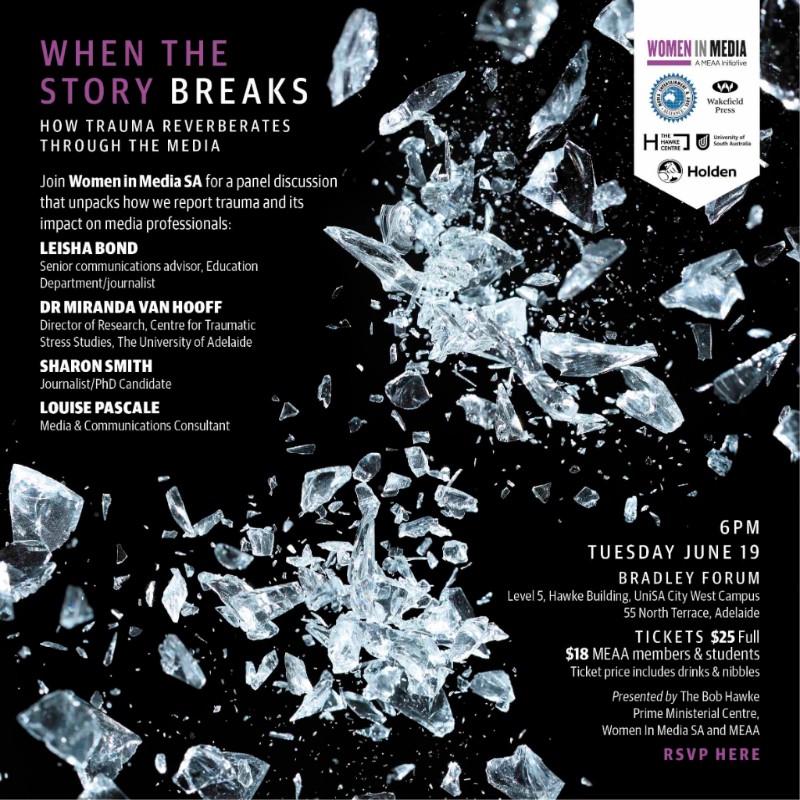
2018 became the year of the painful issue beginning with a state election. WIMSA hosted a complete lineup of all the political party leaders to speak on What’s In It For Women. Held in February at the Mercury Cinema, this gained major media coverage and also featured “democracy sausages”. When the Story Breaks - how trauma reverberates through the media. This was a panel session in the Hawke Centre of UniSA with journalists, psychologist and a woman completing a PhD on the subject. In October we held Kicking Goals, a panel session of and about Women in Sports coverage. It was hosted in the gym of a state football club.

2019 featured The #MeToo Backlash, a panel event featuring media women of all ages who have experienced sexual harassment in the workplace and also a lawyer who specialises in that issue. It was a champagne event hosted by a leading legal firm, Finlayson, in its top floor boardroom. It was a sell-out.

To celebrate 125 years of female suffrage in SA, the state which led the way for women, we have had to compete with many other groups and securing the right speakers on the right dates has resulted in seemingly endless deferrals. October 29 brings it all together in 5 by 5 which is a thrillingly diverse celebrity feminist panel event to be held at UniSA.

In no partical order, some of our posters:

Reflection: There were some good people working on WIM’s behalf in its birthing days with MEAA but there were sometimes crossed wires, delays, rules, booking issues and a feeling of powerlessness.

It has been an agreeable separation on both sides and WIM and MEAA remain warmly related and mutually supportive.

The energy and impetus of the two national convenors have rallied reborn WIM into a body of significant national status. It is a force with which to reckon. It cannot be ignored by proprietors or politicians. Dare I say that it is a new form of union, united women who can stand together and stand up for themselves and each other. We have only just begun. We have yet to flex muscle. But the power is growing. It really is very exciting. I am so glad to have been a part of its emergence - and will always tip my cap to Vickie Laurie who set the ball rolling in WA.

History Footnote: Adelaide journalist Michelle Daw created a pioneer WIM, too in the 1990s. It came to a rather embarrassing end following a great, big, triumphant networking party after which I think I was the only female journalist fronting up to work the next morning - only because I didn’t eat the chicken sandwiches.

Friday, August 16, 2013

Don't put your daughter on the stage...

The ire is roused by the sudden discussion on Adelaide's ABC 891 radio about a student actor turning down a semi-nude scene in a student production.

The girl's mother has come onto the radio to report anonymously under the name of Mary. Not once, but twice now.

She is in some degree of indignation that her first year drama student daughter, who also is to be anonymous, had been asked to perform in any way disrobed. Mother Mary said that the daughter was turning down a "plum role" in refusing to show her flesh. It sounded as if she thought the girl should have had the role regardless. She said her daughter feared she would not get "plum" roles because she had said no to nudity. She went on a bit about "plum roles" for her daughter.

That term, in itself, raises my hackles. Clearly the woman means "lead" or "principal" roles. "Plum" makes me think of casting couches and greed. It is not a term which sings "merit". But this is just me and my mindset.

Mother Mary, outspoken and protective as she is, seems not to be of thespian ilk. If she were, this tempest in a teacup likely would not be happening. A thespian mother would have told her daughter that she was quite right to turn down the nude scene if it made her feel uncomfortable. There are plenty of other roles.

I understand from the radio reports that the role the girl rejected was in a play called "Trojan Barbie". It was last year's student production. I wonder why Mother Mary waited until now to bring her indignation forth.

This year, the student play is "Don's Party". I've seen it quite a few times and, while it is about drunks and boors and cheats, it usually features no nude roles, let alone "plum" ones for girls.

Theatre is not about "plum" roles, in my view. It is about all roles. It is about actors embodying other people, sometimes even showing bits of the body. Some of the world's great actors have shown flesh in the name of the play. I remember Diana Rigg completely pristine in the West End production of "Abelard and Heloise", playing against the great Keith Michell. I vaguely recall the lovely Katy Manning, hot from the side of Dr Who, playing a part deshabille in a 70s Edinburgh Fringe show in the round at The Travers. Since the 60s, nude scenes have been unremarkable in the theatre and cinema. Think of "Hair" without its nude scene. My own son wore nothing but a policeman's helmet in a State Theatre production of "What the Butler Saw". Nude is part of the human condition and, in drama, it conveys vulnerability, sensuality and comedy.

Gratuitous nudity is another matter. Compulsory nudity yet another. Neither is at issue here.

That drama students be asked to confront the idea of nudity onstage seems reasonable. They can say "no", as this girl did.

Now the poor thing is notorious for it, albeit anonymously. And her Mother Mary has pushed the issue as one of propriety and of discrimination right through the media. This is where it gets into the headlines, onto the talk shows and up the noses of arts people. It's an issue in the public arena. It's gone national!

All from an anonymous phone call from a conservative mother who thinks first year drama students should not be exposed to such realities of the theatre.

It is my opinion that Mother Mary's views are at odds with the whole ethos of a university. I'd pop them gently in a church hall where they would sit comfortably within a censorious world view. If Mother Mary did not want her little girl exposed to the ever-controversial perspectives of the theatre and the issues it embraces, she should have recommended a convent for her.

In drama studies, that modest girl will be exposed to scandals of every form - from war, violence, murder, and cruelty through to questions of gender and under-age sex. And that's just Shakespeare.

"Oedipus Rex" deals with incest.

Beware the classics, children!

Oh, dear. Wasn't "Trojan Barbie" based on Euripides?

Monday, April 08, 2013

The Great Chili Cook-Off.

Enough with cooking competitions on the television. Sage Adelaide journalist Helen Covernton (below right) whisked Masterchef off the screens and into the domestic dining room to create the last, or first, word in fine, fun dining. The dinner party Cook-Off.

And so it came to pass that two of Adelaide's high-achiever Americans were pitted to showcase their mastery of their native gastronomic classics - Chili.

Chili Con Carne, generally known just as Chili, is an ubiquitious dish in the US. No diner worth its name has a menu without chili either as a main or side dish. Family restaurants, also. And, there are a gazillion of them in the US. Even the beloved hot dog often gets a garnish of chili. The dish has moved up from its Latin roots in Mexico, through southwestern America's Mexican cuisine and into the realm of culinary domestica.

Many are the expatriate Americans who quietly grieve for a fix of classic chili - just as Aussies abroad may yearn for a pie and sauce.

Helen Covernton knows two of them and set up the challenge for them to showcase that iconic dish in a cook-off.

Gale Carnes is an environmental scientist.

Bruce Blackwell is a physicist-cum-space engineer.

Both are chili cooks.

Helen Covernton laid down the rules. As many variations of chili as they wished could be prepared by the two cooks. There would be three judges. Herself. Arts supremo Cate Fowler. Food writer and critic, Samela Harris. The chili would be marked on Presentation, Discernible Ingredients, Chili levels, Flavour.

The competitors would be called upon to explain and background each sample.

The competing chilis were three.

The Cincinnati Chili - Carnes

TexMex Chili - Carnes

Classic Chili - Blackwell

Cincinnati Chili was presented on pasta with grated cheddar cheese. Carnes explained that this was the chili of her childhood, the common Cincinnati take-away, a strong cult version typical to Cincinnati only.

The judges found the pasta perfectly cooked and the cheese a nice complement. The flavours of the chili had them mystified. There seemed to be no tomato in this version. Nor beans. Red or black beans are traditional but this chili was dark and dense ground beef. Its level of chili heat was moderate. The judges found it pleasant. But they tasted the dish repeatedly to discern the other ingredients. There was a mysterious musky flavour. Very agreeable. But was it herb or spice? The more they ate, the more they liked it. Cloves?

They could not categorise it. They decided it must stand in another class of chili.

Classic Chili was presented on white Basmati rice with a dob of sour cream on top and a light sprinkle of fresh onion.

Blackwell introduced the dish as a derivation of the authentic south-of-the-border tradition, rich in soaked and pre-cooked red beans, its chili flavours achieved by layers of different varieties of fresh chilis and capsicum. This dish was beautifully-balanced with the chili flavors emerging both as an instant sensation and then a good, slow after-burn. "Deep chili", as it is known. There was also a light, healthy sense of vegetables with the fresh tomato base and the perfectly-textured beans. It was moist, the sour cream adding a smooth, luxurious further favour and textures. The meat also was light, being pork and veal. And the tiny, fresh crunch of the onion brought forth exclamations of delight. The judges were rhapsodic.

TexMex Chili was presented straight with nachos on the side and a sprinkle of cheese. Carnes explained that this was a more conventional variation, one she had learned while living in New Mexico. It contained kidney beans and tomato.

It was rich and dense with a very good level of chili fire - softer than the classic, but good with aftertaste. It was more a cayenne than habanero flavor. The nachos were crisp and novel accompaniments giving a very Mex culture and a very hands-on character to the dish. The kidney beans were fairly sparse and nicely textured. The judges could not stop eating it.

The judges repaired to the balcony to compare notes while the cooks re-arranged the table for an ensuing chili dinner for all.

The judges then delivered their verdict.

Cincinatti, it was agreed, required a category all of its own. Quizzed on the elusive flavours, Carnes acknowledged that clove was one of them and also a little Allspice. But the big secret ingredient and that which made it so dense and dark and delicious was chocolate.

The two more traditional varieties, the TexMex and Classic had scored 9/10 from all the judges. Both came first. Both cooks were awarded chocolate Bilbies. There might have been a third chocolate Bilbie to acknowledge the stand-alone winning qualities of the Cincinnati Chili - but it seems that it had already gone into the dish.

Wednesday, December 23, 2009

Mary MacKillop - a tough, smart saint


Mary MacKillop - Australia's first saint.
One does not need to be a Catholic to be thrilled to bits with this news.
Its symbology is more far-reaching.
Mary MacKillop long has been hailed for the exceptional woman she was - but this recognition has been largely from and within the religious world she avowed.
She was a nun who created her own order, using the Catholic system as a way of spreading not just the word of God but the word itself - literacy.
Her brown-clad Josephites, affectionately known as Brown Joeys, opened and ran schools wherever they went. They provided an education for the downtrodden and repressed of the time - girls.

Mary MacKillop was a feminist - way before the word was coined.

Among her wonderful nuns were women for whom life had been harsh, for whom other opportunities may never have arrived, among them women of the street. One could say that she saved them or made them - just as she saved and made all those girls who otherwise would never have had the emancipation of education.

Her schools are still outstanding and progressive.

They are, of course, Catholic schools,  but they accept Muslim and Buddhists and Secular students. In Mary's spirit, they are without prejudice.

With all this erudition there is one wild irony in the years and years of waiting for Mary MacKillop's Sainthood.
The highly patriarchal old Church of Rome, which once excommunicated Mary MacKillop for her fiesty disobedience - has rules, absurd archaic canonical rules. It decrees that, to be a saint, one must have performed miracles.
Miracles must be directly related to the act of prayer to the saint-to-be. They must involve cures of the incurable. They must be accompanied by medical "proof".
This sort of thinking seems incongruous when set against the principles of enlightenment Mary MacKillop represents.

Well, I think so. The fact that Australia has had to wait for decades until a woman emerged with the claim that praying to Mother Mary had cured her cancer is to oddly sideline the wonderful works and meaning of Mary MacKillop.
The woman in question clearly thinks this, too. She has refused to be identified saying that she does not want her cure to detract from the Saint herself and her pioneering work. One likes this woman.

I love Mary MacKillop.
Just as my late father, Max Harris, did.
He campaigned through the national media for recognition of Mary MacKillop as the brilliant pioneer educator that she was. He was a boy raised in the South East of South Australia, near Penola where Mary MacKillop's work with her mentor, priest and scientist Father Julian Tenison Woods all began. Penola is where Mary's first school was - a lovely wee town which is about to boom with tourism.
Max had an immense respect for early female achievers. He read all there was to read about Mary MacKillop and he cited her as one of the great (then) unknown Australians while doing his utmost to ensure that she was not just known but properly celebrated. He adored her spirit and her legacy and used his high media profile to champion her.

The Josephite nuns, an order of particularly interesting and intelligent women, were quick to take note and make themselves known to Max and so the bond became formed between the poet/columnist campaigner and the women who today represent the work and ethos of Mary MacKillop.
Those nuns were to give Max extraordinary comfort and support through his years of illness and, after his death, they were to tuck him under their eternal wing. Hence, his ashes are interred beneath a memorial rock between Mary MacKillop College and the Josephite Nunnery. The Mary MacKillop Centre museum is right there, too.

Max recognised Mary MacKillop's religion - and also the battle she had with that religion's patriarchy to do her work. She had to take on those fusty old Bishops. They excommunicated her. She had to live in hiding and plead to do her wonderful work. She succeeded and her work went on - away from Penola and Adelaide where it all began - across the country. Mary suffered Dysmenorrhea for which she needed analgesic nips of brandy. One always hoped it was St Agnes brandy, a saintly cure if ever one there was. But Mary was in no way airy fairy. She lived a tough life and she was a fighter. She worked truly and humbly for the benefit of others - for girls and education, for Aboriginal children and their cultural displacement, for the poor and their needs and for the sick and aged and their comfort.

Religion or no religion, one could not fail to recognise the extraordinary qualities of this wonderful woman. Her work was 19th Century but it remains vital and contemporary. She was a true pioneer. She is a role model for us all. And, as my late father so perfectly put it all those years ago, she is:

A SAINT FOR ALL AUSTRALIANS.

Saturday, May 10, 2008

Blog, Twitter, chat, snap...who can keep up?

When first I heard of Twitter, it simply sounded like a silly name and yet another thing to have to juggle online.
Let's face it, online life can start to overwhelm that other life. How many more elements of communication can we or need we take on?

Let's see, I started out with bulletin boards in the early 90s but swifty discovered IRC wherein many, many hours were richly consumed. OK, I admit it, I was one of those people with a drawer full of Jolt to swill down so that sleep did not interrupt the thrilling flow of conversation with my mysterious new best friends around the world.
What interesting people they were - and are.

Albiet that those days were full of techno glitschs such as "splits" and hackers and pervs. And, of course, there was the business of getting online at all - through the hiccups of dialup. Oh, what music to the ears was that little chirruping buzz of connection. I still feel a little surge when I hear it. But back then, if someone picked up the phone? Oh no. One's contact with the world was cut. I could not cope with the competition from students and geeks to get phonelines into my young backyard provider of the day, so I paid him to put in a dedicated phone line at his end for me. Thankyou Adrian Corston, for being the best provider of those early days.

Adrian moved on when the big guns began to fire and took me with him - to Internode where I have remained these many long years. They have been good to me and, in my role as a newspaper Internet writer, I was happy to spruik for them and send hundreds of customers their way. Still do. They remain the class act and I am proud of them.

For years, IRC remained a large part of my after-hours life since it is simply a rich world in which I met many good people. Friends for life. But the WWW was growing, email had changed out of sight. When I began it was Pine and it was clunky and nasty - like everything else. Heavens, all those DOS commands one had to key in to make anything happen at all.
Today's net users would never believe how tough and slow it all was. When The Louvre first came online, the first major visual arts entity on the WWW, I could cook a whole dinner in the time it took to download just one image. And I did. Regularly. Feeling richly rewarded at the sheer miracle of seeing that work of art on my computer screen.

As for the coke machine at Berkley - didn't we love waiting for someone to come along and order a coke so we could share in the amazing thrill of being flies on the wall?

A few years later, we all had cams and were talking to strangers and seeing their faces. We even set up live cam websites. I wonder whatever happened to my Sazicam site? Died of neglect?
I will never forget the vet with whom I used to chat in France - who used to turn his cam to the window and show me the magnificent mountains of his world. Magic. More forgettable were the silly wankers who would invite you for a chat only to show their engorged penises.

And here one began to worry about the nature of the Internet. Why did it bring all this ugly sexual frustration into the open? There were stupid pervs messaging one on IRC with obscene proposals. There were exhibitionists flashing on cams. Porn sites were springing up. Porn channels on IRC...
I found this all very demoralising. I am very positive about sex as a natural part of the scheme of things but I find people who have never managed to get their heads to higher planes not just sad and inadequate but intolerably dull.

The preoccupative tedium of the sex players on the Internet really brought the world down. It created issues for use by children. It dominated bandwidth. It made money when nothing else made money. Oh, woe, to lowest common denominators.

The phenomenon has not gone away.

The Internet has liberated not just sex, but a vast world of angry, spiteful morons whose pleasure in life is spamming the Internet with aggressive and ignorance comments, attacking thinking people, honest people, funny people - interesting people with something to say.
The lowest common denominator has found a high niche.

But we old Netizens plough on through the varying morasses, exploring the new applications devised by the brilliance of geekdom.

So, the first communities evolved - IRC groups, The Well, Howard Rheingold's Brainstorms, AOL and then Yahoo groups, web collectives with hobbies, occupations, illnesses in common. And it has not stopped.

Now we have Flickr communities and other photo-based entities, growing blissfully with the evolution of digital cameras and photoshopping. For every development, there is an online expansion. And the blogs, of course, the blogs.

I began this one when writing a feature about them. I figured I needed to have done it to write about it. And them, once I had done it, I had to keep doing it. From time to time.

Now I have three blogs...two here on Blogger and one for the newspaper. Then I have my spots in Brainstorms, which could be a full-time job if one had the time. Rheingold, the master student of the potential for and meaning of online communities, quietly runs the big daddy of them all, having brought together a diversity of people whose lives, interests and opinions are shared to an intense and now long-established degree. Perhaps, despite geography and eclectica, they now are more a family than a community.

And along came Stumbleupon. I love Stumbleupon. It takes longer to get to know one's friends in that medium, but the richness is the sharing of links and webpages, the setting up of blogs which can be just for beauty or just to make a strong point. Or both. Or humour. Or whatever. There's about a million Stumblers out there - 200 of them are on my "friend" list and another few hundred are sort of linked, with more to be discovered. The links we send each other, with or without running commentary, keep us busy reading and responding, and they keep us very well informed. We are powerful as a knowledge gathering and sharing entity. And the foundation of friendships thus forged, has a strong cerebral element.


I tend to be sporadic in all my Internet niches - since my other job in that real world involves a lot of writing in its own right. One can get writ out, so to speak.

And there is all the reading. I have to read a lot of communities...Alternet and Huffington, Salon and Wonkette, friends' blogs


MySpace arrived. I never cared for it. Loud and messy. But the young thrived for a while and the music industry found a powerful meeting place.
Facebook has worked better as community. Well, it is more of a network than a community.
But it has been bringing the communities under its wing - so now we Brainstormers and Stumblers and Flickr community people are networked in Facebook, perchance engaged in killer games of Scrabulous.

And from many levels we converge on one.

Wherein, Twitter rears its chirpy face again.
I had played with it early - and could not really see the point. How much information do we want to put out there? Who are we putting it out there for? Who cares?

Oh yes, I know the conspiracy theorists bristle and run for cover. They are not going to be suckered into all this exposure to the marketing giants. They may have a point.

Then again, we are now enlightened enough to be able to look at ourselves. The Internet was evolved with the idea of the free sharing of knowledge. This is the most wholesome concept there is.
The more knowledge, the healthier the world.

I am not sure how much the minutiae of my movements adds to all of this. Do I tell Twitter that I am happy because I am by the sea? Do I tell it that petrol pump calibrations are criminally rigged? Either or both seems to be the way to go.

I am receiving news bulletins from the media and personal snippets from friends and associates. I think it is all good.
But I am not sure how much is enough.
Or how one keeps up with it all.

Oh, dear, there are 64 Stumbles waiting for me....and did I check my email yet?

Saturday, March 10, 2007

United in music


Festival time in Adelaide and a whole city is out in the streets partying. What a glorious spirit the Fringe brings forth. The experiment of holding Fringe festivals every year seems to rise triumphant, embraced with loving enthusiasm by the city at large. The parklands glitter with coloured lights and crowds, the sidewalk restaurant tables are packed late into the nights and exuberant people stream through the streets. There is so much going on it is hard to know where to be.
I was at Womadelaide, however - one of the world's exquisite festivals, a celebration of world music. In Adelaide it fills the huge Botanic Park, this drought year, rather dusty. Flags flutter on towering bamboo poles, lanterns hang from the gracious old trees, roaming performers in all bizarre guises entertain the picnicking and wine-drinking masses and we all swarm from stage area to stage area to settle for the performances of choice.

It is on a very large scale and, for those of us on an opening-night reviewing schedule, it is very strenuous - scampering to and from our transportable backstage office to turn around tiny, tight reviews for the morning paper. It was wonderful, at about 10pm, to sit under a tree and drink a glass of red wine, bone-tired at the end of the deadlines.
Just letting the rhythms of the world throb around one - tango from one stage and Celtic from another. They had replaced the deep, seductive drums of earlier performances, those pulsing rhythms which join the crowds into one huge visceral mass of humanity. One looks across to see the sea of people bopping as one... This is one of the secrets to this festival, one of the reasons it evokes such sweet temperament amid the crowds.

Another is the universality of the programming - all ages embraced, meeting in the sharing of music. Thus from the Mahotella Queens, the South African all-dancing-and-singing grandmothers, to the Gotan Project's techno for the young, the jaunty jigs of the Irish for all, Latin, Indian, Aussie...


It was wonderful on my review schedule to find myself sittings amid a carpet of friendly strangers with the stars twinkling through the boughs of the old gums and sheoaks, listening to the mysterious and mesmeric harmonics of the Tuvan throat singers. Grabbing needed refreshments - a superb ginger, lime and lemon drink, from the gentle hippies manning their sumptuous cafe tent lined with Persian rugs and serving chai teas, organic coffees and home-made cakes.

A drift of the scent of marijuana here, incense there, aromatic curries, coffee, beer... fragrances all around - another cultural intermingling feeding the senses until they are quite sated.

Saturday, February 24, 2007

Norma Khouri unravelled


Norma Khouri took us all in, hook, line and sinker. But what reason did we have to suspect that she was not telling the truth when she emerged as the author of Forbidden Love, (Honor Lost in the US), the emotional expose of honour killings in Jordan?

We brought her to our city as our guest to celebrate her courage in writing the book, promoting it as a Big Book Club selection, providing discount coupons to make it easier for our readers to afford. We invited the city to meet her - and they came in numbers so large that we had to open the huge Hilton Hotel ballroom to its maximum size and still had people standing.

I introduced her to that sea of people in a paeon of praise - as a woman fearlessly championing a cause.
On meeting Norma, I had been entirely charmed. She was modest, amusing, self-deprecatory and, above all, passionate about her cause. I will admit, however, that I had earlier found it necessary to quiz her in a way that I would not usually do in the course of an author interview. I had found some strange discrepancies in her book and wanted to clear them up. I could not, for example, understand the why and how of her move to Greece. When I asked about this she answered at some length with such fluency and ease that it was not until I went back over my notes that I realised that there had been no actual answer in her words. I had thought I heard an answer, but it was a charming zig-zag. There was no "there" there. I was more annoyed with myself than with her. How come I still had no answer to such a simple question? Now I would have to write around it - "when in doubt, leave it out". But that was not the only puzzle. On first speaking to her, I exclaimed at her American accent. I'd never met a Jordanian with such a strong American accent. "How much time had she spent in the US?", I asked. She gave a long response in which she attributed her accent to the American School in Amman, a diet of American movies and television and a passion for emulation. I could only comment at how well she had mastered the accent - for, I had no reason to suspect that she was not on the level. None of us did.

I suppose the thing that convinced me about Norma Khouri's authenticity in writing Forbidden Love was how bad she is as a writer. The book's text is simplistic in style, clearly put together by someone who is trying to tell a story but who has absolutely no talent as a writer.
And, of course, the book's cover brandished the promise that it was, indeed, a "true story". One tends to trust the Random House label. No, we had no cause for suspicion.

It was Sydney journalist Malcolm Knox who smelled the proverbial rat, and we all went into shock. His revelations reverberated around Australia, where Khouri had been living in high secrecy - to protect her from jihad, or so she told me when first I reached her on a super secret phone number.

Malcolm Knox, in a fine piece of investigative journalism, discovered that she is not only Chicago-raised but also allegedly wanted by the FBI for swindling an elderly woman in Chicago. She turns out to be married with two children.

Wrote Knox:
"Khouri's hoax will take its place in a long Australian tradition of literary fraud, from Ern Malley to Helen Darville-Demidenko. But no other fraudulent book has had such wide sales or impact..."

Many pennies dropped about Khouri's inconsistencies when I read this, but I still wondered. It all seemed so odd to fake with altruistic intent. After all, her mission was to shame the tradition of Islamic honour-killings - to save young women from death at the hand of their families. And, frankly, I could not dislike Khouri.

Now at the Adelaide Film Festival a documentary on Khouri and her story as a fake has its world premiere. Forbidden Lies allows Khouri to tell her own story to camera and then accompanies her to Jordan where she promises to prove that her friend Dalia was a real person who was genuinely killed by her brother because of her association with a young Christian man. But, come Jordan, Khouri is suddenly backpedalling and fudging. She cannot find those promised locations and there is no record of the victim ever ending up in any morgue or cemetery. Under the cool gaze of the camera, we watch Khouri unravelling, coming up with sequential excuses and layers of desperately transparent lies. Oddly, it is really sad. But she has chutzpah. Denying the swindling allegations, she creates a whole new story in which she casts herself as the victim - and we discover a new book is on the way, an autobiography of an abused child whose only way of coping with life is by inventing it...
What a pity we don't believe her.
But somewhere, somehow, we still like her.