Showing posts with label travel. Show all posts

Sunday, March 13, 2016

Is garb turning into garbage?

The glitter has gone from glittering opening nights. In a world obsessed by fashion, people are wearing tat.

There are the gossip pages, endlessly preoccupied by photographs of stars and starlets in designer dresses of the moment arbitrarily accorded marks out-of-ten. In newspapers and magazines, these fashionista displays are given masses of space, as if they are really important. Photos are lined up, set out in extraordinarily clumsy page layouts, some pictures too absurdly small to see, but all of them dominated by marks out of ten for fashion sense.

The media seems to simply snatch them off the wire and then make their earth-shattering and often-mean-spirited editorial judgements. If you saw what some of those journalists were wearing, you'd wonder where the gall, the aesthetic audacity to play god with other people's taste or whim. Perhaps this trait is what is killing the spirit of fashion.

In real life, dressing up for special occasions has gone out the window. What do all these designers create fancy attires for if not for people to wear to fancy nights out? Go to a fancy night out and, what? People are just wearing any old thing. At the opening night of the Adelaide Festival of Arts' headline show, I saw men in shorts and a woman wearing sneakers. Sneakers? Opening night? So much for the glittering formality of the special occasion. So much for a reason to get the glad rags out.

Call me old-fashioned, but I think putting on one's best duds is the making of a special occasion. A room full of people looking their best is not only the sign of a civilised society but it is also a mark of respect for an event. Opening nights used to be the big events; they used to be black tie and formal frock.

It was the black ties which went first. Dinner suits are expensive and men often rented them. The formal tuxedo slipped to dark suit and bow tie. Then dark suit and tie. Then cream jacket, then any jacket, then no tie. Now shorts and open-necked shirt.

Meanwhile, it seems that there are just a few matrons who bother to doll up for opening nights. They look fabulous. But, how ironic is it that they stand out from the crowd. They are fastidiously coiffed, perfumed, and attired, down to their to-die-for shoes. Perhaps, if I was a numbers person, I'd estimate them as making up about five per cent of a foyer crowd. They not only are distinguished by their elegant outfits but also, sad to say, by their age. The sense of occasion seems to be turning into a generational thing. So there's a rub. Beautiful young women certainly wear pretty frocks and smart outfits around the town. But, often, when they go out at night, they wear so little that it is really hard to call it fashion. Skimpy doesn't begin to cover it. It is barely more than primal pheromone for, whether they know it or not, there is a reproductive undercurrent to their baring of the flesh. For the young, dressing up has turned into undress.

Even events like charity dinners and gala nights no longer carry that old glamour cachet. So many people want to short-cut formality that it makes the well-dressed feel self-conscious. The slobs are winning. Nothing is special for them.

This makes one wonder about the massive fashion industry with all those design schools spawning bright new talent. Fashion seems to have turned into an industry of photographs. We look at pictures of it on models and in those endless magazine spreads of never-heard-of-'em starlets posing on red carpets so they can be humiliated with a 2/10 rating for how they look. Perhaps women are so wary of being judged for their formal attire that they have shied right out of the market? Or perhaps people's priorities have changed.

Maybe life is all about speed and comfort these days. Just look at how airports have changed. We used to dress in our best to catch a plane. It was really special. Now, it's worse than a bus depot with all the zigzag queuing, the delays, the scrutinies, and the general intimidatory presence of security. On the planes, the attendants' smiles are rote and their ministrations brisk. They are tired and overworked before one even sets foot in their domain. The meanness of seating for the flying hordes does not encourage dressing up. It requires defensive dressing. Comfort first.

And thus do the denominators go down. Some people's idea of comfort is singlet and thongs. And, heaven help us, they are permitted to travel like that. Dress codes are done with. Wear what you like, from full burqa to next-to-nothing.

But not quite everywhere, thank heavens.

I note that Costo has put up a sign saying it won't admit people who are not wearing footwear. "You have no idea how many people come in here with bare feet," said the door attendant when I commented on the new sign. I was incredulous. I am incredulous. We're not talking poor people; Costco is not cheap. We are talking slobs.

The slobs are taking over. They'll be turning up barefooted to opening nights next.

Monday, July 13, 2015

Where Eyre We Roam

Day 2.

Soft rain and grey skies greeted us on Wednesday morning. The pet chilli plant was able to feel the elements for a while and I went for a swim in the lovely motel pool before we packed the car, went shopping for things we had forgotten to bring, such as straws for our Pimms, and then meandered out to the Arid Botanic Gardens for lunch and a walk amid the plants. We love this place.

Everyone does. It is special - spread out in the red sandy soil with the Flinders Ranges as a breathtaking landscape backdrop, blue against a bluer sky. We gazed upon this beauty and brunched at the Garden Cafe - upon an Aussie burger which was flavoured with bush herbs of some sort and utterly delectable, Bruce upon a toasted sandwich. We drank in the pristine desert air, examined the seemingly inexhaustible variety of eremophilas, pored over the industry of bull ants, and marvelled at the sweet scent of the witchetty acacia.

And then it was back on the road and south down Eyre Peninsular to the steel town of Whyalla. It was a mighty mecca in its day and it is still a really striking place, its red-roofed industry juxtaposed against a vivid azure sea.

The town has some lovely old architecture and it features Hummock Hill, a vertiginous winding trail up which one drives to lookouts which showcase the town in all directions. And there is the shallow bay - pale swirling greens and yellows against white sands and deep aquamarine seas. Cargo ships dotted the horizon. A busy marina lies in one foreground and industrial buildings in another.

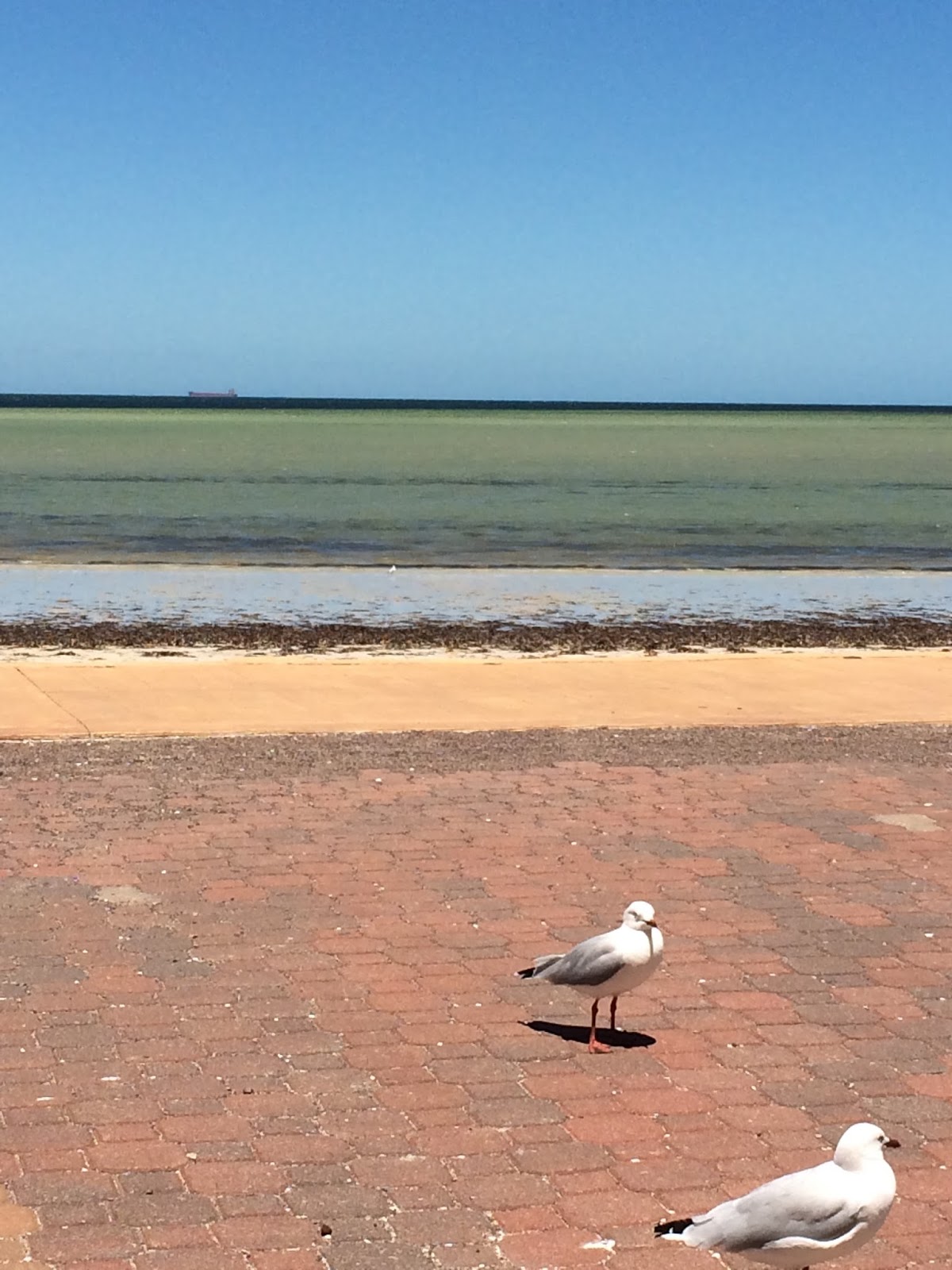
The shallow bay lured us down for closer examination: those colours like nowhere and nothing else; a well-tended foreshore, perhaps too much so; a lot of cement paving and strange zig-zagging roadways onto the beach; playground and exercise machines; an elaborate sculpture of a diver beneath a school of fish; a white sandy strand with moderate seagrass; indifferent seagulls. We ordered a cup of tea at the cafe and sat in the brisk breeze enjoying this very different view before using spotless loos and and resuming our drive, noting as we went the darling old workers' cottages.

There followed a long, straightish drive down a beautiful road through undulating scrublands with the plan to hit Cowell with plenty of daylight.

My friend Janice Madden had organised accommodation for us. I thought it was going to be at the dear old Commercial hotel in Cowell's main street which I remembered fondly having stayed there years ago when visiting Cowell on a newspaper assignment. But, no, it turned out to be around the corner in a very modern two-storey holiday house which is an adjunct to the hotel.
Blossom, the pet chilli plant, took the sun on the bonnet of the car as we explored these swanky digs. There was a lovely little balcony where we could put her out in the fresh air and where, once unpacked and organised, we sat and relished a Pimms, looking out on a strange wasteland vista which seemed to separate the township of Cowell from a section of burbs.

Cowell's great claim to fame is as an oyster-producer. It used to be a major grain port but times have changed and now its exquisite, pristine waters are home to big, beautiful, delicate oysters - knee-tremblers, if you are an oyster-lover of my ilk.

We booked a table in the pub for dinner and went off for an exploratory walk down to the jetty, looking out to where the oyster beds sit in the clear sea, finding a lovely mangrove boardwalk. It was a pleasant walk which gave us a strong sense of the place.

The feeling was very laid-back and quiet and yet the caravan park was crowded and the town's other pub was rocking with merry tourist business as we walked past.

Funnily enough, our pub was very, very quiet indeed. It would seem to be out of fashion, patronised more by locals than tourists. We ate at a side table in the dining room, fascinated by the quaint old salad bar with its lace-motif plastic flaps to protect the food from the famous Aussie flies.

I had Cowell oysters, of course. A dozen. Presented in four different ways; specialty of the house. The food was not gastronomically remarkable. It was strictly country-pub. And off we trotted to our great big house to stretch out in the upstairs living room and watch the telly.

Road trip - where Eyre we care.

It's a road trip.

Destination: Elliston on Australia's Eyre Peninsula.

Day 1.

The red Rav hummed north up the Port Wakefield Road out of Adelaide. Dense traffic gave way to a steady flow of road trains and oversized trucks carrying mysterious construction objects. It had been a fast and frazzling time clearing the desk of last-minute bills and Women In Media communications to take the long-scheduled break away from the city. The thinning traffic heralded that relief of freedom - but the true spirit of getaway has to be expressed by a stop at a Port Wakefield Roadhouse.

There amid the lineup of truckstops was Pope's, as it always had been, a simple Aussie cafe: pies and pasties, fish and chips, sandwiches. We sat at outside tables under the expectant gaze of a solitary seagull. Bruce chomped a succulent chicken pie and I had a cheese, tomato and mustard sandwich toasted thin, crisp and gorgeous. Oh, and a nice cup of tea as the trucks, caravans, boats, horse trailers, and cars streamed steadily north.

Our destination was Port Augusta, a large town at the head of Spencer Gulf whence comes South Australia's coal-fired power. These days, the aesthetic of long strands of hilltop windmills symbolises the change in power generation.

From market gardens, past the spectacular pink lakes of Lochiel, the road narrows to a single lane interspersed with passing lanes. An hour or so north, the ridges of the Flinders Ranges rise to the right. Beautiful.

Entering Port Augusta, one crosses bridges, swampy and a bit sulphurous on one side, but blue and deep on the other. We are crossing the upper reaches of Spencer Gulf. We swiftly found our Majestic Oasis motel beside its grassy shores. The high security of the motel compound surprised us - high fences and high electric gates. But the staff was chirpy and welcoming. Palm trees and murals adorned the parking areas and the two-story accommodation units were named after Aboriginal Elders.

Our room 15, with a nice little outside deck, looked out onto the water and a bridge, the view interrupted by fences and palms. The pool was a couple of metres away. I put our travelling chilli plant outside for some fresh air and made us glorious happy-hour welcome-to-Port-Augusta Pimms cups.

My old colleague Paul Lloyd and wife Roseanne rocked up to take us out to dinner. "Mostly pub food in Port Augusta," said Paul - and then they drove us to the Standpipe Hotel wherein, belying everything they had said about P.A. cuisine, we were served a range of authentic curries of exquisite quality. And we drank a little wine and exchanged accounts of where life had taken us. Paul, an erudite and talented writer in his era as a journalist, now calls himself a hermit immersed in botany and music while his magistrate wife is engaged in Aboriginal life and welfare. They are both interesting and engaging individuals, and it was an enriching time.

Roseanne presented me with a tub of eremophila hand cream, a traditional Aboriginal unguent made by an Aboriginal friend of hers. It is pea-soup green and oddly pungent, almost repulsive at first, but once rubbed into the hands its aroma mellows out while the skin turns utterly silky. Roseanne told of how the unguent, believed to have healing properties, used always to be made with emu oil and hence could only be made by the women when the men had killed an emu. These days, the men no longer are hunters and processed emu oil is expensive, so the women pop into the supermarket and buy olive or canola oil as the cream's base. The loss of men's roles as hunters has been a root issue beneath the disintegration of Aboriginal society, Roseanne lamented.

Later Roseanne took us on an interesting night tour of the back blocks of P.A. along a dirt road which touches on the very top of Spencer Gulf meaning that one second one is on York Peninsula and then next, Eyre Peninsula. It was a moonless, black night and it was a surreal tour.

Saturday, May 17, 2008

A sentimental journey


My late grandfather kept moving further north - "for the air", he used to say. He ended up living in a small, dreary town in the middle of the wheat plains of the north. Hardly anyone has heard of Booborowie, a tiny little grid of streets out there in the vast agricultural no man's land. But why should they? I only discovered it because my old Pop chose to live out the last of his years there.

The other day, I made a sentimental pilgrimage back there.

Actually, it is relatively hard to find Booborowie at all. No roadsigns brag its presence out there amid the vast wheatfields. Even the GPS said it could not find it.
But we did, off the road between Burra and Spalding in the South Australian mid-north.
"We" were my husband, Bruce and I with our cherished friend Peter. The trip was prompted by Peter having to open an Antiques Festival in Burra - a job he did with immense wit from the stage of the Burra Institute Hall (which is probably the only theatre in the world which has a real, functioning fireplace on the stage). While Peter schmoozed with his adoring public, I took Bruce to see the old copper mines and some of the town's history before we all grabbed a sausage sizzle snag for lunch and went off in search of Booborowie.


The drive was a chance for me to recount stories of my grandfather and the strange, sour woman he married after my darling Nanna died. I loved Pop - but it was hard ever to really know him. He had been a bully as a husband and father, a braggard, a bigot, a loudmouth and a very generous man. He'd been the spoiled baby of a family of 7 and his big sisters always said he was still the spoiled baby, even when he was a ripe old man. He had some sweet characteristics - he could sing zany little ditties of bastardised Yiddish words to which he would dance a lively jig. And he was a terrific cook of sauces and pickles and jam. His Kryne was the best in the world. Actually, so was his tomato ketchup. He loved to do things first, biggest and best. He usually did - and we never heard the end of it.

When he retired as MD of a large meat and dairy produce company, he headed north, bought a beautiful small farm, and bred Border Leicester sheep with which he won all the blue ribbons there were to be won at the assorted agricultural shows. To the amusement of the other farmers, he had a miniature poodle which was very good at working the sheep, albeit superfluously, since Pop's flock came when he called them.

Tiring of sheep breeding, he moved further north to buy a gorgeous colonial mansion in a proud country town in a burgeoning wine area. Here, for many years he used other skills to restore antiques and historic items for the National Trust. He enjoyed being a sort of curator in one of the local Trust properties and loved to show people the objects he had so skilfully restored.


And then, to everyone's amazement, he announced that he and his surly wife were moving to Booborowie - which has to be one of the world's dead end towns. He had emphysema by then and said the dry air out there was the best in the world. And so he settled in and lived out his last decade in a dreary cream brick house in a little grid-plan settlement where even the streets could not dredge up interesting names. First, Second, Third...

Booborowie has a pub, a general store, a farm store, a sports oval, a primary school and about five churches. Its town sign says it has a population of 130.

But we saw none of them when we visited. I heard a cock crow. I saw a dog. But no living human being. Nor car.

It was truly like entering a ghost town - empty streets, store closed, pub deserted. There were some caravans with all signs of people camping on an empty lot near the pub. But neither man nor child was to be seen.

We drove around the town - once, twice, thrice. I could not remember the house that Pop used to live in - and wondered vaguely if his widow was still alive. She was 25 years younger than Pop. She could be. But she was not in the phone book. At least, not as Harris. Had she remarried? Probably.
She had hated Pop's family from the outset. She made our visits with him into very tense affairs. Since we always had a long drive to get there, he'd insist that she serve us at least a light lunch. She did so grudgingly and, oh my, she made sure they were light. One shave of chicken, a sliver of ham, a slice of tomato...

Poor woman. I think she was deeply disappointed in life. I am not quite sure why she hated us so much - but we were part of the package of her punishment.

Once we had paid for Pop's funeral and headstone, we politely retreated from her life - sad that she could never bring herself to share any of my grandmother's rings with us. Oh well.

So around and around Booborowie we drove...me getting cheeky in the realisation that there was not another car on the road. I could drive backwards and on the wrong side of the road - and I did.
We kept driving because we figured that, surely, there would be some sign of life. Surely?


Then, with absolutely nothing left of not much to see, we headed for the Booborowie Cemetery to pay homage to Pop. I knew the cemetery was out of town, but I had not recalled how far. It was 7 kilometres. That is a long way away to keep your dead. How odd.
But what a lovely graveyard out there in the place of the landscape - gums and parrots and grasshoppers.
It was our day's reward. And Pop's of course.

Saturday, April 14, 2007

Kafka's airport

Do not be tempted to change planes in Montreal en route to the USA. Who could have known that it would be such an exceptionally awful ordeal?

In blissful ignorance, we had accepted the Star Alliance option of flying Air Canada from Paris to Boston via Montreal. It was a bad start when Air Canada's Charles de Gaulle checkin desk insisted that, despite our long-standing booking and early arrival at the airport, we were destined to "the last seats on the plane" and hence, had to sit separately in central seats at the back of the plane. It was decidedly unimpressive, if not repulsive, to unfold my airline blanket after removing it from its plastic bag and find it absolutely covered in long blonde hairs. Such things seem par for the course these days. The cabin service was adequate and the seven-and-a-half-hour flight was pleasanty uneventful with good movies.

The big puzzle was when the stewards handed us all Canadian customs forms and said we had to fill them in - despite the fact that Canada was not our destination. There was considerable debate among incredulous passengers, but the air stewards just kept insisting, explaining that we had to collect our baggage on landing and go through Canadian customs. It seemed a bit odd.

But it came to pass. Of course, one of our bags was last off the carouselle, giving us some anxiety about our two hours of change-planes time. Little did we know that we would need every minute of it to stand about in slow cattle grid queues going through the most bizarre airport protocol in the world.

It turns out that Montreal takes transit passengers but does not have a transit area.

It is an airport designed by Franz Kafka!

The only way to get to the next plane is to go through all the formalities of entering Canada and then go through the formalities of leaving Canada and then go through the formalities of entering America. Hence we queued and queued in the cattle grids, firstly for Canadian Immigration stamps, then another queue for Customs. Then, lumbering along with our luggage, we had to follow signs around the airport to a Departure area where we had to queue at a checkin again, to show boarding passes, then fill in new Customs forms and join another cattle grid queue for US immigration and yet another cattle grid queue for customs before being able to part with the luggage and queue in another massive cattle grid for Security checking. By this time, we were not only cutting it fine to catch our plane, we were absolutely ga-ga with the infinity of zig-zag ropes and queues snaking to and fro across these endless hallways - and utterly mind-boggled that there was such a thing as a modern International Airport without a transit area.
If I was a gibbering cot case at the end of this absurd, impractical and insulting queue torture of officialdom, how on earth did old and frail people cope? Or mothers with bubs and toddlers?

Montreal, nice city that you are, you should be ashamed at this treatment of transit passengers. It is uncivilized and inhumane. Pure Kafka.

Tuesday, April 03, 2007

Ills of air travel

Air travel has now descended to a point where one can only say it has become a squalid experience.

I am old enough to remember when people dressed to travel. It was big deal - even in economy.

Now, one can't say that air travel is cheap. It is not. But it certainly is popular, despite the fact that it also is hell. Has become hell.
It has become an animal scrum.

I truly believe that most people are really nice - and interesting. But put them in the miserable airport holding pens waiting to get on planes and they are all the enemy. They sit about looking suspiciously at their fellow passengers, readying themselves for a ruthless ritual of queue-push and trample they to get to onto the plane. As if it's going to leave without them. When called in to board first (after the elite travellers, wheelchairs and babies), because you're one of the poor bloody sods allocated seats in the arse end of the plane, you suddenly find access to the departure gate blocked by a cram of scowling people. You have to squeeze between these sods with the better seats because they simply don't want to let you get on ahead of them. They want to be first on so they can hold up all progress down the plane by fussing around in the aisles while trying to jam ten tons of handluggage into the overhead lockers. The logic of loading the rear passengers first seems to strike some nerve of outrage in the modern traveller. So they push their way on among the tail-seaters and there they are, blocking the aisles in elaborate displays of aerial luggage juggling.

The airlines have their passengers where they want them - absolutely under their power. Well, let's not say the airlines as such. Whatever service or product one mentions these days is in busy answering to voracious shareholders and boards which forever seek higher and higher profits. There is no such thing as enough profit. Only "more". Hence, the interminable cut-backs and compromises.

I've become very sad and disillusioned by Qantas in recent years. A lifetime of passionate loyalty to the "national carrier" has been eroded into, well, straight-out aversion. I feel badly treated. Disrespected.
It is a very long time now since I had a civilized seat allocation from Qantas. It does not matter how early I book and pay - a year ahead! I am still victim to some perverse check-in seat allocation which will put me exactly where I hate to be, bumping around in the tail of the plane. Yes, I know it's the safest place. But it is not the most comfortable. I happen to hate it.
Yet, somehow, there is never any other seat to be had - even if I check in four hours ahead. Told that I can only get seat allocation at check-in, I al told at check-in that all the seats already have been allocated. Am I the only person who can only get seat-allocation at check-in. Qantas told me last time I inquired that I simply did not have enough Frequent Flyer points to merit a good seat allocation. I am only a Bronze flyer. Therefore worthless.
So, this time I chose Singapore Airlines.
Uh-oh. Arriving early at Adelaide airport to get seat allocations, where was I seated? Right at the back of the tail. Again!
And on the next leg to Frankfurt? Well, not quite in the back rows - but in the centre block of the tail section. This was another experience altogether - very odd. It seems the air stewards just can't see you there as they roam the aisles with their trays of drinks or snacks.

On both legs, the aircraft were filled to capacity. Indeed, I heard one check-in queuer in Adelaide mention that the airline had phoned to offer Business class seating if she would reschedule for the following day - the plane was overbooked.
Out of Singapore, Singapore Airlines turned into the Star Alliance flight which meant that it was also taking Lufthanser passengers and those of several other airlines. Needless to say, it was packed to the gunwhales, so to speak.
And there is the barrel over which the airlines have us. Volume is all. Sardine travelling at all costs, sorry, I mean profits.
So it comes to pass that the passengers are just a hapless form of product - willing to accept the myriad inadequacies, most of them with no idea that it was ever otherwise.

And, here comes the crunch, they travel packed in together against all rules of personal space, cheek to jowl with strangers in proximity they would tolerate in no other circumstance. They are fed a thin supply of oxygen to make them docile and drowsy. And, in sharing this meagre air, they share generously the myriad germs being introduced amongst them. Yes, I sat beside a sore-throat and coughing Malaysian accountant on the first leg and across the aisle from a French woman with an incessantly sneezing, nose-blowing streaming cold on the second leg. An ugh of ambient illness. And, that is not counting the chorus of sneezing, hooting and coughing from the rest of the section. Bugs and viruses from everywhere poured into an an aerial petrie dish.
I give myself three days before I find come down with my share of these illnesses. It is the dividend of every long-distance air trip.

Not only do we pay a lot of money to travel, it costs us.
Yes, a squalid business it is.
It is time for some organised air rage.