Showing posts with label samela harris. Show all posts

Wednesday, September 25, 2019

Women In Media SA, WIMSA - our story

The 2019 Women In Media Conference is over. One feels a little bit melancholy. There are some wonderful people on the state committees and one wishes one had had the chance to get to know some of them better. With the vitality and professionalism of our two national convenors, Cath Webber and Kathy McLeish. the states have been rallied so that we now are truly national. We are an officially independent national entity. There is also a sense communicated by some that South Australia is considered to be a minor place in the scheme of things. That has long been an eastern states perception.

Perhaps we need to shout louder.

Certainly we have been a successfully established WIM body for longer than many of the other states and we have not been slack in having events and covering the issues of the day - often ahead of the curve, as is our wont in South Australia.

Considering that we started out in substantial debt to MEAA for the expenses of bringing the Sydney presence to town for our launch, we have come far.

.

Indeed, there is a certain pride in the way in which WIM has grown since those early days. Perhaps to the surprise of MEAA, we just forged forward and did our own thing.

It all began in 2014 when Angelique Ivanica, the union's branch secretary, was tasked with asking me, as a woman and as President of Journalists in SA, to step up and form a WIM committee.

COMMITTEE:

Arna Eyres-White, Louise Pascale, Amber Cordeaux, Collette Snowden, Jayne Stinson, Tory Shepherd and Dana Wortley MP….a top band of woman gathered. At first we tried to meet in cafes but they are too noisy. My home, known as the SaMahal and later as “the Tardis” because it is bigger than it looks, became the monthly meeting place. Wine, cheeses and wursts on the 400 year old oak table became our tradition, with rowdily collegiate and only loosely formal meetings. Over the years, our committee has changed shape. Louise took a sabbatical. Dana melted back into Parliament. Tory Shepherd had to leave when her celebrity demands overwhelmed her timetable. Jayne Stinson left to run, successfully, as a state politician. She is now shadow minister for the arts. Angelique retired when we left MEAA. Louise returned. PR goddess Karyn Foster joined the ranks. Former editor Megan Lloyd came aboard. Senior ‘Tiser journo Kara Jung followed, freelancer Kate Hannon also and most recently wine writer Katie Spain. Laila Ferrier is waiting in the wings and now Catherine Zengerer has moved over from Hobart where she was Convenor of WimTas. She is automatically a popular inclusion. We’re a big committee.

For the record, WIMSA EVENTS:

On February 18, 2015, we launched WIMSA with an address by Adelaide-born Walkley Awards superstar Adele Ferguson. This significant event drew an official Sydney WIM presence in the form of Tracey Spicer who was Sydney convenor. Seira Atkins of MEAA also came from Sydney to give the formal MEAA imprimateur. It was a huge and successful event.

We hit the ground running and attracted another big crowd to an armchair interview with Anne Summers in May of that year held in the Lyceum Club of SA. In July we celebrated our lineup of WIMSA Mentors with a networking event in a chic laneway bar. In December we held a ritzy event celebrating the Walkley Awards and new sponsorship by women winemakers. Channel 7 provided its board room and roof garden.

We opened 2016 with another Mentors networking event at the 2KW rooftop bar. Huge success. In May a Sliding Doors panel event with discussions on the transitions between journalism and PR packed a reborn east end pub to the rafters.

In 2017 we hit the #me2 and bullying issue for the first time when Tracey Spicer came over to speak on her book #goodgirlstrippedbare. It was a very popular event hosted at UniSA. We also had an Adelaide Fringe Festival event based on the show of a feminist comedian and her failures in media. She was a bit of a failure and it was our worst event. In June at a chic new apartment development foyer we held Fireworks, surviving trolls and paving your own way on the Internet. This was a panel event with journalists who have been stalked, hate mailed and trolled. It included an in-depth account of a columnist’s relationship with her troll. Lastly, the trendy East End Cellars wine bar hosted an extremely indulgent Christmas party. Much merry networking.

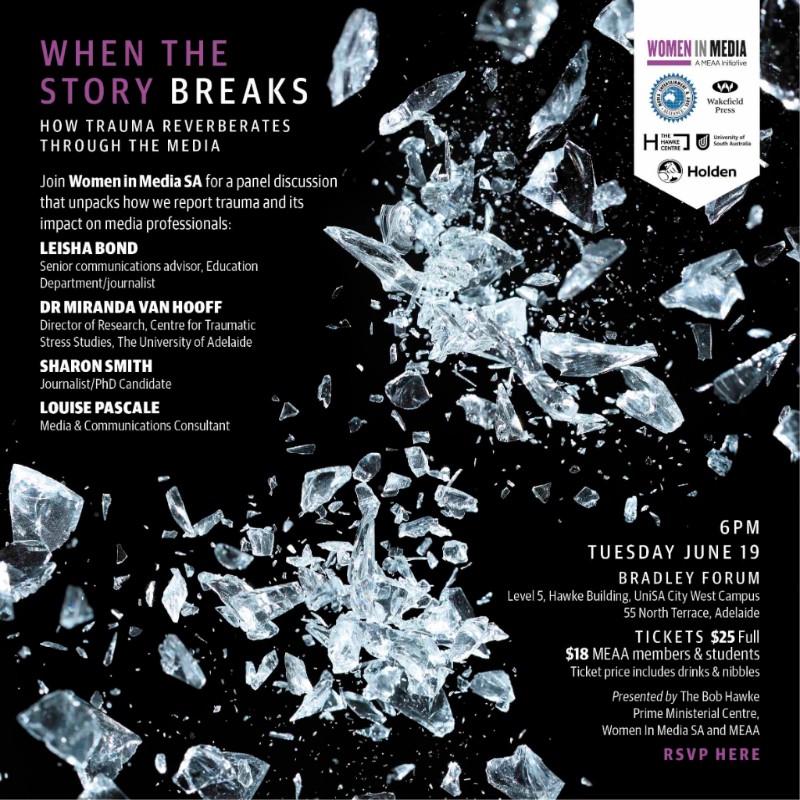
2018 became the year of the painful issue beginning with a state election. WIMSA hosted a complete lineup of all the political party leaders to speak on What’s In It For Women. Held in February at the Mercury Cinema, this gained major media coverage and also featured “democracy sausages”. When the Story Breaks - how trauma reverberates through the media. This was a panel session in the Hawke Centre of UniSA with journalists, psychologist and a woman completing a PhD on the subject. In October we held Kicking Goals, a panel session of and about Women in Sports coverage. It was hosted in the gym of a state football club.

2019 featured The #MeToo Backlash, a panel event featuring media women of all ages who have experienced sexual harassment in the workplace and also a lawyer who specialises in that issue. It was a champagne event hosted by a leading legal firm, Finlayson, in its top floor boardroom. It was a sell-out.

To celebrate 125 years of female suffrage in SA, the state which led the way for women, we have had to compete with many other groups and securing the right speakers on the right dates has resulted in seemingly endless deferrals. October 29 brings it all together in 5 by 5 which is a thrillingly diverse celebrity feminist panel event to be held at UniSA.

In no partical order, some of our posters:

Reflection: There were some good people working on WIM’s behalf in its birthing days with MEAA but there were sometimes crossed wires, delays, rules, booking issues and a feeling of powerlessness.

It has been an agreeable separation on both sides and WIM and MEAA remain warmly related and mutually supportive.

The energy and impetus of the two national convenors have rallied reborn WIM into a body of significant national status. It is a force with which to reckon. It cannot be ignored by proprietors or politicians. Dare I say that it is a new form of union, united women who can stand together and stand up for themselves and each other. We have only just begun. We have yet to flex muscle. But the power is growing. It really is very exciting. I am so glad to have been a part of its emergence - and will always tip my cap to Vickie Laurie who set the ball rolling in WA.

History Footnote: Adelaide journalist Michelle Daw created a pioneer WIM, too in the 1990s. It came to a rather embarrassing end following a great, big, triumphant networking party after which I think I was the only female journalist fronting up to work the next morning - only because I didn’t eat the chicken sandwiches.

Tuesday, May 11, 2010

Burqa bizzo

When I was in Muslim countries, I was expected to dress modestly in keeping with the traditions of the culture.

When in Rome...one tries to fit in. Or so it was before the Islamic disapora.

I might be wrong but I believe that Muslims are the first people to come to live in our country and openly disapprove of us. It's hard to forget the cleric who described Australian women in summer attire as "meat left out for the cat".

There are now a lot of Muslims in Australia. They are spread widely and evenly through the urban population, but they don't blend in. The women's dress makes them instantly recognizable. Their range of religious habit goes from a token headscarf to abaya, those long drab button-up overdresses, and huge hijab around their heads.
The full burqa or niqab face covering is rare here but it is seen.

However, it now is in the news and and we are all forced to think about how, exactly, we feel about this sort of dramatic separation from the rest of the community.  As a liberated country, we don't conform. We display our diversity with everything from muted conservative garb to a mass of tattoos and piercings. We are proud of our freedom to self-expression.

This should, of course, including the Muslims. Yet, by dressing differently, Muslims are dividing us.

And, thanks to political correctness, we feel inhibited and compromised about expressing reservations. This automatically makes us racist.

But I am getting to the age when one speaks one's mind. And I have to say that I am disturbed by the sight of Muslim women shrouded under burqas.  They rouse a confusion of emotions in me. I am intimidated by them. I feel they are spying on us, shunning us, and hiding in plain sight.  I also mistrust that they are actually female. I have no way of knowing.

The thing that most disturbs me is that the Islamic rationale that women are covered from head to foot because of the belief that they are too tempting to be seen. They need to be protected from their own sexuality. Just the sight of their hair is such a provocation that men may completely lose control.

What does this make of Islamic men? They have such crude sexual urges that they cannot  safely see women in public?

This religious dress code, therefore, not only oppresses and insults the women, it demeans men.

It makes no sense to me at all.


Photo: CharlesFred, Flickr

Saturday, June 06, 2009

Loxton the lovely - a travelogue


In an era when history seems to have been made redundant by by the phrase "that was before my time", it is heartening to find official, state-wide celebrations of the past - reminders of our roots and both the triumphs and failures of what we like to call heritage.
I was charmed and honoured to be invited to a town called Loxton to given the opening address for History Week. I was assigned the topic of "Pioneer Women" and instructed to speak on this subject for an hour. I could have wished for less of a maelstrom of a domestic and working life to make the writing of such an epic somewhat easier. Elective time has become elusive. This is a reflection on the history we are living now - the era of information overload wherein the days grow shorter and more pressure cooker, work presses and thinking time has vanished into the archives.
Irony, irony.

However, thanks to History Week and a Loxton man called Bert Haslam, I earmarked my owed overtime from work to pilgrimage to Loxton.
What a revelatory experience.

It is about a three-hour drive from Adelaide -beginning by heading up the freeway to lovely Tailem Bend. This town on a bend of the River Murray has a fabulous roadhouse with a stunning view and decent food - not to mention wireless Internet. Heading out the Karoonda Road we suddenly were in another world - we were in the almost remote countryside. Wheat country with railway lines and tiny silo towns. Marvellous mallee groves along smooth, open road. We saw few cars. But we did see ruins and bleak little settlements.
Approaching a place which was called Sandalwood, and which had nothing much more than the sign saying it was called Sandalwood, we found a roadside pallet with a mound of pumpkins for sale with a wee honour box. We bought one of the $3 ones.

It was a beautiful road, but there was a strange spirit of desolation to its environs, sometimes uncomfortably so. We turned off at a semi-derelict settlement which, incomprehensibly, bragged a racecourse. I wanted to see this racecourse. We drove past cracked and abandoned tennis courts with knee-high weeds, past a lovely but very sadly abandoned house with its rainwater tanks toppled alongside it.

We bumped onto a dirt track with, of all things, a 15k speed sign marker. Not a car in sight, but I slowed from my wild and crazy 25kph to the required speed we wound our way to a fenced compound, at its gate, a corrugated iron ticket booth with $10 entry fee signed. Within, there was a fairly respectable country racing set up - all made of corrugated iron. There was a grandstand, horse boxes and parading ring. One wondered how often it was used. It seemed a bit surreal out there in the desolation of disuse. Like a ghost racetrack.
However, as we were turning back onto the main road of this little ghost town, a big white ute crept out of a road on the other side, one of those big vehicles with bull bars, spotlights, huge tyres... And it drove behind us. It drove close behind us. And we started to feel rather oppressed by it. If I drove fast, it drove fast. If I slowed, it slowed. Eventually we hit another sad little settlement and I pulled over outside a rusty General Store. The white ute went on by and turned down a side road. I thought it may emerge again when we continued, but it didn't. Twas all in the imagination. Too many movies about weirdos in rustic country towns.

There were many ruins and abandoned buildings along the road - telling tales of droughts and lost dreams. There was even a side road signposted "Deferred Works Road".
But the countryside generally is lovely out there. Beautiful mallee.

Loxton was a surprise. A massively wide main road with a huge median strip leads down towards glorious meandering bends of the grand old River Murray. Loxton is, or was, a citrus town. It is surrounded by "fruit blocks" created by a post-war irrigation system which provided opportunities for returned servicemen. The town itself was originally German-settled, however. There are lots of German names in the community, but now also Greek and multicultural ones. It is a famously sunny town and, despite the dire economic crisis which besets it as the river water allocations dry up the once-lush fruit blocks and vineyards, it still seems to have a thriving and progressive atmosphere. At least, that was the impression that big-hearted Bert Haslam, a former school headmaster and now a member of the Loxton Council, conveyed to us as he took us around the sights. Retirement communities are big business in Loxton. A very wise move by the council in a time when Baby Boomers are looking for alternative lifestyles. Loxton is attractive for tree changers.

The fruit blocks are a sorry sight, however. It is heartbreaking to see dead orchards and piles of bulldozed dry orange trees, abandoned fruit drying racks and sadly shuttered houses.


Fortunately some alternative crops are emerging - olives and almonds among them.
We were to meet some of the grape and fruit growers at the History Week opening and to learn that they had been paying something like $300,000 a year for water to keep their orchards and vineyards cropping. They are deeply in debt.

Banrock wine flowed, however, for the opening event.
It was held in a large marquee in the grounds of The Pines, which is Loxton's simply gorgeous old heritage house open to the public. The house was left to the people of Loxton and is lovingly maintained by the council and staffed by keen volunteers. Built by the Thiele family in 1909, it was handed down to Ella who married a car dealer called Kingdon. It would seem to have been an odd, childless marriage but Ella outlived her chainsmoking husband by a long time and was to become beloved of the townsfolk for her gracious ways and her regular, brandy-soaked tea parties. The house has been kept as she left it - a window to a more gracious era which, for some, is still in living memory. It was another thing one had to love about Loxton, another thing that makes it different and better than most country towns. The fact that it also maintains an historic village is another. And then there are the mammoth old gums along the river and the sandy river shores which won the award of Best Inland Beach in Australia. And there is The Big Pelican, a piece of glorious fibreglass folk art which was made originally for a street parade and now sits in all its naif glory on a big water-motif plinth at the entrance to the riverside campgrounds. It is a cultural treasure.


I was a bit anxious about speaking to the people of Loxton on the requested subject of Pioneer Women. It was my feeling, rightly, that Loxton people are already very well informed about their own and the country's history and that, whatever I said, it would seem like teaching granny to suck eggs. I angled my address to pioneer women journalists which meant that I could move through time from first settlers to my own experiences as the first woman journalist on the news floor at two newspapers.


A wonderful array of people turned up to fill the marquee and the school prefects did a sterling job of serving drinks and nibbles. There was even a jolly pioneer folk trio. I was made to feel really welcome and, indeed, despite some very unusual improvised lighting at the lectern and a bit of trouble with the mike, it as all rather good fun and the audience seemed engaged. They were certainly responsive and I had a lovely time talking to lots of them afterwards. They presented me with a hamper of superb local produce - quandong syrup, olive oil, fruit conserve...
My general impression was that it was a really civilized place full of interesting, intelligent and community-minded people. It added to my sense that Loxton was a place a person could happliy live.

With Bert and Kath Haslam, we repaired to the Loxton Community Hotel for an agreeable, albeit not gastronomically brilliant, dinner and a last glass of wine.

Again, it was the pleasure of the people. The Haslams are special - both lifelong career teachers now retired. Bert is one of those golden men whose energy, enthusiasm, knowhow and warmhearted skill with people is the glue which sticks a rural community together. He is a doer and he makes doers of everyone around him. As Kath says, he has two speeds, full-on and stopped.
In the morning, we took a beautiful stroll along the banks of the River Murray. Slow, brown and beautiful. Bird life vivid and raucous. Oh, those ancient eucalypts. Reeds and duckweed...
Bert and Kath met us after our walk and we drove around to see places where Daisy Bates had come to live and work after her famous years of working with the Aboriginals at Ooldea. We explored little backroads, some of them impassable, and saw all sorts of fruit blocks and stretches of the river before arriving at Banrock Station where the wonderful wetlands were dry and there were no waterbirds to be seen.

More evidence of the seriously sad state of the River.
Banrock Station is a very impressive enterprise way out there in the Riverland - an elegant upmarket restaurant with the best possible art and a produce store and wonderful views as well as a conservation enterprise.
Many times living in New Hampshire I have pulled up its webcams to look at the birdlife.

It was disappointing not to see it in real life. We continue to hope for long, drenching and reviving rain to resupply the rivers.
And perhaps the Government could start buying up those cotton farms and rice fields upriver and in the eastern states which have been allowed to divert our precious water.

For Banrock. For the fruit growers. For all.

Thursday, May 24, 2007

Geoffrey Rush sweet in stardom


Flicked on the telly this morning and what should I see but Geoffrey Rush cooking pavlova with Martha Stewart.
Good heavens. Geoff the chef.
Well, of course, it is uphill with Martha Stewart. She has an annoying habit of having to one-up her guests - so of course she was making a rival pav and decorating it with fruit in the American colours. How rude, when she is supposed to be demonstrating an Australian tradition. Geoffrey looked a bit nonplussed. Geoffrey put bananas and lashings of passionfruit on his - to which Martha raised her authoritarian eyebrows.
"I've never heard of anyone putting bananas on a pavlova," she snapped.
Well, she, of all people, would have heard!
Geoffrey looked nonplussed again - and politely explained that it was sort of, er, well, popular where the pav came from.

Rush has been doing the talk circuit this week, promoting the new Pirates of the Caribbean movie.
I get a rush of Rush pride whenever I see him - elegant and urbane Australian actor that he is.
And I get a little thrill in knowing that way back there in the beginning, I had a little hand in his success.
Not that he was not always an exceptional actor. He was based in Adelaide back in the 80s where I reviewed him in State Theatre Company productions, interviewed him on occasion and even, finding him alone at the bar in the legendary La Cantina restaurant , sat down and had a drink with him one late, late night.
I'd admired him from the first time I saw him in the theatre. He is an outstanding stage actor - somehow defying the extraordinary gaunt angularity of his build to embody a veritable panoply of diverse characters. 'Twas ever a pleasure to watch him work.

How did I have a hand in his success?
Well - I wrote the article that inspired the film that won him the Oscar!


May 28, 1986. Page 3, Adelaide Advertiser
Out of the gloom, a genius reborn

Meeting pianist David Helfgott is like tumbling out of everyday life into a softly eccentric wonderland of sounds.

But David, 38, is a world unto himself -- and his tale is one of genius, tragedy and triumph.

The extraordinary WA musician has recently returned to the concert platform after a decade of psychiatric treatment and musical obscurity, shepherded by a woman's love. He is in Adelaide to give a recital at Edmund Wright House tonight.

Peering myopically through milk-bottle-bottom lenses, he proffered a warm, long-fingered hand and his murmurous voice began a strange rhythmic exploration of the sound of new names: "Sssam-sam-samela-sam..."

Then, as if magnetically drawn to the piano, he sat at the sleek Steinway, caressed its keys and filled the ornate old room with the intricate sounds of Liszt's La Campella while transforming his name-refrain into friendly serenade.

Rocking on the piano stool, sometimes bowing his head to the keys, singing, sighing and occasionally asking for a cigarette -- yet never interrupting the fluidity of his music -- he resembled no other concert pianist.

As the musical prodigy son of impoverished Polish migrants, David Helfgott was, at 12, the youngest to enter the ABC's annual WA State concerto and vocal competitions, which he went on to win six times.

At 14, he was the youngest to reach the Commonwealth finals and he pursued a brilliant career to be assessed at 19 in London as a "near-genius" talent. His performance of the Liszt Concerto at the Royal Albert Hall received a standing ovation from an audience of 8000.

Soon afterwards Helfgott suffered a serious nervous breakdown. On his return to Perth in 1973, he was admitted to hospital and his psychiatric and drug treatments lasted 10 gloomy years.

He continued privately to play the piano, sometimes for 10 hours a day, in his cramped lodge where he lived with 60 other psychiatric patients.

His musical career was surprisingly revived in 1983 when a Perth restaurateur, Dr. Chris Reynolds, asked him to fill in for a sick pianist.

Nervously chain-smoking, he produced a few discordant two-fingered sounds on the restaurant's piano, and as the diners began to jeer, he launched into Rimsky Korsakov's Flight of the Bumble Bee.

It was an historic night at Riccardo's restaurant. Diners, drinkers and staff were stopped in their tracks. They gave a thunderous ovation -- and Helfgott played on for four hours of non-stop classics.

Helfgott was "adopted" by the restaurateur and it was while living in his home that he met visiting divorcee Gillian Murray. At their second meeting he proposed to her and within months they were married.

But he was subsisting unhealthily on 130 cigarettes and 25 cups of coffee a day and prescribed medication, while playing piano three times a week at the restaurant.

Since their meeting in 1984, Gillian has gradually limited his smoking to less than one packet a day, reduced his coffee intake to a maximum of five cups, eliminated his need for medication and strengthened his bowed and lean body with a shared regimen of swimming, jogging and yoga.

Mrs. Helfgott described her husband as "an absolutely unforgettable, irresistibly endearing, hopelessly impractical genius who does not know meanness or dishonesty."

She nurtures him like a rare flower, believing that "fine performers need special care and support so they can blossom to full potential."

Of his wife, Helfgott said she had restored his confidence and blessed him with the sweet fortune to resume the career he loved.

After his "return" tour of Australia, the Helfgotts will leave for a study tour of Britain and Europe and then, according to Mrs. Helfgott, Australia can look forward to hearing much more from "one of the few truly romantic pianists in the world."


On reading this story in the paper, film director Scott Hicks telephoned me and asked "is this man for real?" I assured him enthusiastically that David Helfgott was very much for real, had been quite the most extraordinary extraordinary to meet - and confirmed where Helfgott was playing that night. Scott subsequently excused himself from his wife's birthday party to leap off to hear Helfgott - and Shine was born - wherein, a decade later, Geoffrey Rush's name soared from the world of Australian theatre and into the shimmering lights of international movie stardom.

So, I like to think I was a little acorn...