Australian kayaker Andrew McAuley must qualify for a Darwin Award.
The adventurer died recently on while trying to become the first person to paddle alone across the Tasman Sea from Australia to New Zealand.
Shortly before his death he had said that, although he didn't think adventure was worth dying for, nonetheless, some people needed to put their lives at risk to appreciate how precious life is.
And his death proved what, exactly?
Meanwhile, Norma Khouri did not turn up for the world premiere of Forbidden Lies, the film in which she stars. Instead, she has been sending out letters of protest saying that the film is all lies.
I'm starting to get the giggles.
Tuesday, February 27, 2007


Saturday, February 24, 2007
Norma Khouri unravelled

Norma Khouri took us all in, hook, line and sinker. But what reason did we have to suspect that she was not telling the truth when she emerged as the author of Forbidden Love, (Honor Lost in the US), the emotional expose of honour killings in Jordan?
We brought her to our city as our guest to celebrate her courage in writing the book, promoting it as a Big Book Club selection, providing discount coupons to make it easier for our readers to afford. We invited the city to meet her - and they came in numbers so large that we had to open the huge Hilton Hotel ballroom to its maximum size and still had people standing.
I introduced her to that sea of people in a paeon of praise - as a woman fearlessly championing a cause.
On meeting Norma, I had been entirely charmed. She was modest, amusing, self-deprecatory and, above all, passionate about her cause. I will admit, however, that I had earlier found it necessary to quiz her in a way that I would not usually do in the course of an author interview. I had found some strange discrepancies in her book and wanted to clear them up. I could not, for example, understand the why and how of her move to Greece. When I asked about this she answered at some length with such fluency and ease that it was not until I went back over my notes that I realised that there had been no actual answer in her words. I had thought I heard an answer, but it was a charming zig-zag. There was no "there" there. I was more annoyed with myself than with her. How come I still had no answer to such a simple question? Now I would have to write around it - "when in doubt, leave it out". But that was not the only puzzle. On first speaking to her, I exclaimed at her American accent. I'd never met a Jordanian with such a strong American accent. "How much time had she spent in the US?", I asked. She gave a long response in which she attributed her accent to the American School in Amman, a diet of American movies and television and a passion for emulation. I could only comment at how well she had mastered the accent - for, I had no reason to suspect that she was not on the level. None of us did.
I suppose the thing that convinced me about Norma Khouri's authenticity in writing Forbidden Love was how bad she is as a writer. The book's text is simplistic in style, clearly put together by someone who is trying to tell a story but who has absolutely no talent as a writer.
And, of course, the book's cover brandished the promise that it was, indeed, a "true story". One tends to trust the Random House label. No, we had no cause for suspicion.
It was Sydney journalist Malcolm Knox who smelled the proverbial rat, and we all went into shock. His revelations reverberated around Australia, where Khouri had been living in high secrecy - to protect her from jihad, or so she told me when first I reached her on a super secret phone number.
Malcolm Knox, in a fine piece of investigative journalism, discovered that she is not only Chicago-raised but also allegedly wanted by the FBI for swindling an elderly woman in Chicago. She turns out to be married with two children.
Wrote Knox:
"Khouri's hoax will take its place in a long Australian tradition of literary fraud, from Ern Malley to Helen Darville-Demidenko. But no other fraudulent book has had such wide sales or impact..."
Many pennies dropped about Khouri's inconsistencies when I read this, but I still wondered. It all seemed so odd to fake with altruistic intent. After all, her mission was to shame the tradition of Islamic honour-killings - to save young women from death at the hand of their families. And, frankly, I could not dislike Khouri.
Now at the Adelaide Film Festival a documentary on Khouri and her story as a fake has its world premiere. Forbidden Lies allows Khouri to tell her own story to camera and then accompanies her to Jordan where she promises to prove that her friend Dalia was a real person who was genuinely killed by her brother because of her association with a young Christian man. But, come Jordan, Khouri is suddenly backpedalling and fudging. She cannot find those promised locations and there is no record of the victim ever ending up in any morgue or cemetery. Under the cool gaze of the camera, we watch Khouri unravelling, coming up with sequential excuses and layers of desperately transparent lies. Oddly, it is really sad. But she has chutzpah. Denying the swindling allegations, she creates a whole new story in which she casts herself as the victim - and we discover a new book is on the way, an autobiography of an abused child whose only way of coping with life is by inventing it...
What a pity we don't believe her.
But somewhere, somehow, we still like her.
Sunday, February 04, 2007
The state of the states
Unlike America, Australia has always been in some denial about the differences in character and attitude between the states. While America is proud of the contrast between, say, New York and California or Georgia and Vermont, we have been a bit secretive about state contrasts - seeing it as some sort of dirty family business. The feelings between Australian states have not been exactly affectionate.
Hence, the immense schadenfreude we now feel at the Sydney Morning Herald's report of English psychologist and author Oliver James's analysis of the Australian states. He has said the things that we mutter to each other but dare not declaim. He has said that Sydney is the most vacuous city of superficial people obsessed with real estate, personal prestige and appearance.
The "Dolly Parton" of Australian cities!
He has hit the nail on the head. He has not mentioned, because he may not have known, that Sydney also produces the most astonishingly arrogant attitude towards the rest of Australia - a sense of absolute superiority. It would eliminate the other states completely, if it could. If it cannot ignore them, it will demean them. It is all-wonderful, all-powerful, it is simply all.
We call it "Sydneycentricity" here in the south.
Sydney has created its own image of the other capital cities - none of them friendly. We, the arts capital, are always dubbed "the city of churches" and accused of a conservatism which does not apply. We are also dubbed a "poofter" city because of our emphasis on the arts.
Melbourne is the upstart, greedy city, in the Sydney view. If Sydney disdains Adelaide, it loathes Melbourne - a feeling that is reciprocated by Melbournians. Hobart and Perth? Well, they are not worthy of Sydney interest at all. They are so remote, they are country towns in the big city view of the country.
Now, of course, Sydneysiders are in a lather of indignation. They have been internationally exposed as the vain and vapid, materialistic drears that they are. All they have is more. More people and more money, more traffic and more tourist.
I've always described Sydney as a "blousey" city - like an overblown rose. It is showy, gorgeous and big.
Adelaide is the pink bud rose - delicate, pretty and rich with promise. If one was to continue the rose metaphor, Melbourne would be the yellow climber, Hobart the wild bramble and Perth the standard rose, staked tall and isolated, but lovely.
Sydney has dominated the country like a schoolyard bully (yes, changing metaphors) - and we have all cowered in our geographic corners, quietly seething resentment but not nationally disloyal enough to repay the rudeness. Certainly in Adelaide we have always known that we are the creative crucible of the country. We export brains and talent to the rest of the country - and the world. The more we lose, the more we make. Perth may have had the first art festival, but we are the Festival city - simply because, like Edinburgh, we were made for festivals. We have the cultured population and the physical dimensions to make arts festivals into all-embracing happenings. Our festivals are not just a program of events scattered around a vast area, as is the case with Sydney. They are a city coloured in the arts.
Melbourne, our nearest capital neighbour, is jealous and predatory - thieving what it can from Adelaide's events. I quite like Melbourne, but I find its inability to come up with its own ideas a bit tiresome. I find Melbourne's pathological loathing of Sydney most amusing, however. Melbourne wants to be what other cities are. It lies and contorts history, it steals and generally behaves rather badly.

Adelaide? Well, at a million people it is just the right size. It is small enough to have a sense of community but large enough to have a thriving metropolis. It has a vast stretch of superb beaches and lush, agriculturally productive hills - along with fertile wine and dairy valleys. We eat extremely well - living an enviable quality of life which is untrammelled by congestion. We are what they call "a lifestyle city". A gentle decadence prevails. We neither need nor want what Sydney has. Particularly its attitude.
So why haven't we blown the whistle on the ugliness of Australia's most beautiful city?
Perhaps it is because we have a population of only 21million versus the USA's 310 million that we have kept a loose sense of nationalism rather than state identification, allowing the most populous city to stake its claim as gateway to the country. Perhaps we simply don't want to wash our dirty linen in public.
It took a foreigner.
Hence, the immense schadenfreude we now feel at the Sydney Morning Herald's report of English psychologist and author Oliver James's analysis of the Australian states. He has said the things that we mutter to each other but dare not declaim. He has said that Sydney is the most vacuous city of superficial people obsessed with real estate, personal prestige and appearance.
The "Dolly Parton" of Australian cities!
He has hit the nail on the head. He has not mentioned, because he may not have known, that Sydney also produces the most astonishingly arrogant attitude towards the rest of Australia - a sense of absolute superiority. It would eliminate the other states completely, if it could. If it cannot ignore them, it will demean them. It is all-wonderful, all-powerful, it is simply all.
We call it "Sydneycentricity" here in the south.
Sydney has created its own image of the other capital cities - none of them friendly. We, the arts capital, are always dubbed "the city of churches" and accused of a conservatism which does not apply. We are also dubbed a "poofter" city because of our emphasis on the arts.
Melbourne is the upstart, greedy city, in the Sydney view. If Sydney disdains Adelaide, it loathes Melbourne - a feeling that is reciprocated by Melbournians. Hobart and Perth? Well, they are not worthy of Sydney interest at all. They are so remote, they are country towns in the big city view of the country.
Now, of course, Sydneysiders are in a lather of indignation. They have been internationally exposed as the vain and vapid, materialistic drears that they are. All they have is more. More people and more money, more traffic and more tourist.
I've always described Sydney as a "blousey" city - like an overblown rose. It is showy, gorgeous and big.
Adelaide is the pink bud rose - delicate, pretty and rich with promise. If one was to continue the rose metaphor, Melbourne would be the yellow climber, Hobart the wild bramble and Perth the standard rose, staked tall and isolated, but lovely.
Sydney has dominated the country like a schoolyard bully (yes, changing metaphors) - and we have all cowered in our geographic corners, quietly seething resentment but not nationally disloyal enough to repay the rudeness. Certainly in Adelaide we have always known that we are the creative crucible of the country. We export brains and talent to the rest of the country - and the world. The more we lose, the more we make. Perth may have had the first art festival, but we are the Festival city - simply because, like Edinburgh, we were made for festivals. We have the cultured population and the physical dimensions to make arts festivals into all-embracing happenings. Our festivals are not just a program of events scattered around a vast area, as is the case with Sydney. They are a city coloured in the arts.
Melbourne, our nearest capital neighbour, is jealous and predatory - thieving what it can from Adelaide's events. I quite like Melbourne, but I find its inability to come up with its own ideas a bit tiresome. I find Melbourne's pathological loathing of Sydney most amusing, however. Melbourne wants to be what other cities are. It lies and contorts history, it steals and generally behaves rather badly.

Adelaide? Well, at a million people it is just the right size. It is small enough to have a sense of community but large enough to have a thriving metropolis. It has a vast stretch of superb beaches and lush, agriculturally productive hills - along with fertile wine and dairy valleys. We eat extremely well - living an enviable quality of life which is untrammelled by congestion. We are what they call "a lifestyle city". A gentle decadence prevails. We neither need nor want what Sydney has. Particularly its attitude.
So why haven't we blown the whistle on the ugliness of Australia's most beautiful city?
Perhaps it is because we have a population of only 21million versus the USA's 310 million that we have kept a loose sense of nationalism rather than state identification, allowing the most populous city to stake its claim as gateway to the country. Perhaps we simply don't want to wash our dirty linen in public.
It took a foreigner.
Friday, February 02, 2007
Oh, Molly.
The geographical distance could not be greater but nor could the spiritual proximity.
Molly Ivins was one of my own kind - one of the very best. She may have been writing in Texas, but we were reading her in South Australia. Avidly. With absolute joy that she was allowed to have a voice in the American media landscape. The balanced voice, the funny one - satirist and wise woman. She wielded wit and irony as weapons of mass communication.
That breast cancer has taken her is an outrage and an injustice.
Molly Ivins was one of my own kind - one of the very best. She may have been writing in Texas, but we were reading her in South Australia. Avidly. With absolute joy that she was allowed to have a voice in the American media landscape. The balanced voice, the funny one - satirist and wise woman. She wielded wit and irony as weapons of mass communication.
That breast cancer has taken her is an outrage and an injustice.
Thursday, January 25, 2007
Sweet mystery of history

What a strange position. Quite wonderful, but oddly unnerving. The National Library of Australia is touring an exhibition of Australian Treasures held in library collections - symbolising the way in which libraries are curators of the national heritage. I'd had an email from a State Library archivist alerting me to the arrival of an anonymously-donated scrap book containing clippings about the Ern Malley saga of the early 1940s - the famous literary hoax perpetrated against my father, Max Harris. The archivist invited me to have a look at the book, to see if I could help to shed light on it. As it happened, I had also been invited to the media preview of the Treasures exhibition so I liaised to see the scrapbook between the official Treasures speeches and the VIP lunch.
And so it came to pass that, while celebrating the way in which significant pieces of history survive the often inauspicious happenstances of time, I found myself with one such piece of history in my hands. A piece of Australian cultural history which also was celebrated within the context of the Treasures exhibition. Indeed, Ern Malley is even on the cover of the exhibition's big, glossy catalogue. And there I was, upstairs with the archivist, handling the fragile, browning pages of a 1941 clippings book, seeing reports that I had never seen before on that piece of history and, with Neil Thomas, the archivist, puzzling over where this thing has been for all these years, how it ended up in Angelsea, Victoria, why it was sent to the library anonymously and who on earth had compiled it.
This was a profoundly thrilling experience. With a rush, it made me realise that archivists have the most fascinating jobs. And for me, as the connected person called in to throw light on the find, there was a sense of love, sorrow, wonderment as I leafed very carefully through those fraying old pages which revealed, in unprecented detail, the dramas of my father's life. How painful they must have been for that very young man - all those screaming headlines, all those excoriating reviews.
At the same time, there was a sense of relief because so much of this history had been lost or in fragments here and there. My father kept nothing. He was a dedicated discarder. A biographer's nightmare. Yet here was a collection of clippings which encompassed media coverage in journals large and small, from all over the world. Beautifully collected and collated.
The tiny handwriting identifying sources was another mystery. It looked vaguely like Max's script, but not quite. So whose was it?
I phoned my mother and asked if there was any chance Max had ever made a clippings scrapbook. She replied that this would have been atypical. In all the years she knew him, he had never scrapbooked anything. She had known him from school days - so this, one could accept as fairly definitive. It was not he.
Puzzling at night with my mother, it was not until I had described the scrapbook's cardboard binding that some sort of penny dropped. "Mary did it," she said. Aaah. Mary Martin, my father's long-time friend and business partner, she who stayed in Adelaide and managed the Angry Penguins journal office while Max was in Melbourne producing it with John Reed.
And so the bits of jigsaw slip into place.
There is so much more to know.
How did this book get to Victoria? Was it among Mary's possessions, dispersed in her family after her death over 30 years ago? If so, why did the family keep it and now, why give it to history? And why do so anonymously?
Such are the mysteries we may never solve.
But at least the treasure is now in the right place - under the protective wing of librarians, the wonderful keepers of the cultural history.
Monday, January 22, 2007
Botox for blogs
I've finally done it. I have given angrypenguin a facelift, thanks to Blogger's upgrade-to-Google facility. I am pleased with the crisp, clean look.
Of course, I am having problems in this new, much-overdue template change. Blogger says one can access the original blog to get at template adds, but now I can't find it. Maybe this is because I made more than one change to the template as I moved over. Seeing my original choice in full-screen, I realised the column width was too wide for easy online reading and sought a narrower column - this template. That is a flaw in the preview facility - the small window gives a skewed perspective. The design looked dramatically different when I adopted it.
So, all my logos, my counter and illustrated links are gone - along with the link Blogger originally offered to my archived original blog. I've scoured the Help lists - to no avail.
One always dreads making any changes online - it is never problem-free and ends up being really time-consuming. I am a content expert, but never claimed to have much aptitude for the techie side of the WWW. So here I am, floundering.
Of course, I am having problems in this new, much-overdue template change. Blogger says one can access the original blog to get at template adds, but now I can't find it. Maybe this is because I made more than one change to the template as I moved over. Seeing my original choice in full-screen, I realised the column width was too wide for easy online reading and sought a narrower column - this template. That is a flaw in the preview facility - the small window gives a skewed perspective. The design looked dramatically different when I adopted it.
So, all my logos, my counter and illustrated links are gone - along with the link Blogger originally offered to my archived original blog. I've scoured the Help lists - to no avail.
One always dreads making any changes online - it is never problem-free and ends up being really time-consuming. I am a content expert, but never claimed to have much aptitude for the techie side of the WWW. So here I am, floundering.
Thursday, January 04, 2007
No fan of Duncan Chessell
As Willy Loman said, "attention must be paid". We all crave attention. Some demand it.
I am thinking of Duncan Chessell, "adventurer", who has just climbed the highest peak in Antarctica. Not alone. He had a satellite phone. He does not move without communications for, otherwise, how could he make the world pay attention to every move he makes? He has not been climbing Mt Vinson (4897m) for science. He has been climbing it because he wants a personal record of having climbed all the world's highest peaks. And he wants everyone to know that he is doing it. There are others climbing with him, but one barely hears of them. They are not media manipulators.
Chessell is an absolute expert. He is a better media manipulator than mountain climber, methinks. He has finessed reporters on various media, charmed them to bits. They all think he is their special friend. They all believe he is reporting exclusively to them. They will not hear a word against him. Of course, they do. From me.
This bloke does not have me fooled and I am appalled that experienced journalists have been suckered in. We of the media are always being wooed by people seeking publicity. PR people finess us all over the place. They treat us like good friends with the hope that we will think of them as good friends. Ingenuous young journalists make believe them - until their job description changes and they discover that they have been dumped like the proverbial in favour of the new journalist who serves the PR cause better. We jaundiced oldies know this syndrome - uncritically, since PR people have to serve their masters and getting through to us is a primary requirement.
Duncan Chessell is his own PR person. He has the media phone numbers on speed dial and he rings and texts his good media buddies daily, often many times. He even texted one colleague in the depths of the night to announce the birth of his child. The colleague was tickled pink thus to be treated like a member of the family, this celebrity family.
But Chessell is creating his own celebrity for his own selfish ends.
He is a man obsessed with his own thing - climbing bloody mountains and making a personal record. The old PB - personal best. The operative word is "personal".
Massive resources are required for the sort of PB he seeks. Delicate environments are trampled. Planes fly in to the fragile Antarctic to bring his crew in and out.
It is all spectacularly expensive.
The canny Chessell has tried to offset this by making his adventures a "charity" cause. He has called his expedition "The Centrecare Antarctic Challenge". It is like a sponsor's naming rights, but the sponsor is a church charity. I gather that we can donate to it in the name of Duncan Chessell and his challenge - hence, he can claim to be supporting its cause. But, of course, it is supporting his cause. His incredibly egocentric PB.
Come on. Who needs Duncan Chessell's name in order to donate to a church charity? If one wishes to donate, one simply donates. Chessell exploits its name for his own cause, not the church cause. How come everyone is suckered in?
No, I am no fan of this man.
I do not feel a wrench of the heart when I see him on television lamenting the fact that he is missing out on his baby daughter's growth because he has to be far away in Antarctica.
He does not have to be anywhere. He is simply putting his adventure above his family.
His wife does not seem to mind. She is getting a lot of attention, too.
In between his myriad media calls, he rings her, also.
Duncan Chessell certainly has achieved a world record of sorts, I think.
He may claim the pinnacle of media connectivity. The top of self-generated media coverage in the world today. Well, South Australia.
I am sure the rest of the world neither knows nor cares.
Until Chessell gets their phone numbers.
antarctica
Duncan Chessell
media
mountaineer
I am thinking of Duncan Chessell, "adventurer", who has just climbed the highest peak in Antarctica. Not alone. He had a satellite phone. He does not move without communications for, otherwise, how could he make the world pay attention to every move he makes? He has not been climbing Mt Vinson (4897m) for science. He has been climbing it because he wants a personal record of having climbed all the world's highest peaks. And he wants everyone to know that he is doing it. There are others climbing with him, but one barely hears of them. They are not media manipulators.
Chessell is an absolute expert. He is a better media manipulator than mountain climber, methinks. He has finessed reporters on various media, charmed them to bits. They all think he is their special friend. They all believe he is reporting exclusively to them. They will not hear a word against him. Of course, they do. From me.
This bloke does not have me fooled and I am appalled that experienced journalists have been suckered in. We of the media are always being wooed by people seeking publicity. PR people finess us all over the place. They treat us like good friends with the hope that we will think of them as good friends. Ingenuous young journalists make believe them - until their job description changes and they discover that they have been dumped like the proverbial in favour of the new journalist who serves the PR cause better. We jaundiced oldies know this syndrome - uncritically, since PR people have to serve their masters and getting through to us is a primary requirement.
Duncan Chessell is his own PR person. He has the media phone numbers on speed dial and he rings and texts his good media buddies daily, often many times. He even texted one colleague in the depths of the night to announce the birth of his child. The colleague was tickled pink thus to be treated like a member of the family, this celebrity family.
But Chessell is creating his own celebrity for his own selfish ends.
He is a man obsessed with his own thing - climbing bloody mountains and making a personal record. The old PB - personal best. The operative word is "personal".
Massive resources are required for the sort of PB he seeks. Delicate environments are trampled. Planes fly in to the fragile Antarctic to bring his crew in and out.
It is all spectacularly expensive.
The canny Chessell has tried to offset this by making his adventures a "charity" cause. He has called his expedition "The Centrecare Antarctic Challenge". It is like a sponsor's naming rights, but the sponsor is a church charity. I gather that we can donate to it in the name of Duncan Chessell and his challenge - hence, he can claim to be supporting its cause. But, of course, it is supporting his cause. His incredibly egocentric PB.
Come on. Who needs Duncan Chessell's name in order to donate to a church charity? If one wishes to donate, one simply donates. Chessell exploits its name for his own cause, not the church cause. How come everyone is suckered in?
No, I am no fan of this man.
I do not feel a wrench of the heart when I see him on television lamenting the fact that he is missing out on his baby daughter's growth because he has to be far away in Antarctica.
He does not have to be anywhere. He is simply putting his adventure above his family.
His wife does not seem to mind. She is getting a lot of attention, too.
In between his myriad media calls, he rings her, also.
Duncan Chessell certainly has achieved a world record of sorts, I think.
He may claim the pinnacle of media connectivity. The top of self-generated media coverage in the world today. Well, South Australia.
I am sure the rest of the world neither knows nor cares.
Until Chessell gets their phone numbers.
antarctica
Duncan Chessell
media
mountaineer
Wednesday, January 03, 2007
Living in a drought
All because of a drought and severe water restrictions, my potplants have never been better watered. They smile up into the searing heat, their roots happily sucking up the "greywater" from my morning shower.
Having been conditioned by the urgency of our South Australian water crisis into acute awareness of water use and waste, I now keep a bucket in the shower. It is either full or half full by the end of my morning ablutions, depending on whether it is a hair-washing day or not. So, every morning I traipse out into the garden with my bucket and share the precious water out - on plants which, previously, were lucky to be watered once a week.
Recycling greywater makes one very conscious of just how much water slips away as oone performs the usual domestic tasks. I now stand over the laundry sink when the washing machine heads for spin cycle and catch the rinse water in my bucket. There are four full buckets to a full load of washing. Four! A lot of happy plants.
But not in the street. The street trees are starting to droop. I have tried sharing my shower water with them - but the earth is so dry, the water just runs across it and the next thing you know, it is heading for the storm drain. One needs to spend some time dripping it slowly in on the rock-hard suburban earth. Many trees are not going to survive this drought. Those that do will record it for posterity - a slim line of deprivation in their growth rings.
Meanwhile, we watch our water and each other. There are a lot of dirty cars on the road. A good sign. One is permitted only to wash cars with a bucket and sponge. No hoses. Or one may go to a water-recycling car wash. A dirty car now is seen as a good citizen. A lush lawn is seen as greed. One wonders when the abuse will begin - people turning on each other over water waste.
For there is one clear thing. This drought has made people realise that although they may have all the material possessions in the world, water truly is the most precious of all commodities. We must never take it for granted.
news
drought
australia
environment
Having been conditioned by the urgency of our South Australian water crisis into acute awareness of water use and waste, I now keep a bucket in the shower. It is either full or half full by the end of my morning ablutions, depending on whether it is a hair-washing day or not. So, every morning I traipse out into the garden with my bucket and share the precious water out - on plants which, previously, were lucky to be watered once a week.
Recycling greywater makes one very conscious of just how much water slips away as oone performs the usual domestic tasks. I now stand over the laundry sink when the washing machine heads for spin cycle and catch the rinse water in my bucket. There are four full buckets to a full load of washing. Four! A lot of happy plants.
But not in the street. The street trees are starting to droop. I have tried sharing my shower water with them - but the earth is so dry, the water just runs across it and the next thing you know, it is heading for the storm drain. One needs to spend some time dripping it slowly in on the rock-hard suburban earth. Many trees are not going to survive this drought. Those that do will record it for posterity - a slim line of deprivation in their growth rings.
Meanwhile, we watch our water and each other. There are a lot of dirty cars on the road. A good sign. One is permitted only to wash cars with a bucket and sponge. No hoses. Or one may go to a water-recycling car wash. A dirty car now is seen as a good citizen. A lush lawn is seen as greed. One wonders when the abuse will begin - people turning on each other over water waste.
For there is one clear thing. This drought has made people realise that although they may have all the material possessions in the world, water truly is the most precious of all commodities. We must never take it for granted.
news
drought
australia
environment
Monday, January 01, 2007
And another year...
The youthful badge of New Year honour. The hangover.
There are sad and seedy people all around me on this first day of 2007.
It has always bemused me that this is the way people choose to start a new year, wiping out the old year in a last night frenzy of excess and abandon, only to confront the first day in a fog of misery and regret.
Oh well, the year can only get better for them, I suppose.
Mine is not an attitude of age. It is a lifelong opinion and I can't remember ever seeing in a new year drunk. That I can't remember it does not mean it never happened. But the odds are against it, since I have always seen the passage of time in a melancholy light. I am not all that keen to let go of the years and it seems illogical to me that people are so keen to do so.
Then again, society needs its rituals and celebrations, its excuses for yet another fireworks display. The positive of new year as a celebration is that it is not encumbered by religion. It is a celebration which applies to one and all, whether it be the partying affluent young or the old alone in front of the television, waiting for the fireworks.
Beautiful as they are, fireworks are burning money. One thinks of the good causes to which those sparkling explosions of millions may be directed - causes which would really do something for a new year or many years. But now I am just too curmudgeonly.
Here's to hoping that this is a year of peaceful resolution and political restraint, that common sense and compassion will prevail and that a sense of consequences and care for the future will emerge where now there is short-sighted coporate greed.
There are sad and seedy people all around me on this first day of 2007.
It has always bemused me that this is the way people choose to start a new year, wiping out the old year in a last night frenzy of excess and abandon, only to confront the first day in a fog of misery and regret.
Oh well, the year can only get better for them, I suppose.
Mine is not an attitude of age. It is a lifelong opinion and I can't remember ever seeing in a new year drunk. That I can't remember it does not mean it never happened. But the odds are against it, since I have always seen the passage of time in a melancholy light. I am not all that keen to let go of the years and it seems illogical to me that people are so keen to do so.
Then again, society needs its rituals and celebrations, its excuses for yet another fireworks display. The positive of new year as a celebration is that it is not encumbered by religion. It is a celebration which applies to one and all, whether it be the partying affluent young or the old alone in front of the television, waiting for the fireworks.
Beautiful as they are, fireworks are burning money. One thinks of the good causes to which those sparkling explosions of millions may be directed - causes which would really do something for a new year or many years. But now I am just too curmudgeonly.
Here's to hoping that this is a year of peaceful resolution and political restraint, that common sense and compassion will prevail and that a sense of consequences and care for the future will emerge where now there is short-sighted coporate greed.
Wednesday, December 20, 2006
News exclusive
Exclusive.
Only on Fox News will you see Mount St Helen having a minor eruption. Or, so the srident screen tickers and excited news anchors proclaim.
This volcano clearly has signed million-dollar rights to the sensationalist news service and will perform for no one else.
Blow me down!
I wonder who is acting as its agent.
news
volcano
Fox
exclusive
Only on Fox News will you see Mount St Helen having a minor eruption. Or, so the srident screen tickers and excited news anchors proclaim.
This volcano clearly has signed million-dollar rights to the sensationalist news service and will perform for no one else.
Blow me down!
I wonder who is acting as its agent.
news
volcano
Fox
exclusive
Friday, December 15, 2006
Oh, Qantas
It is hard to be happy about the sale of Qantas.
Australia's iconic national airline suddenly is not so national. It is part-American. Not that I am in a position to make judgement about this, being, in a sense, part American. But Qantas?
The worry, of course, is not nationality so much as the fact of privatisation. The shareholders, we hear, are very happy with this sale. The shareholders profit from it. Once they have added up this profit, they will, of course, be looking for more.
Modern corporatations cannot cope with a steady profit margin. To their values, the graph line should continue ever upwards, yielding ever more, slashing into everything that makes the corporation successful to carve out more dividends.
This is the secret behind declining standards all around us.
So, we will see Qantas start to cut corners. First the staff, then the maintenance. Then, oh fear, the reputation for safety.
The world's safest airline is in peril.
Of course they are making all sorts of assurances right now about how the airline will be handled. They lie. Lying has become a norm. We expect it. It eases the passage of deceit. After all, the truth is unpalatable
But so long as the shareholders have their nests feathered, does anyone care?
Until the first crash.
qantas
australia
politics
airlines
Australia's iconic national airline suddenly is not so national. It is part-American. Not that I am in a position to make judgement about this, being, in a sense, part American. But Qantas?
The worry, of course, is not nationality so much as the fact of privatisation. The shareholders, we hear, are very happy with this sale. The shareholders profit from it. Once they have added up this profit, they will, of course, be looking for more.
Modern corporatations cannot cope with a steady profit margin. To their values, the graph line should continue ever upwards, yielding ever more, slashing into everything that makes the corporation successful to carve out more dividends.
This is the secret behind declining standards all around us.
So, we will see Qantas start to cut corners. First the staff, then the maintenance. Then, oh fear, the reputation for safety.
The world's safest airline is in peril.
Of course they are making all sorts of assurances right now about how the airline will be handled. They lie. Lying has become a norm. We expect it. It eases the passage of deceit. After all, the truth is unpalatable
But so long as the shareholders have their nests feathered, does anyone care?
Until the first crash.
qantas
australia
politics
airlines
Sunday, December 03, 2006
Heide Revisited
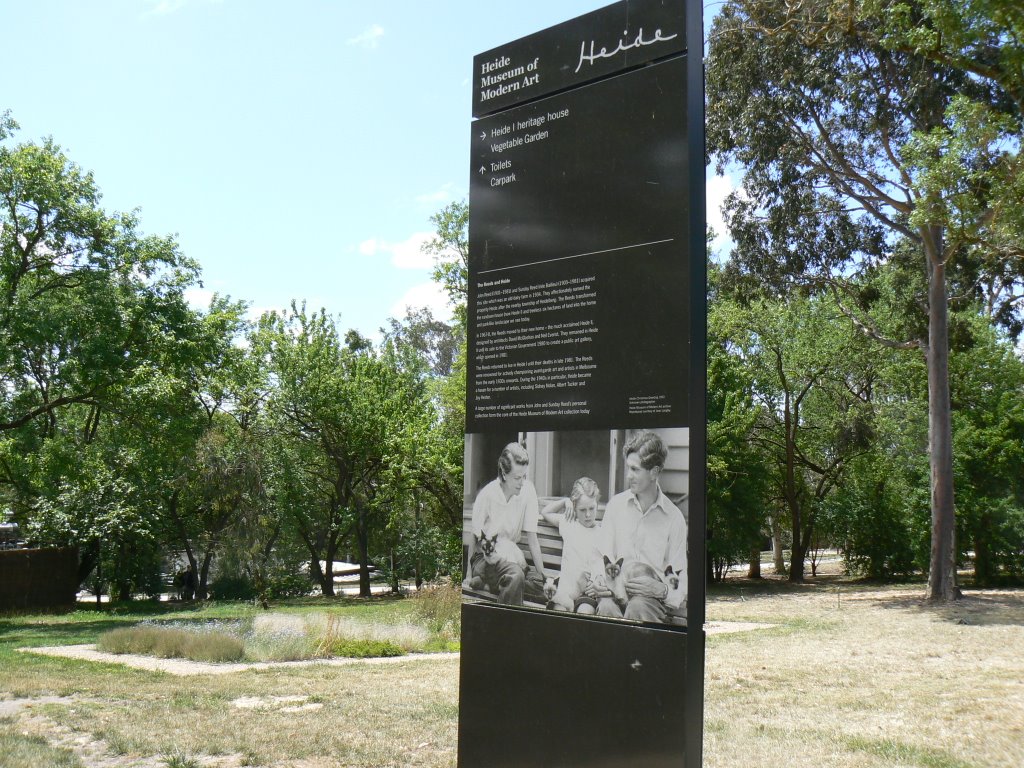
It must be 50 years since I visited Heide, the home of John and Sunday Reed, just outside Melbourne. It was a home-away-from-home for my parents in the 1940s and, indeed, I was conceived there.
Through my childhood, we returned for visits with the Reeds and I established a strong friendship with their adopted son, Sweeney. None of them is alive today - not even sweet Sweeney, who committed suicide in 1979 when I was still living overseas. By then our contact had become sporadic - but my affection towards him never had dimmed. In childhood, he just a year older than I, he had been a hero to me - a superhero, even, since he liked to take on that guise, wearing a red cape and assuming the role of my protector. When he locked me in the cat house at Heide, the grownups were very upset. I was not in the least perturbed, however. I was in there for safekeeping. Sweeney had put me in there to make sure no harm came to me and nobody could take me away, since it was his intention that I stay with him.
He would, to my shock, sneak into his parents' bedroom and steal money from Sunday's purse - to take me down to the shops and buy all sorts of forbidden sweets which we would devour with unspeakable relish in the shade of the orchard trees. And we would play fleet-footed, highly-imaginative games through gardens and orchards. We would dress up and role play. He would lead and I would follow. With his mop of unruly blond hair, he was the most beautiful boy in the world - and the most daring and dangerous. A wild child. My friend.
To me, Heide is all these memories. I remember the well-scrubbed and busy kitchen with Sun, who seemed so tall and austere and yet was warm and affectionate. I remember John, who was more remote - and his library, cosy and full of talking. They were interesting grownups and I remember quite a few people always seemed to be around when my father came to visit - the exotic, arty highbrow variety of grownups who had always been part of my environment. Wine-drinking, smoking, lively and loquacious grownups.
I also remember cats and gardens and even sitting around the table eating, my mother fussing around helping Sun.
Yesterday I returned to Heide - and there was nothing left.

Oh yes, the old farmhouse still stands. It is called "Heide 1". But it is empty - a shell with polished floors and odd things on the walls, an ugly gallery. There is a particularly cruel portrait of Sunday and another of John which does not look much like him. And white canvases with signatures and bits of quotes hanging on walls. One room was a mass of positively hideous murals!
The library still is walled with books, but I could see none of the period. Not a single book published by John Reed in his own library! How unlikely! How atypical! Reed & Harris were prolific and adventurous publishers in the 1940s, the heyday of that house's illustrious history. That was when Sid Nolan was burgeoning, after running from the army under an assumed name, and where he created a something akin to a maison a trois with Sun and the hapless John.
It was to Heide that John brought my father so that, together, they could produce "Angry Penguins", the modernist magazine my father had been editing in Adelaide...and the house breathed poetry and prose and art - and a very healthy vegetarian diet, which was Sunday's rule. Nolan and my father used to sneak off to the nearest pub to get meat fixes - very secretly. There in that old farmhouse, my father had his special writing place, allocated by John. Sid had his painting place...and used many places. And everyone read voraciously - and discussed in earnest the world that they were changing.
Sunday's kitchen was a heart to that house. But now? In a supposed shrine? It is gone.
What is called the kitchen is nothing like the kitchen. What is called the cat house is nothing like the cat house. I could not find the orchard, or the pond. I did find a lot of carparks.

A friendly volunteer guide took us to a rather well hidden sculpture which is known as "Sweeney's Keepsake". It looked a bit like a gallows hanging a red heart. Sweeney did not hang himself, as I understood it. He took pills. I did not like the memorial. But at least there was one.
There is little else which revives any memory of the people of the house. The same photo of Sun, John, Sweeney and cats is posted in a couple of places.
I heard a woman guide telling her group how Sunday so loved cats that she kept 40 of them. Rubbish. Maybe six or nine I recall. Sunday was not ga-ga. But what would these people know?
The Reed property has been turned over to the celebration of two Angry Penguins painters, Sid Nolan and Bert Tucker. They are the two primary modernists associated with Heide. And, where once they were Angry Penguins painters, they are now "Heide Movement" painters. For there is absolutely no inclusion of Angry Penguins at all in the modern Heide. It has been excised from the history. There were only painters in this version of Heide. Not all the painters, either.
I hunted high and low to find a Joy Hester or a John Perceval or a Vassilieff. I finally found a Vassilieff and some Boyds in Heide 2, the Lloyd Wrightish modern house the Reeds briefly inhabited on the property. This modernist building they sold to the Victorian government not long before they died. They wished it to become a modernist gallery. And it is. But now there is also Heide 3, a harsh, angular barn of a gallery which is filled with a glory of Nolans and Tuckers - some good, some not so good.
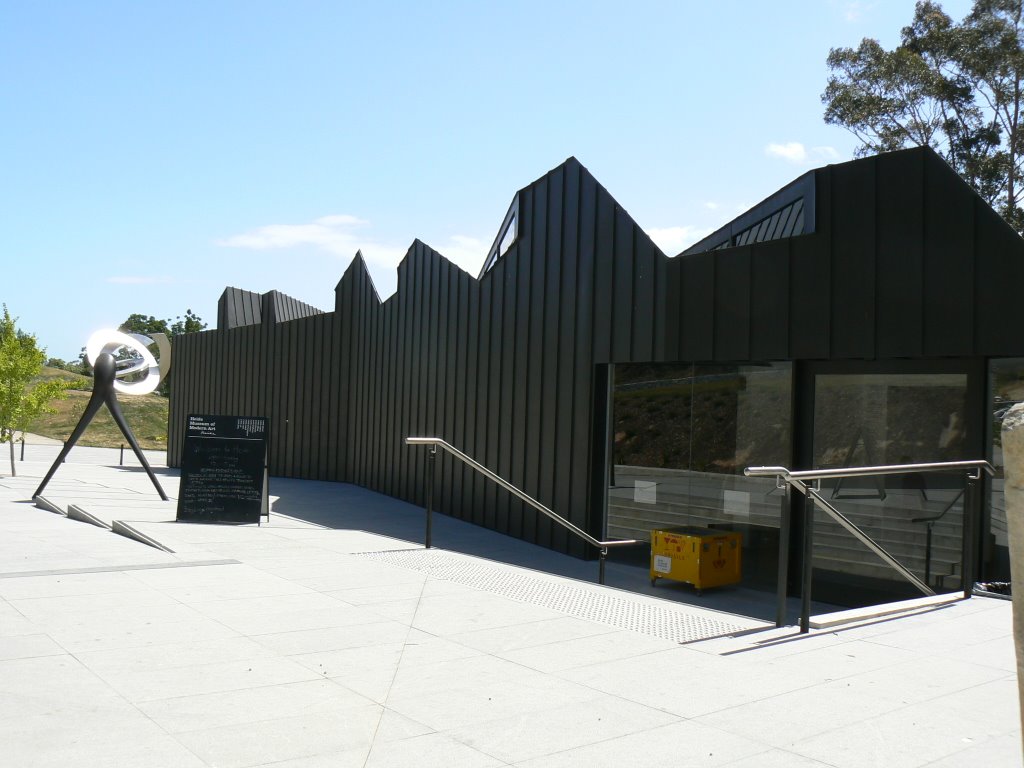
There is also a cafe on the grounds - part marquee, with a public convenience beside it. It serves trendy cafe cusine, its token to the Reeds the use of bone-handled knives and apostle teaspoons. But Sunday would shudder at all the meat on the menu. Oh dear.
For several hours I wandered the grounds and buildings, seeking something, anything that would meet my memory. Despite the carefully-kept gardens and the happy parties picnicking in the parklike grounds, I found a souless place - a grotesque theme park of modernist art. The only moment of ease, undestroyed by the Melbourne art machine, was the meandering bend of the Yarra River down in the wild native groves at the end of the property.
To me, the Heide empire is a travesty. It has lost its spirit, the sense of the human and creative vibrancy. It is now just a place.
And I have to wonder by what misguided agenda was Angry Penguins excluded from its history? It was so important at the time, so vital to the emergent arts and ideas. It was one of the significant ingredients of Heide and the birth of modernism in Australia.
They display Nolan's cover for famous Ern Malley edition of Angry Penguins in the gallery - but they do not mention its provenance. Its role with the most infamous journal in Australian history has been censored out. It is just a picture.
So, I suppose I could also say there is a streak of dishonesty in the place.
I will cherish my memories of Heide - but I shall never return.
art
australia
censorship
heide
Thursday, November 23, 2006
A Fox version of Jon Stewart?
"Fox News is always looking for new cutting-edge programming ideas," said Bill Shine, senior vice president, programming at Fox News.
How cutting-edge can they get? Fox is planning a copycat but right wing version of the Jon Stewart "Daily Show".
My jaw drops, so impressed am I with this wild and ground-breaking Foxian concept, not to mention an executive who is impressed by emulation.
Of course it has taken many years for Fox to come up with this idea. Stewart is now an American institution. But, hey, who's counting? The idea is new and now.
They are going to have anchors on a mock news show, just like Jon Stewart and Stephen Colbert. And they will have on-the-street interviews. Er, like Jay Leno?
How many edges can these guys cut?
Clever little Republican possums that they are.
Of course, right wing satire has had a short and inglorious history.
The reason there are so few right wing humour shows is that the right simply is not funny and cannot be funny. Its idea of satire is attack. The right does not laugh. It hates.
So this program is doomed from the start.
The only funny thing about it is the idea that Fox thinks it can be funny.
Fox
Jon Stewart
political satire
How cutting-edge can they get? Fox is planning a copycat but right wing version of the Jon Stewart "Daily Show".
My jaw drops, so impressed am I with this wild and ground-breaking Foxian concept, not to mention an executive who is impressed by emulation.
Of course it has taken many years for Fox to come up with this idea. Stewart is now an American institution. But, hey, who's counting? The idea is new and now.
They are going to have anchors on a mock news show, just like Jon Stewart and Stephen Colbert. And they will have on-the-street interviews. Er, like Jay Leno?
How many edges can these guys cut?
Clever little Republican possums that they are.
Of course, right wing satire has had a short and inglorious history.
The reason there are so few right wing humour shows is that the right simply is not funny and cannot be funny. Its idea of satire is attack. The right does not laugh. It hates.
So this program is doomed from the start.
The only funny thing about it is the idea that Fox thinks it can be funny.
Fox
Jon Stewart
political satire
Wednesday, November 22, 2006
US cops a bad rap

More than half 20,011 internationals polled have claimed that America is the most inhospitable country when it comes to passing through immigration, says today's Reuter's report.
That's a pretty tough call - and not altogether fair, I think.
Immigration is a strict business all over the world. Try popping in to Indonesia or England. It is not a barrel of laughs anywhere.
The thing that is wrong with US immigrationn is the volume of people passing through - the terrible queues, often policed by officious martinets in uniforms who snap at the hapless, exhausted travellers telling them to get behind this line or this rope or, in some cases, telling them something completely incomprehensible but definitely not friendly - for it is possible to come across airport officials who don't seem to speak the language.
However, while the queues are hell, it has been my experience that the immigration officials themselves are simply professionals doing their job. The other view of those immense queues is from their side of the process - a stream of zombie-like faces and god knows what paperwork plus endless computer checking. What a wild diversity of people front up to them day in and day out. Talk about a stress job.
And, while I recall some ghastly waits in the queues of LA or San Francisco, I cannot cite a single official who has not been courteous in our encounters - most of them always bidding me a welcome to the US when they have finished processing me.
So I think this report is a nothing but a gratuitous bad rap.
What the hell do these complaining travellers expect? A bloody red carpet?
immigration
air travel
USA
That's a pretty tough call - and not altogether fair, I think.
Immigration is a strict business all over the world. Try popping in to Indonesia or England. It is not a barrel of laughs anywhere.
The thing that is wrong with US immigrationn is the volume of people passing through - the terrible queues, often policed by officious martinets in uniforms who snap at the hapless, exhausted travellers telling them to get behind this line or this rope or, in some cases, telling them something completely incomprehensible but definitely not friendly - for it is possible to come across airport officials who don't seem to speak the language.
However, while the queues are hell, it has been my experience that the immigration officials themselves are simply professionals doing their job. The other view of those immense queues is from their side of the process - a stream of zombie-like faces and god knows what paperwork plus endless computer checking. What a wild diversity of people front up to them day in and day out. Talk about a stress job.
And, while I recall some ghastly waits in the queues of LA or San Francisco, I cannot cite a single official who has not been courteous in our encounters - most of them always bidding me a welcome to the US when they have finished processing me.
So I think this report is a nothing but a gratuitous bad rap.
What the hell do these complaining travellers expect? A bloody red carpet?
immigration
air travel
USA
Subscribe to:
Posts (Atom)