A passing mention in "The Australian" identifies James Packer, newly-inherited richest man in Australia and head of a media and gaming conglomerate, as a scientologist.
I must say I was gob-smacked.
There is much one could say about this - but I have written about Scientology in the past and the repercussions from the scientologists were pretty nasty. They were aggressive and persistent. A bit on the bully-boy side, my experience showed.
So one leaves them alone, feels contempt for the pitiful pea brain of Tom Cruise - and one wonders about how much influence this sect may exert on our country through its hold on James Packer who might be the richest man on the block, but was never the sharpest knife in the drawer.
The Packers control a huge gambling empire - so one wonders how gambling and sceintology go together. I did a Google and found a mention of "clam casinos" which apparently are where scientologists gamble. This indicates that profits from gambling must suit their cause - and the connection with the Packer empire might suit them very well indeed.
This is only speculative, of course. But I think it is probably something Australia should know and ponder.
Thursday, December 29, 2005


Tuesday, December 27, 2005
All hail Ricky Gervais
Ricky Gervais IS new comedy. If we are lucky, every era produces some ground-breaking new comic form. The Goons. That Was The Week That Was. Monty Python. Fawlty Towers. Absolutely Fabulous.
They all left strong influences on the culture of comedy.
Ricky Gervais is the "now" comedy of this comic history timeline - with series that will live on in timeless reruns. I just watched his new series, Extras, and I ache from all the laughter. It is as funny as The Office - no, funnier. Ineptitude, eccentricity, the little man at large...
So long as the Brits keep breeding original comics, the world is alive and well.
They all left strong influences on the culture of comedy.
Ricky Gervais is the "now" comedy of this comic history timeline - with series that will live on in timeless reruns. I just watched his new series, Extras, and I ache from all the laughter. It is as funny as The Office - no, funnier. Ineptitude, eccentricity, the little man at large...
So long as the Brits keep breeding original comics, the world is alive and well.
Sunday, December 11, 2005
Tourist hell
Once they said it was the Americans. Those in the know in Europe always said it was the Germans. But I am starting to think that the Singaporeans have become the worst tourists in the world today.
Certainly this was the impression of an entire boatload of people this week, cruising the fragile Coorong ecosystem in South Australia.
The first sign was when the boat had to wait at dock and delay departure. The busload of Singaporeans was late because, reported the bus driver, they had made an en route loo stop and the Singaporeans had just gone off and taken their time re-boarding the bus.
When their bus pulled in to the dock, the Singaporeans scattered again and had to be rounded up. One small boy spotted a pair of ducks grazing on the grass and charged at them, waving his arms and screaming. We all called out to leave the ducks alone, but he made repeated charges until they had made a series of defensive flights to the edge of the dock. A grey-haired man looked as if he was coming after the boy and we thought, "oh, good, a parent". But the man indulgently watched as the boy made a last screaming affront on the ducks and forced them to fly out into the water. The man then put his arm around the boy and they meandered amid their tour pack onto the boat. Not just one small boy but more and more...a large group of boys aged between 7 and 11.
If only they had all had IPods or gameboys! If ever children needed them, this was the time.
At the sight of this rowdy bunch, we quickly escaped to the exposed upper deck. Bad luck. Within minutes they had followed us. They shouted, wriggled, fought, yelled, jumped, wrestled...
We asked them to quieten down. They cared not a hoot, although they spoke good English. I tried a warning in Malay. They understood this, too, and were amused by it, but not impressed.
No sign of parents. Just a teenage girl who seemed to be in charge. A Singaporean nanny who took care, kept company, but did not discipline the kids.
And thus, as the parents sat comfortably downstairs with the other adults in their group, did the quiet eco journey of bird-watching become a noisy riot of stomping and screaming.
Repeatedly we told the children to hush so we could hear the guide's commentary on the locations. Repeatedly we received defiant stares or laughs.
The parents popped up once or twice to look approvingly upon their young. They were indifferent to our general misery and annoyance.
When we moored to walk across the dunes, the boys raced up the sanddunes screaming and proceeded to make landslides for the fun of it. I could only walk away at this point. Where were their parents? Oh well, I don't suppose they really understand environmental degradation. Singapore is hardly an eco site. Was this trip meant to edify the young on this issue? Or, had they thought it was some sort of a leisure cruise?
I was hoping the long trek across the sandhills to the open ocean may have tired those kids from hell. But no. They returned bouncy and noisy, the horror boy with his nose running badly. And ugly site. We turned away. "Go blow your nose," snapped Ben.
The wrestling and shouting resumed as the boat chugged quietly back upstream, pausing to look at massed swans and pelicans.
It was not until this worst of the children held a coke can over the side of the boat threatening to throw it in the protected waters of the reserve that we really exploded. "Don't even think about it". "Do not do that!" This pleased him and he threw the can in.
That was it. Four of us turned hissing with fury. "You can't throw rubbish in your country, how dare you thow it in ours," bellowed Ben.
"In your country you would get 20 lashes for that", shouted Bruce.
At last, something was said to cow that horror child. He retreated to the nanny. The others joined him and they sat in a huddle looking grim - and then, at last, they withdrew to the lower deck and their doting parents.
We had, at last, some peace on the trip - half an hour from home on a four and a half hour trip.
Certainly this was the impression of an entire boatload of people this week, cruising the fragile Coorong ecosystem in South Australia.
The first sign was when the boat had to wait at dock and delay departure. The busload of Singaporeans was late because, reported the bus driver, they had made an en route loo stop and the Singaporeans had just gone off and taken their time re-boarding the bus.
When their bus pulled in to the dock, the Singaporeans scattered again and had to be rounded up. One small boy spotted a pair of ducks grazing on the grass and charged at them, waving his arms and screaming. We all called out to leave the ducks alone, but he made repeated charges until they had made a series of defensive flights to the edge of the dock. A grey-haired man looked as if he was coming after the boy and we thought, "oh, good, a parent". But the man indulgently watched as the boy made a last screaming affront on the ducks and forced them to fly out into the water. The man then put his arm around the boy and they meandered amid their tour pack onto the boat. Not just one small boy but more and more...a large group of boys aged between 7 and 11.
If only they had all had IPods or gameboys! If ever children needed them, this was the time.
At the sight of this rowdy bunch, we quickly escaped to the exposed upper deck. Bad luck. Within minutes they had followed us. They shouted, wriggled, fought, yelled, jumped, wrestled...
We asked them to quieten down. They cared not a hoot, although they spoke good English. I tried a warning in Malay. They understood this, too, and were amused by it, but not impressed.
No sign of parents. Just a teenage girl who seemed to be in charge. A Singaporean nanny who took care, kept company, but did not discipline the kids.
And thus, as the parents sat comfortably downstairs with the other adults in their group, did the quiet eco journey of bird-watching become a noisy riot of stomping and screaming.
Repeatedly we told the children to hush so we could hear the guide's commentary on the locations. Repeatedly we received defiant stares or laughs.
The parents popped up once or twice to look approvingly upon their young. They were indifferent to our general misery and annoyance.
When we moored to walk across the dunes, the boys raced up the sanddunes screaming and proceeded to make landslides for the fun of it. I could only walk away at this point. Where were their parents? Oh well, I don't suppose they really understand environmental degradation. Singapore is hardly an eco site. Was this trip meant to edify the young on this issue? Or, had they thought it was some sort of a leisure cruise?
I was hoping the long trek across the sandhills to the open ocean may have tired those kids from hell. But no. They returned bouncy and noisy, the horror boy with his nose running badly. And ugly site. We turned away. "Go blow your nose," snapped Ben.
The wrestling and shouting resumed as the boat chugged quietly back upstream, pausing to look at massed swans and pelicans.
It was not until this worst of the children held a coke can over the side of the boat threatening to throw it in the protected waters of the reserve that we really exploded. "Don't even think about it". "Do not do that!" This pleased him and he threw the can in.
That was it. Four of us turned hissing with fury. "You can't throw rubbish in your country, how dare you thow it in ours," bellowed Ben.
"In your country you would get 20 lashes for that", shouted Bruce.
At last, something was said to cow that horror child. He retreated to the nanny. The others joined him and they sat in a huddle looking grim - and then, at last, they withdrew to the lower deck and their doting parents.
We had, at last, some peace on the trip - half an hour from home on a four and a half hour trip.
Tuesday, November 29, 2005
Workers uniting
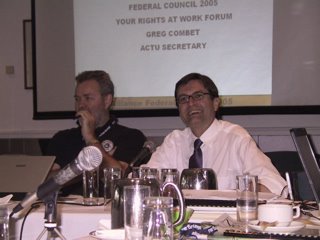
A union meets to view the prognosis for its existence under the forthcoming Workers' Legislation. It is an odd union, a merger between journalists and theatricals - the Media, Entertainment and Arts Alliance. Like all the other unions in Australia, it is in for a hard time - with most of its conventional forms of negotiation and communication about to become illegal. The Howard Government has made the move of its dreams, to disempower 150 years of worker union strength and to give employers the ability to call the tune without argument.
The ACTU secretrary, Greg Combet, a quietly-spoken and restrained man, came to give support and advice to the union's Federal gathering in Sydney.
He spoke of the ethos of unions, of why they exist, which, of course, is to defend and support the working people. He spoke of the beliefs on which unions are founded - compassion at their core.
And he noted that this new legislation would be but a blip in the great scheme of history. For, indeed, reason and fairness must prevail - eventually. But not right now.
He noted the sweet irony of how the Government's $55million advertising campaign to promote its new Workplace Legislation had resulted in a one per cent fall in its approval rating.
But he warned that things were going to be dark, dark, dark. The Government has everything in place to give power to its forthcoming rules. Even the High Court is stacked now with people of the Prime Minister's mindset.
Unions' right of entry to workplaces now becomes perilous with constraints. It will take only one cavalier union official to lose rights of entry altogether, he warned. To put it bluntly, "union activity is being criminalised".
He called for union restraint - and opposition to be only in the form of a professional campaign by which the public, which is still remarkably unaware of what is happening, is informed of their immense vulnerabilities as workers.
Employers henceforth will be able to dictate the terms of employment, the rates of pay, the hours worked, the shifts worked. They will be able to dismiss at whim - with no recourse through "unfair dismissal", if the company is under 100 strong.
Young people will be signing workplace agreements without option, or at least option of which they know. Their careers will begin at a disadvantage. And, indeed, this is all about young people - for their future is written in this legislation.
Combet left to hold a press conference - and was still at it, cornered by a gaggle of cameramen and boom mikes in the hotel foyer, when the meeting broke for lunch.
Lively and diverse with its range of talents, the union delegates talked on into the afternoon - for a second day of discussions and deliberations. Sedition reared its ugly head. It is another of the Howard Government's forms of suppression - raised in the name of the War Against Terrorism. It seeks to censor written word and, well, any manner of things it may choose to define as inciteful - a union meeting, for example. Once such laws are in place, they may go as far as the whim of those in power.
It is a sad and difficult time to be in a union - but we must have fortitude because once the people clue up, they will seek change. And perhaps, in a perverse way, this appalling legislation will shock the country out of its years of apathy - the years which have allowed this Government to have its way for so long.
Until then, we shall maintain the rage.
Saturday, November 26, 2005
Creationists evolving
A colleague wrote a column critical of creationists. He was spammed by streams of primitive vitriol - most ubiquitously containing the accusation of "idiot". He was shocked by the spiteful vehemence of the mail, more abusive than articulate. But such are the creationists, it seems.
We might not find them very educated or articulate - but one has to acknowledge that they are organised and outspoken. Their campaign is a serious attack on science and education and it is succeeding - so much so that it has, in the USA epicentre of creationism, managed to intimidate respectable corporations.
Hence, the disturbing report that the historic Darwin exhibition is unable to find sponsors in the US.
From the SMH: The failure of American companies to back the exhibition reflects the growing influence of fundamentalist Christians, who are among President George Bush's most vocal supporters, in all walks of life in the US.
While the Darwin exhibition, which features a live Galapagos tortoise, has been unable to find a business backer, the Creationist Museum near Cincinnati, Ohio, which takes literally the Bible's account of creation, has recently raised $7 million in donations.
We might not find them very educated or articulate - but one has to acknowledge that they are organised and outspoken. Their campaign is a serious attack on science and education and it is succeeding - so much so that it has, in the USA epicentre of creationism, managed to intimidate respectable corporations.
Hence, the disturbing report that the historic Darwin exhibition is unable to find sponsors in the US.
From the SMH: The failure of American companies to back the exhibition reflects the growing influence of fundamentalist Christians, who are among President George Bush's most vocal supporters, in all walks of life in the US.
While the Darwin exhibition, which features a live Galapagos tortoise, has been unable to find a business backer, the Creationist Museum near Cincinnati, Ohio, which takes literally the Bible's account of creation, has recently raised $7 million in donations.
Saturday, November 19, 2005
Pondering economic rationalism
Economic rationalism mystifies me. There is no such thing as "enough" for the corporations of today. Shareholders always want more and every era of management has to seek elevation and reward by generating greater profits than the one before - and the year before. Logically, success has to plateau at some time. But that is not acceptable. If the success rates cannot grow any more, then cost cuts must be made to ensure that the graph can keep rising. And so the functioning of the workplace keeps eroding. The golden creature rots from within to keep the shareholders happy. I just don't get it.
Thursday, November 17, 2005
Fun with Rumsfeld
So the old Rummy is in town - to talk defence with other heavyweight warmongers.
We are just so thrilled in gentle Adelaide. So much so that we have cancelled all police leave and put our sweet city into lockdown. Streets are blocked all over the place. People have been told "don't come to town unless you have business there". Great for the economy. But we comfort ourselves that at least we are being protected from Rumsfeld, which is very thoughtful of our City Fathers. Talking of which, the Town Hall is in lockdown - and even the Mayor is not allowed in. He is performing his duties in a cafe!
Protesters have been out by the thousands, of course. They have business in the city. Protesting.
It has been reassuring to note that Rumsfeld takes all this gravity in his stride. Having arrived on his super jumbo with a massive security entourage and been delivered to the lockdown, security surrounded Hyatt at high speed through sequenced green lights in the midst of his bigger-than-Ben-Hur motorcade, he donned his shorty shorts, grabbed a racquet and went off with a handful of mates on foot across the parklands - to play squash! And all that security is guarding no-one! The city is in lockdown for a man playing squash.
We are just so thrilled in gentle Adelaide. So much so that we have cancelled all police leave and put our sweet city into lockdown. Streets are blocked all over the place. People have been told "don't come to town unless you have business there". Great for the economy. But we comfort ourselves that at least we are being protected from Rumsfeld, which is very thoughtful of our City Fathers. Talking of which, the Town Hall is in lockdown - and even the Mayor is not allowed in. He is performing his duties in a cafe!
Protesters have been out by the thousands, of course. They have business in the city. Protesting.
It has been reassuring to note that Rumsfeld takes all this gravity in his stride. Having arrived on his super jumbo with a massive security entourage and been delivered to the lockdown, security surrounded Hyatt at high speed through sequenced green lights in the midst of his bigger-than-Ben-Hur motorcade, he donned his shorty shorts, grabbed a racquet and went off with a handful of mates on foot across the parklands - to play squash! And all that security is guarding no-one! The city is in lockdown for a man playing squash.
Sunday, November 13, 2005
Bill O'Reilly - the ultimate boor
As if there is not enough to get grumpy about in this world, that vulgar loudmouth has inveigled his way into the headlines again with the most crass opinions about San Francisco, a city which he seems to find expendable. So much so that he seems to want the city to be attacked my terrorists. Why, I wonder? Do the free-thinking, multicultural inhabitants offend his bilious bigotry? The mission is on to Google Bomb him as a terrorist sympathiser - which is not a bad idea, albeit that it gives the redneck ego yet more attention. The comfort is that he is, at last, being left behind the times. Americans are turning against his bellowing form of patriotic jingoism. He is becoming a has-been - and the sooner he is fully reviled, the better, in my gentle opinion.
Sunday, November 06, 2005
Reform redux
Howard's Industrial "Reforms" have made me almost too angry to blog. It's the old "reform" trick again, that mutiliated word which brings evil tidings and regression. It is frightening to realise just how vulnerable this workers' legislation will make the workers. It de-powers the unions, of course. People continue to re-join their unions in a panic. But it is really too late. The tiger has been de-fanged. And the thing which annoys me most of all is that so very, very many of the people now bleating about the employer-takes-all attitude of John Howard are the idiots who voted him in.
Tuesday, October 25, 2005
ET Phone home
Cellphones - the blessed curse or the cursed blessing. We love to hate them and we absolutely depend upon them. But they have produced some extreme behaviour - and as this article suggests, they have emerged as some sort of post-air flight epidemic. The moment a plane touches down, everyone is on the phone. Well, almost everyone.
One notices that in airports people can't stay off their phones. Mainly the conversations go: "Where are you? I'm at the airport."
Perchance a lot of people are just walking around with their phones to their ears and no one on the other end, simply because they feel more secure looking as if they are popular on the phone. For that is what it is all about. People don't NEED to make the phone calls they make from public places. They make the calls because they are afraid of being seen alone. They are afraid people will think they are alone. If they are on the phone, they are not alone. It is the fear of abandonment - the stigma of solitude. Just as people are now afraid of silence, they also are afraid of solitude.
It's rather sad, really.
One notices that in airports people can't stay off their phones. Mainly the conversations go: "Where are you? I'm at the airport."
Perchance a lot of people are just walking around with their phones to their ears and no one on the other end, simply because they feel more secure looking as if they are popular on the phone. For that is what it is all about. People don't NEED to make the phone calls they make from public places. They make the calls because they are afraid of being seen alone. They are afraid people will think they are alone. If they are on the phone, they are not alone. It is the fear of abandonment - the stigma of solitude. Just as people are now afraid of silence, they also are afraid of solitude.
It's rather sad, really.
Les
My friend, Les Nayda, had a stroke a few weeks ago. He was up in central Australia where lay on the floor for some days before he was found, I was told. It sounded very bad. He was brought down to Adelaide for treatment. I sent him a card saying that I knew he would recover because he was Les and he had surmounted worse obstacles in this life. Yesterday my cellphone rang and it was Les. The old Les with just a bit of a slur. And, oh yes, he is recovering, for the fire was there in his belly - that wonderful, irrepressible fire. A beautiful, fierce, optimistic fire.
Les is an Aboriginal man. He was one of the "Stolen Generation" because his skin was light. He was taken from his mother and sent to a Church of England boys' home whence he was adopted by a white family who loved him dearly. He was given a good education. He grew up and married a white woman. But in his heart, he was a black man. A black man who mourned what had been taken from him, but returned the love of the white people who loved him. It was not their fault, that appalling governmental paternalism which assumed that "half-caste" Aboriginal children should be absorbed into white society. "Assimilation", they used to call it.
Les went on to make a success of his life. He was an Aboriginal activist with a gift for connecting with white society. Such an unusual firebrand was he that the enlightened Leftist government of the 70s put him where he belonged, working with and for the government on Aboriginal issues. He rose in the ranks and, by the time I met him in the 80s, he was running a vital Aboriginal affairs department and initiating bold and orginal schemes to help young Aboriginal offenders and dispatching wholistic counsellors to support the stoic "Aunties" of the Aboriginal world to cope with the weight they bear as the true carers, the ones at whom the buck stops in Aboriginal society. They are the strength of Aboriginal community who try to cope with the drunkenness, crime, petrol sniffing and deaths-in-custody, try to steer the young to another path... Les understood that, of all people, the "Aunties" must be kept strong. Many people looked askance at what they perceived as very "alternative" thinking. But Les got on with it, swearing and endlessly calling us in the media to help him keep the show on the road.
Governments change and bureaucrats jostle for elevation. Les could see it happening as they elbowed him sideways and then, crudely, out of his job. He had been decorated with a high Australia Day honour for his achievements - but the new powers-that-be were disinterested. Les put up a fight, and lost. He was devastated. He got cancer - and there was another fight. This one he won.
Meanwhile, something odd had happened. He had been overcome with an urge to paint. He had never painted and he did not know how. As a cross-cultural man, he took up chopsticks as his art tool, along with acrylic paints and board. And he did astonishing dot paintings. "Black Man with Chakras" comes to mind. And suddenly he was quite a good artist - exhibiting and selling his work.
Then he decided to move north. His marriage was all over. He had found a new woman and she worked in Alice Springs. He would return to his roots. And, up there, still ringing media and agitating for Aboriginal causes, he set up his new life - until the stroke.
Now, only weeks later, still working at physical co-ordination, he is back on the phone to his media mates, telling us how it is, what is wrong and what we have got to do to fix it. The solution is, says Les, to take Les on as a newspaper columnist - since, let's face it, we've never had an Aboriginal columnist.
You know, it's a great idea.
If only I could make it happen.
Les is an Aboriginal man. He was one of the "Stolen Generation" because his skin was light. He was taken from his mother and sent to a Church of England boys' home whence he was adopted by a white family who loved him dearly. He was given a good education. He grew up and married a white woman. But in his heart, he was a black man. A black man who mourned what had been taken from him, but returned the love of the white people who loved him. It was not their fault, that appalling governmental paternalism which assumed that "half-caste" Aboriginal children should be absorbed into white society. "Assimilation", they used to call it.
Les went on to make a success of his life. He was an Aboriginal activist with a gift for connecting with white society. Such an unusual firebrand was he that the enlightened Leftist government of the 70s put him where he belonged, working with and for the government on Aboriginal issues. He rose in the ranks and, by the time I met him in the 80s, he was running a vital Aboriginal affairs department and initiating bold and orginal schemes to help young Aboriginal offenders and dispatching wholistic counsellors to support the stoic "Aunties" of the Aboriginal world to cope with the weight they bear as the true carers, the ones at whom the buck stops in Aboriginal society. They are the strength of Aboriginal community who try to cope with the drunkenness, crime, petrol sniffing and deaths-in-custody, try to steer the young to another path... Les understood that, of all people, the "Aunties" must be kept strong. Many people looked askance at what they perceived as very "alternative" thinking. But Les got on with it, swearing and endlessly calling us in the media to help him keep the show on the road.
Governments change and bureaucrats jostle for elevation. Les could see it happening as they elbowed him sideways and then, crudely, out of his job. He had been decorated with a high Australia Day honour for his achievements - but the new powers-that-be were disinterested. Les put up a fight, and lost. He was devastated. He got cancer - and there was another fight. This one he won.
Meanwhile, something odd had happened. He had been overcome with an urge to paint. He had never painted and he did not know how. As a cross-cultural man, he took up chopsticks as his art tool, along with acrylic paints and board. And he did astonishing dot paintings. "Black Man with Chakras" comes to mind. And suddenly he was quite a good artist - exhibiting and selling his work.
Then he decided to move north. His marriage was all over. He had found a new woman and she worked in Alice Springs. He would return to his roots. And, up there, still ringing media and agitating for Aboriginal causes, he set up his new life - until the stroke.
Now, only weeks later, still working at physical co-ordination, he is back on the phone to his media mates, telling us how it is, what is wrong and what we have got to do to fix it. The solution is, says Les, to take Les on as a newspaper columnist - since, let's face it, we've never had an Aboriginal columnist.
You know, it's a great idea.
If only I could make it happen.
Wednesday, October 19, 2005
Bird Flu stew
There has not been a global pandemic flu since the Spanish flu of 1918 and yet we are all in a state of abject fear about the bird flu of 2005. It is difficult not to be infected by the fear factor of it all as governments withdraw the stocks of flu fighting drugs and even face masks for their own defences - leaving the hapless public to their own fates. This sudden division, the sense of rightness of authority in denying the people supplies of defences, is the way in which to whip up fear. Make the little people feel vulnerable. Show them where the power is. Look, little people, you can just get sick and die. We will keep the show on the road with the drugs and masks while you are dying.
It is the stuff of science fiction writers.
There have been other flu epidemics. Asian flu was nasty in the late 50s. The Hong Kong flu in the late 60s. Then there was SARS which seemed to be contained. But oh what a panic governments and media made of that one. There was a run on face masks and they became impossible to buy.
One could be cynical enough to think that mask manufacturers or drug manufacturers whipped up such scares for a bit of profit - as wars are generated for weapons manufacturers, many believe.
I am quite sure that the Bird Flu is out there among birds, just as cat flu is out there among cats, and cat AIDS which is not the same as our AIDS. Then there is Ebola which is the scariest thing of all.
Then again, influenza generally is the biggest of all killers - and the 1918 pandemic was a recor-breaker. Maybe 50 million people died.
Today it is easier to spread disease with the little germ tubes of international air travel. I have never escaped from a long-distance flight uninfected - a nasty upper respiratory tract infection after every major trip. Air travel is sickness travel.
So, if they are going to get the flu shots going,(and they are working like fury on getting them ready, testing now and maybe results by December) they should begin my innoculating every air traveller and move on into the general community from there. Not looking after politicians and the military. They need to go to the points of infection.
But of course that would not work for the power play of politics. Like terrorism, the Bird Flu is another way to make the populace afraid and vulnerable.
We are discriminated against. We are depowered. We are shown who is boss.
Oh yes, there is more to this media campaign than Bird Flu.
It is the stuff of science fiction writers.
There have been other flu epidemics. Asian flu was nasty in the late 50s. The Hong Kong flu in the late 60s. Then there was SARS which seemed to be contained. But oh what a panic governments and media made of that one. There was a run on face masks and they became impossible to buy.
One could be cynical enough to think that mask manufacturers or drug manufacturers whipped up such scares for a bit of profit - as wars are generated for weapons manufacturers, many believe.
I am quite sure that the Bird Flu is out there among birds, just as cat flu is out there among cats, and cat AIDS which is not the same as our AIDS. Then there is Ebola which is the scariest thing of all.
Then again, influenza generally is the biggest of all killers - and the 1918 pandemic was a recor-breaker. Maybe 50 million people died.
Today it is easier to spread disease with the little germ tubes of international air travel. I have never escaped from a long-distance flight uninfected - a nasty upper respiratory tract infection after every major trip. Air travel is sickness travel.
So, if they are going to get the flu shots going,(and they are working like fury on getting them ready, testing now and maybe results by December) they should begin my innoculating every air traveller and move on into the general community from there. Not looking after politicians and the military. They need to go to the points of infection.
But of course that would not work for the power play of politics. Like terrorism, the Bird Flu is another way to make the populace afraid and vulnerable.
We are discriminated against. We are depowered. We are shown who is boss.
Oh yes, there is more to this media campaign than Bird Flu.
Tuesday, October 18, 2005
Moving blues
The horrors of house moving dwindle to serenity when one is faced with the process of moving not just an office but an entire newspaper. We move into our state-of-the-art new building on Monday. Rolling towards the Friday deadline of having all gear packed and owner-coded in uniform boxes finds newsrooms wherein the sounds of phones and keyboards are overwhelmed by the rrrripp of packing tape and the thud and whack of box-packing. The new premises is large, but desk space is smaller by far than that to which we are accustomed. It's throw-out time. How did we accumulate so much? Bins are rolled away and replaced with fresh ones throughout the day as old files are turfed, boxes and boxes of papers, press releases, note books, research... Review books and CDs, sample cosmetics and DVDs are being hauled from cupboards and set out for general grabbing. There is no room for reference books in the new office. It is supposed to be paperless. So we drag our private libraries home in bags. All will be pristing and sleek in the new building. Well, that is what the designers believe. We shall see. Journalists are untidy and busy workers - and the incoming tides of material often are overwhelming. I predict it will be only a matter of days before the new takes on a look of the old.
Wednesday, October 12, 2005
Airport to nowhere
What does one most want to do at airports?
Get out of them.
But not here in Adelaide. Oh, no. We have a new airport terminal and everyone wants to be there. It is the place for the A-List to play. It is just the "in" thing to go and hang out at the airport. Fancy dinners have been held there. Charity events. Some people brag that they have already been to the airport two or three times. This does not mean they travel. It means they are important.
I guess that means that I am a slavish follower of the "in" crowd that I accepted an invitation to the Adelaide Festival of Arts 2006 program launch at the airport. And, I admit I was curious to have a look, since everyone has been carrying on about it.
Well, guess what? It is an airport. It is a spacious, modern airport - with not very many check-in desks but masses of room for those snaking queues, which are really the fashionable thing in travel these days.
Of course everyone else also had accepted their invitation to this event - and it is a big one on the Adelaide agenda. The Festival is a singularly splendid thing and everyone is agog waiting to know what is going to be on the program.
However, this meant that there was a massive crowd at the airport. One could not move. It was cheek-to-jowl in-crowd, all clutching glasses of wine, seeing and being seen - well, as best they could in the cram.
There's no such thing as a free lunch, let alone a free launch.
So there were speeches - one after another after another. Sponsors, politicians, high arts factotums and, finally, the Festival artistic director revealing all with powerpoint on giant screen. The cost of this for the hapless "in" crowd was standing on the hard stone floor for two solid hours. It's an airport. The seats are in departure - not in the massive check-in foyer. Many of the social dainties were in their best stilettos. Even those of us in sturdy sneakers felt the pain. In fact I was feeling it a day later. It was a tough stand.
But, hey, we now can say we have been to the airport. And gone nowhere.
Get out of them.
But not here in Adelaide. Oh, no. We have a new airport terminal and everyone wants to be there. It is the place for the A-List to play. It is just the "in" thing to go and hang out at the airport. Fancy dinners have been held there. Charity events. Some people brag that they have already been to the airport two or three times. This does not mean they travel. It means they are important.
I guess that means that I am a slavish follower of the "in" crowd that I accepted an invitation to the Adelaide Festival of Arts 2006 program launch at the airport. And, I admit I was curious to have a look, since everyone has been carrying on about it.
Well, guess what? It is an airport. It is a spacious, modern airport - with not very many check-in desks but masses of room for those snaking queues, which are really the fashionable thing in travel these days.
Of course everyone else also had accepted their invitation to this event - and it is a big one on the Adelaide agenda. The Festival is a singularly splendid thing and everyone is agog waiting to know what is going to be on the program.
However, this meant that there was a massive crowd at the airport. One could not move. It was cheek-to-jowl in-crowd, all clutching glasses of wine, seeing and being seen - well, as best they could in the cram.
There's no such thing as a free lunch, let alone a free launch.
So there were speeches - one after another after another. Sponsors, politicians, high arts factotums and, finally, the Festival artistic director revealing all with powerpoint on giant screen. The cost of this for the hapless "in" crowd was standing on the hard stone floor for two solid hours. It's an airport. The seats are in departure - not in the massive check-in foyer. Many of the social dainties were in their best stilettos. Even those of us in sturdy sneakers felt the pain. In fact I was feeling it a day later. It was a tough stand.
But, hey, we now can say we have been to the airport. And gone nowhere.
Subscribe to:
Posts (Atom)