Monday, July 31, 2006

At the Lowell Folk Festival


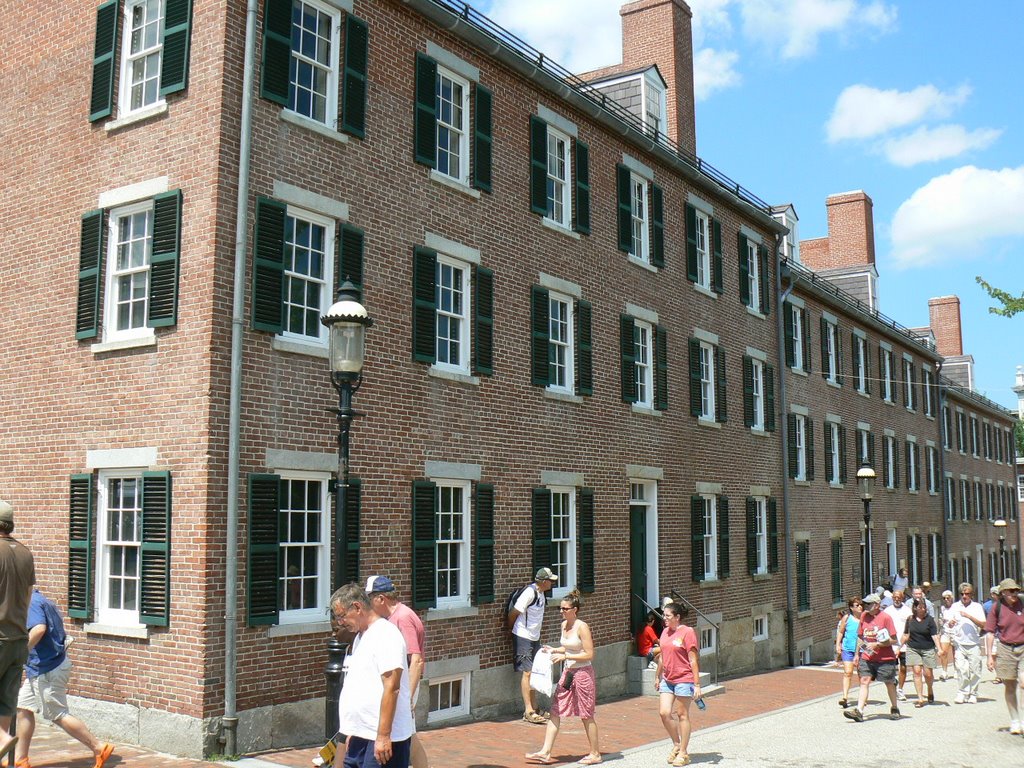
I love Lowell. It's a once grimy old cotton mill town which has dragged itself up by the bootstraps to become one of Massachusetts' most interesting tourist towns. It has added to museums and cotton industrial revolution tours, a series of festivals - most interestingly, one celebrating its most famous former resident, beat poet Jack Kerouak, and another simply the great American tradition of folk music. It was the 20th Lowell Folk Festival we attended this weekend - albeit in somewhat melting heat. This festival is big and it is free. The town closes its old flower-adorned cobbled streets and sets up stages, avenues of craft exhibitions and art shows, arrays of food vendors, a street of old-fashioned games for children, another for shops to set up bargain stalls and community groups to showcase their activities.

Sounds of music meet one wherever in the town one wanders - music Mexican, Greek, Polish, Indian, Native American, Cajun, Blues, brass - and multicultural Americana at large wanders along with one. People soup at its best.


There were power mums with high-tech uber strollers complete with cup-holders for baby bottles. Lots of them children, adored children. There is nothing wrong with the birthrate. There were rambling, extended families with dads carrying young on their shoulders. There were bare-chested, tattooed young tough guys with their jeans worn low over exposed bands of underwear - a particularly absurd fashion. But they were probably the only folk festival attendees who are worried about fashion. In the American heat, anything goes. The fatter the body, the more inappropriately skimpy the attire. I suppose that after one gets to a certain obesity, one stops checking oneself in the mirror and therefore has no idea of how appalling a tanktop and shorts looks on a 300lb figure.

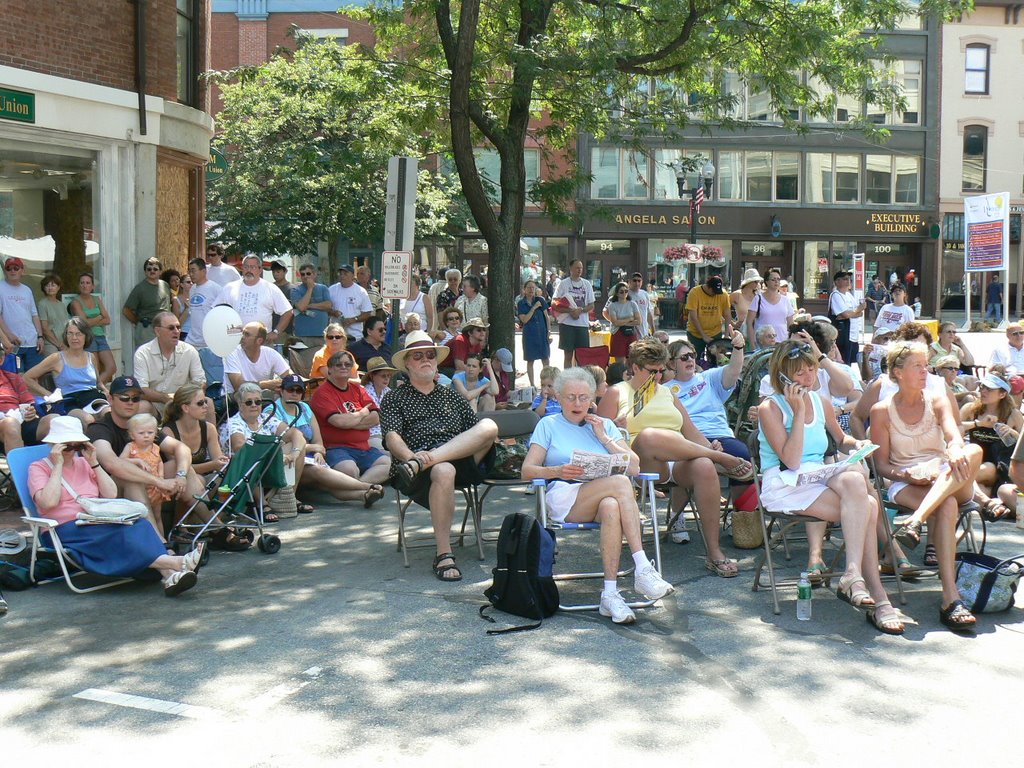
As Bruce and I sat in chairs that we and a lot of others had moved from the unbearable full sun stage area to the shade of trees to listen to the Paisley brothers and their North Virginia bluegrass, I watched the passing parade with avid fascination. I was awash with the American experience, the nasal Appalachian singing, the sparkling banjo and the dazzle of folk fiddles - accompanied by strolling stream of people seeming to represent almost every possible aspect of American society. Therein, one cannot miss the tragic fatties - for they are as ubiquitous as they are immense. Often they are shamelessly fuelling up as they walk, carrying bowls of french fries or slabs of sugary fried dough. They were too huge to sit down on the frail little concert chairs so they headed for city benchs. Unsurprisingly, one sees more and more of these morbidly obese Americans riding disabled scooters.


Of course, there were myriad other hues of the cultural rainbow among the people. As at most every cultural event held anywhere, there was a strong showing of "women of a certain age" - women over 50. These are the most undervalued power of society, the great civilized and civilizing core of consumers. They exude a certain "niceness" and tend to move in small, congenial groups. We sat among a group for some time, me eavesdropping as, eagerly, they chose which acts they would see in what order and why. These middle class women, perhaps a little on the plump side, also wear shorts and t-shirts, but with belts and crisp pleats. Among them sometimes were yet older women, seniors, also in shorts. One cannot imagine grannies in shorts in Australia, but shorts are de rigueur in the US. Only the teens eschew them. They like skirts - some absurd mini skirts with flimsy halter tops, some in rather long retro frocks. Teens care about looks more than comfort.
Then, in the always moving crowd of festival goers, there were the dregs - sad waifs and strays who also have a place at a free event. Some were decidedly strange-looking. I noticed a cadaverously thin, tall African girl with a rickety, rocking gait. Some gaunt and prematurely-aged urban druggies. An odd, scraggled-haired and towering madman in a loud Hawaiin shirt. A well-dressed but obviously simple-minded man who could not stop dancing to the music, despite the oppressive heat. Then there was a seemingly quadraplegic, one-legged man simply parked in an extended wheelchair all alone under a tree, watching the world go by. How sad. Was he a relic from Iraq, I wondered. Where were his people? Such are the mysteries of other people. Everyone has a story and one yearns to be a fly on the wall of their lives - just for a moment or two.
Naturally, the American societal hues also embraced the full gamut of the diversity of ethnicity - albeit that I did not see any evidence of Islamic women. But there was plenty of evidence of blended families, always a sign of a peaceful and tolerant community.
And common across the boggling spectacle of humanity in extremis drawn together by the joy of music, there was a convivial spirit. Faces smiled and feet tapped, responding to the magic that is music, the universal language. And we, I suppose, slotted in somewhere in the cultural middle ground, just another couple strolling, smiling, looking, listening, sweating in the heat, and basking in the pleasure of the event.


Saturday, July 29, 2006

Living larger.

The tour boat that capsized drowning 20 elderly tourists in upstate New York last year turned out to be licensed to carry 50 people and had only 48 on board. And yet one of the reasons that it capsized was that it was grotesquely overloaded. It seems that things have changed since the 1960s when they measured average weights of people and applied them to estimates of passenger limits. Today's bodies are much, much heavier - the young are taller and most everyone is fatter, often to the degree of obesity. The capacity estimates now are outdated and dangerously wrong - by an average 25 lbs per person. Something we need to bear in mind when we step into an elevator!


Wednesday, July 26, 2006

Boston's Big Dig debacle

Poor Boston. What a grotesque tale of modern values has beset the city. The Big Dig, the epic work of urban engineering which was to lead the world and liberate the city in streamlining high-density traffic management has turned out to be a humiliating nightmare of rorts and shortcuts. It was such an exciting venture, the biggest of its kind in the world, which would transform the city, removing the "Green Monster" of ugly elevated roads which slashed through the city, turning tenements into prime real estate and liberating waste land to parks for the people. I remember going to the Big Dig's display seven years ago when the venture was the pride of the city, marvelling at the sophisticated way in which the harbour mud would be removed to make new traffic tunnels... In ensuing years we have ventured into the city always wary of the delays which have blighted Bostonians as they waited for the venture to be completed. Closed roads, construction sites, detours, jams of crawling cars... But it would all be worth it in the end. Now the end has come and it is closed roads, construction sites, detours and jams of crawling cars. Why? Because contractors took shortcuts, because everyone has to cut a corner and save money. So now, bolts suspending tunnel roofs have not been properly secured and not tested at all. Because a hapless woman was killed when a chunk of concrete ceiling fell on her car. Because even the great jet fans which keep the air clean on the tunnel ramps may not be safely suspended. Big Dig tunnels are closed indefinitely. Cheap bolt and epoxy fasteners are blamed - and a lack of safety checking. A lack of safety checking! Apparently it would have been expensive to check. So checks were not made. It would have required taking down ceiling panels to check the safety of their bolts. The contractors did not want to do that. Everyone was trying to cut costs as the price of the Big Dig blew out.
So much so that one enterprising worker actually tried to secure one of the bolts with duct tape! Perchance it was the safest bolt. Let's face it, a lot of the world is held together with duct tape.

This is the era of cost-cutting. This also is the era of people growing absurdly rich. It is the economic rationalists' path to success - success being wealth and a personal goal which abnegates altruism or public interest.
Boston is now in the middle of a desperate blame game in which lawyers will be the only winners.


Monday, July 17, 2006

American perils

Australians grow used to it - the constant association of our country with dangerous creatures. Whenever we travel we are asked, with varying degrees of incredulity, how on earth we manage to live with our lethal wildlife. Well, it does not worry us too much. It is really not so bad. Its reputation is worse than its reality.
Unlike the USA.
Nobody ever goes on about how dangerous things are in the US in terms of wildlife. Well, we hear the odd story of bears or rattlesnakes. But America has established itself as a highly urbanised nation in which the main perils are fellow man.
I won't argue the fellow man thing - but I think it is time we stopped letting the Americans cringe and carry on about our dangerous creatures by reminding them of the beasties which lurk all around them all the time.
Now, we've seen hornets in the cartoons and movies. They are wasps. But not the only wasps to be found here. Since I have been here in north Georgia, I've heard assorted tales of people being stung by wasps and hornets. One of my in-law family arrived zonked on antihistamines after disturbing a hornet nest under his toolbox. He had suffered at least 12 stings - having to run from a chase of the swarming furies. Then there was the gardener. We wondered why a can of WD40 and the garden shears were just lying in a garden bed. The explanation came that he had disturbed some red wasps and, suffering multiple stings, had run off without a backward glance.
Then there are the ticks which inhabit these parts. There are different sorts of ticks which carry different diseases, clever little things. They hang around in some sort of tick torpor until some hapless man or beast stumbles by and then they drop onto them and crawl to a good spot where they can suck the blood until they are fat and full. Beware walking in the woods or in the long grass.
Then there are the chiggers or red bugs. They lurk in the grass, too. Do not kneel or lie on the lawn. Do not walk in the wild grass. These tiny things embed themselves in your skin where they feed and live until they die - leaving you with huge, red, itching welts.
Nasty, nasty, nasty.
Give me a redback spider any day.

Sunday, July 16, 2006

Bucolic in Georgia


In the Georgia night, the katydids chorus the measures of the train tracks - chacka-Cha-chacka-Cha - beating staccato rhythms from colony to colony, the sounds meeting and retreating, sometimes in one uniform pulse, sometimes in stereophonic exchanges. They have become my meditation of the night, after the darting lights of the fireflies have died away. Sometimes the crickets join the orchestra to sing the alto thread. But it is the katydids who own the humid nights out there in the great oaks and hemlocks. They are all around us, raucous and busy, calling to one another, with one another - a complex and mysterious other world going about its business.

It has been hot. It has been iced tea on the porch hot. One can envisage generations of overdressed Southern belles sighing "Oh, my, Blanche, the heat, oh, the heat". It's lolling weather, too heavy with humidity to achieve anything other than a languid pace. We move from room to room like restless cats seeking a cool piece of the floor. The heat has been building up with the ground dry and red. For days we have waited for the clouds to build, to bring relief. Today it did. As we lay about with books, too enervated to talk. The sky darkened over the northern mountains and we went outside to watch and hope. Sure enough, a drop of rain. Another. Just a few. Oh,no, don't let it pass us by. But just as we began to think our little vigil had been in vain, the thunder began to rumble and the rain began to fall. Then we were in a spectacle of torrential electrical storm - lightning strokes striking Lynch Mountain right in front of us, over and over. Great crashing explosions of thunder, trees twisting in the bursts of wind and rain cascading down and down and down. We sat in the screened porch damp with the misty spray and rode the sensations of this wild bounty - cooling down with the earth. Ah, sweet relief.

And now the harmonies of lush greens are greener yet - and the Blue Ridge Mountains are adorned with plumes of steamy mist.


Ho hum for Heide

So, Heide art museum has been given the big bucks to perpetuate its heyday of the Australian modernists. And Bert Tucker, his personal collection now contributed (thanks to Janine Burke says the self-serving Ms Burke in The Age today) and Tucker is celebrated in all his glory as an Angry Penguin. Nolan, too. Joy Hester also. I am not sure how much John Perceval has been incorporated into this display. I have not seen the show and I am on the other side of the world. But I wonder when this Melbourne push of the Heide legend may find room to include writers in their representation of the era. The intellectual catalysts. Ah, so cynically manipulated has been the history. As the Melbourne push has played it, Heide was exclusively an artists' "commune" and their exposure in print and their exposure to the public eye was pure Reed chemistry. Angry Penguins was a Melbourne creation, they seem to think. This little angry penguin knows otherwise and awaits the country's real historians to put the record straight. As it stands, poor, silly, vain old Melbourne can only admire the pictorial aspects - for, perchance, dealing with the intellectual grist which set the movement in motion would be in their cerebral too-hard basket. Nah, they can make it up as they go along.


Thursday, July 06, 2006

On patriotism and July 4


One may view American patriotism several ways. To much of the world, it seems to be a blinding insularity - and it is true, America is, in general, more interested in itself than in the rest of the world. That said, American patriotism is deeply touching and, in some ways, enviable. It goes hand-in-hand with a fierce sense of identity - the same sense of identity that irks the outside world when it struts and brags. But, it also encompasses a love for home and country which is really very sweet. And this is what strikes one most profoundly when July 4 comes along and Americans celebrate their country's birthday, the birth of Independence, the rejection of British imperialism.

American patriotism is the fiercest and most unified in the world - as so very far from the casual love of country of the Australian. Australia, after all, has experienced nothing much more than the Eureka Stockade by way of rebellion in its history and, still, lives under the token rule of the Queen of England. Even its flag is more a cause of debate than delight. It is burdened by the Union Jack - the apron string to the "Mother Country". It is not a flag which stands on its own like the Stars and Stripes, or the maple leaf of Canada or the cedar tree of Lebanon. So we don't flourish our flag as the Americans do. It is just not as handsome a flag.

My first impression of the ubiquity of flags in the USA was one of cultural cringe - very Australian. I thought it was way over the top. How come all these people bedecked their homes, clothing and cars in their national flag? Did they have to be reminded of their nationality? I made jokes about buying shares in American flag-making companies.

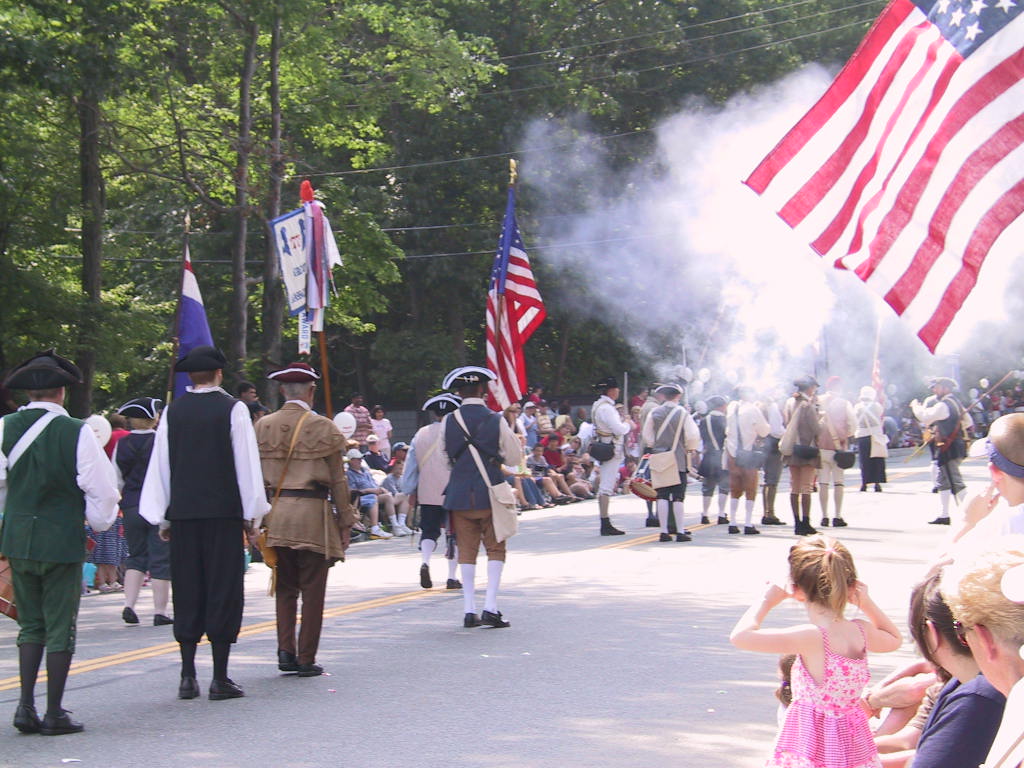
Yesterday, 11 years after those first impressions, I popped a little American flag in one of the potplants on our porch. It was July 4, after all. I had been given the flag at an Independence Day march in the New England town of Chelmsford - just a few miles down the leafy, riverside road from Nashua.


Independence Day dawned threatening storms - heavy with heat and drenched in humidity. It is a public holiday for everyone but the retail world, which celebrates with sales. Nonetheless, the roads were less jammed with cars than usual - until we entered Chelmsford where they were queuing to park anywhere/everywhere. Serendipitously (Bruce would say with scintillating brilliance) we parked by a school sportsfield whence a short walk took us to the town parade's rallying point - and we passed through the costumed locals and their assorted floats to take a place at the roadside, just as the march began. Perfect parking AND perfect timing.


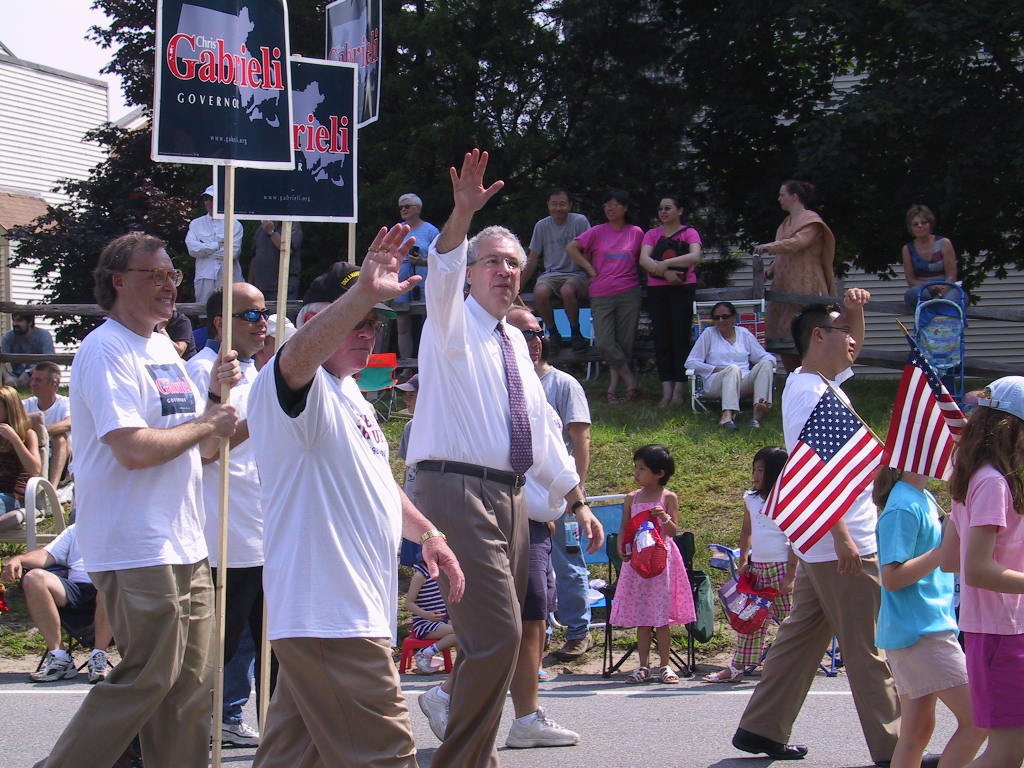
Big surprise of the march was the presence of the regional politicians. They all had floats and banner-waving teams along with people throwing candy to the children. It was the big wave and gladhand parade - for the first 15 minutes or so. Republicans and Democrats, candidates for local office and elected leaders.

The crowd was huge, stretching down the road into the tree-lined distance. People had brought chairs, their pets and one woman even had a portable playpen set up with her two toddlers in it. Most had dressed in honour of the day - Stars and Stripes on everything. Children were in red, white and blue ensembles. Many wore Statue of Liberty crowns. Everyone had flags.


The floats represented local businesses and community organisations - some more spectacular than others. Interspersed among them were trucks loaded with jubilant little boys equipped with very large water pistols. It was their job to squirt the crowd - something they did with absolutely delight. And it was wonderful. We had been standing, sweating in the cloying heat for some time. Sprays of cool water were delicious. We spread our arms and welcomed the wet. So we didn't flinch when confronted by the biggest truck, done up as a pirate ship with huge water cannons down the sides.

The pipers piped, the drummers drummed, the bands played, the girls danced and waved pennants, the vintage cars and theme floats went by along with war veterans and dance students, people stepped out in period costumes, Minute Men bore antique arms and shot blanks into the air... and the people waved their flags, clapped and cheered while the children scooped up the thrown candy until they had more than they know what to do with.

At march's end, we hummed back to Nashua and indulged in some retail therapy and lunch in the mall. Surely there could not be a more American activity on July 4.


Well, there was - for there was also the Nashua fireworks in the evening.
We parked in the main street and walked a distance to the Holman Stadium, again avoiding the parking melee. The closer we got, the more people joined our route until we were in a river of walkers. Well, they were strolling. It was an annoyingly slow pace for those of us used to stepping it out. We were astonished by the number of Hispanics around us and realised it was they who were setting the excessively languid pace. The demographic in Nashua seems to have changed. I do not remember such a large Latino representation in the past. None was speaking English - and I suddenly realised why so much Spanish signage had popped up in the retail areas and restaurants. It strikes me as odd and excessively considerate of the Americans to translate their world into Spanish and not to require their Hispanic immigrants to speak the national language. Instead, America is teaching Spanish at school. I wonder at the social wisdom of this. It strikes me that the great cultural melting pot is melting away from its traditional identity. Perchance, in a few decades time, the USA will be a Spanish-speaking nation.

An interesting phenomenon to ponder as we assembled in the stands amid the families eating hot dogs and fried dough. It was all very convivial - and very warm.
Nashua's pride, the Spartans marching band, performed very sophisticated and complex music as a prelude - and then the fireworks lit up the sky and lit up the sky and lit up the sky.
Nashua is the second-largest town in New Hampshire and it turns on a real spectacle for its people - for free. Well, the price is a bit of a sore neck, since the sky show goes on for so long. Loud and lovely.

And then it was all over - apart from the townsfolk who set off their own small skyrocket shows from their back yards, to entertain the crowds as they streamed away from the stadium. And, again, we were enclosed in a colourful river of people, together bathed in the moist warmth of the summer night.
And we were all home in time to watch the Boston July 4 fireworks on the TV. Just in case we had not had enough.

Tuesday, July 04, 2006

Big Brother blues

Big Brother in Australia is in all sorts of hot water. Two young men have been removed from the house for performing an obscene "joke" on a female housemate - something called a "turkey slap" which, according to the myriad reports around the place, is a slap in the face with a penis. After 70-odd days locked in the house with just each other for entertainment and not an awful lot of grey matter to go around, this is the depth to which immature males would seem to descend. Schoolboy willy-wagging.

There have been calls for BB to be stopped. Not just the prudes and the religious, but politicians and media pundits. Already BB's "Adults' Only" weekly show has been canned because of its lewd and tawdry content. It consisted of whatever "sexy" clips the editors could glean from the housemates' activities. The housemates, of course, play up to the expectation of the programming. "Exposure" is a primary reason these people seek to be in the house. They sell themselves in a quest for fame.

But, as the years of BB have rolled on, the calibre of people the BB producers have chosen has been steadily sinking. This year it was quite clear to me that they had gone for the lowest common denominator - a group of exeptionally vain and vapid young people whose primary achievement in life has been the body beautiful. There's the 18-year-old who has attempted to escape her profound ordinariness with breast implants, and a series of narcissistic young males with workout-sculptured bodies...with "careers" as "personal trainers".
There is a devastatingly handsome former male model who has asserted his image as a gay farmer. He seems rather more educated than the rest of them. And there is Camilla, the former nightclub "door bitch". She is the BB House irritant - and, ironically, perhaps the most interesting character. Which says little.
These, in my opinion, are not interesting people. Their massive egos insulate them from the reality that they are really not very bright at all. I doubt that any of them would dream of reading a book for pleasure.
The one thing they are proud of, apart from their bodies, is the fact that they are young. One of the dullest of this dull group has complained about everyone older than he because, he thinks, young people=fun people. He strikes one as a crashing self-obsessed bore who thinks his age makes him "fun". He showed his idea of "fun" with a lot of canoodling in bed. Fun for him, perhaps. But, oh, how boring for the audience.

This is the stereotype BB has chosen to project - and the consequences of trapping a group of such shallow self-worshippers in a house together with nothing but each other (read self) for entertainment is indeed dooming the show to tits and teeth. And a lot of appallingly bad grammar! Poor little pedestrian souls, they are not masters of the language.

The pity of it all is the Australia's BB has been an infinitely more interesting creature than its overseas counterparts. Unlike the American version, it has a real Big Brother controlling everything that happens and he ensures that there can be so such thing as alliances and power plays. This suits the Australian character since Aussies are not cut-throat competitors. They tend to like each other and bond like a family in the house. The public, which gets to phone vote people out of the house, becomes riven as the game draws to a close - because it, also, becomes fond of the surviving housemates.

BB Australia has the potential to be a brilliant reality show. But the cynical "casting" that has been imposed has lowered the cultural common denominator to that of the universal non-achiever. The assumption has been that audiences are only interested in looking at sunbronzed bodies, that audiences are as vacuous as the housemates.

I wonder what it would be like if they tried a house with some educated grownup people? Some role models - people with a future rather than the dead-enders they have inflicted on the public this year...

And pigs may fly.


Sunday, July 02, 2006

The patent monster

Economic rationalism and greed are much the same thing. And they are the downfall of the civilized world - no better exemplified than by the fate of the Broad Institute's RNAi Consortium as reported in today's Boston Globe.
The Consortium, a scientific alliance between Harvard and MIT, has been funded by drug company donations in an altruistic attempt to create specific gene-blocking molecules which may be able "to turn genetic research into real treatment for diseases".
It's a marriage of pharma dollars and science for the human good.

Laboratory scientists, in all their erudition and brilliance, may discover, evolve and invent - but they do not manufacture. More's the pity.

For when it comes to a volume production of the molecules for dispersal to the research and experiment spheres of the rest of the world, commercial interests must be involved - licenced to produce and stockpile the supplies.

Now, as the Globe reveals, there is a legal spat between a global lab supply company in St Louis and a private supply firm in Alabama - a claim on two scientific patents. The idea is that one company can shut down the other and monopolise the supply.

Says the Globe:
The suit illustrates an emerging challenge for supporters of publicly accessible medical research: Patents and intellectual property in the life sciences have grown so valuable that they are jealously guarded as potential keys to millions of dollars in revenue.

Surely, it is time for the Justice system to step in and curtail the potential for such rapacious exploitation of the future of science. This is one of those stories which fills one full of the "where-will-it-all-end" dread.


Tuesday, June 27, 2006

An Inconvenient Past


Of course it's preaching to the converted. Ever was it thus. But Al Gore keeps plugging away and the film, "An Inconvenient Truth", certainly expands the exposure of the lecture he has been taking around the USA for these many long years. That, after all, is what the film is - a lavish powerpoint presentation embellished by some backgrounding, some good close-ups and a bit of political history. Some have told me that it is a political film. Propaganda. A campaign towards another Presidential run.
This is concluded because the film shows some Gore family background and some of the lost Presidential race. But Gore is between the proverbial rock and a hard place in what he does and does not include in this film. I saw the personal backgrounding simply as context. I think it needs to be there - to explain how he came to the environmental obsession which has caused him to spend his time touring the country with his laptop under his arm, talking endlessly about global warming.
It explains that this was what he was doing before he ran against George Bush and throughout his political career.
There was not a lot I did not know in the film. Then again, I am one of the "converted". I have read "The Weather Makers", Tim Flannery's book on the subject - and, surprise, surprise, much of the scientific evidence is the same. It is the same because it is what it is. The knowledge.
Both Gore and Flannery demonstrate how relatively simple it would be to reverse the crisis and to save the planet for our children. If we could do it for the hole in the ozone layer, we can do it for the greenhouse effect.
What boggles the mind is the campaign of debunking the global warming phenomenon. The Blogsphere is riddled with vitriolic critics and the opinions of so-called scientists who question the status quo. One realises, of course, that the core of their venom lies in the source - in Gore. The Far Right is passionately invested in hating anything they perceive as a Liberal agenda. And, if Gore is proselytising an environmental crisis, then it is tree-hugging lunacy. It must be mocked and discredited. And the minds remain closed out of political spite.
This is the sad baggage Gore must carry.
And the people who are going to see the film are the ones who already care about the state of the planet and who know he is right - and politics be damned. Well, politics is the damnation.


Sunday, June 25, 2006

Travel and the chaos theory

Never was the chaos principle better demonstrated than in the crowded world of international travel. The butterfly flapped its wings in Adelaide on Friday morning when, most unusually, the airport was shrouded in thick fog. Planes were neither landing nor departing. My international connection was going down the drain quickly. But, it turns out, there were fogs in Sydney and Melbourne, too. Planes were circling airports waiting until they had to be diverted to safe havens. And the airport passengers waited and queued, asking questions, and they killed time, and gazed at the moods of the fog and the depressing departures screens. My plane was delayed for four hours, due to leave Adelaide half an hour after my international flight was due to leave Sydney.

A sense of utter helplessness. I sat and watched as, every now and then, a plane would roar in through a fog window and taxi to a gate - not my gate. My plane was not getting through. It had been diverted to Melbourne and had not yet left.
As the fog began to lift, the unflappable and helpful Qantas customer service staff found me a seat on an earlier flight. If, as they thought, the Sydney departures were delayed by two hours, I might yet make it. Little were they to know that, on landing in Sydney, our aircraft was going to have to wait on the tarmac for a queue of no less than 18 other planes to find a landing bay. Delayed flights were backed up badly. The delayed were being delayed by the delay.

I disembarked into another chaos in Sydney, to discover that my LA flight had, indeed, been delayed. By four hours! And, here was another, much bigger, airport in a state of swarming chaos. People were fretful and stressed. Again, the Qantas ground staff was besieged by travellers whose connections were in chaos. I queued for an hour to gain elucidation on my fate, chatting with a couple who had spent seven hours getting from Melbourne to Sydney and whose connection to Ho Chi Minh City was gone for ever. Angrily we watched the queue jumpers - particularly a group of Indian men who would not take no for an answer, would not join the queue and managed to occupy two of the four desk assistants for the entire hour. The desk staff was unfailingly polite - unlike the Indian men who were not only barking at the assistants but also shouting down their mobile phones at their travel agents, all the while, having one of their number deliver them coffees and cool drinks to keep them refreshed at their post. They refused to stand aside and wait, despite repeated requests from the desk staff. Our emotions in the queue were mixed. We resented these arrogant men very deeply yet felt a sense of superiority that we had the cultural grace to accept the given order of the crisis. We also wanted to go over and scream at them. But we just watched, realising that the Indian caste system was at the root of this phenomenon. These Brahmins believed that they had birthright to VIP treatment, they were born more important that the rest of us. We simply did not count. And we pondered the glaring irony that the higher incarnation was born to bad manners - like petulant, spoiled children.
It is not the first time I have observed this. Sadly.
The Hindu caste system is a terrible human con game.

When a new staff member started to work our tired queue, I was told that, somewhere, when my LA flight was in the air, Qantas staff would be sorting out new connections and we would be told at the baggage claim in LA. There was nothing else I could do. Just accept that I was in a vortex of chaos and had absolutely no control. That is the fate of the air passenger. It is a sphere in which one must let go.
The only game in town was time killing. Wandering around for exercise. Drinking coffee slowly. Gazing at the endless duty free arrays under their dazzling bright lights. Sydney International is graced by the civilized facility of a smokers' room - a very comfortable place within air-tight doors. Comfortable armchairs, a view of the tarmac, a television on CNN and, oddly, a departures screen which only seems to show the planes which have departed. Perhaps that is a wee punishment. Look, smokers, you missed your plane while you were having that ciggie.
Anyway, that smokers' room was my greatest comfort and pleasure as the hours rolled on. The four-hour delay was extended by another hour. No one seemed to know why. The waiting passengers were camped in aisles all the way to the departure lounge - which they were not permitted to enter. It was like an upmarket refugee camp - people sitting and lying on the floor, since there were no more seats.
Finally we boarded and I had the joy of my Frequent Flyer upgrade to Business - a sky bed. I blessed Qantas for this luxury and felt bad for the hundreds back in Cattle - which is where I usually suffer the trip. I loved my skybed. I loved the entertainment program. I loved the service and the food. I relished every detail. And I had a proper sleep for the first time in years and years of flying. It was a very good flight indeed.
And every ounce of its advantage was needed when we hit LA.
Almost every passenger was in the same boat as I - they had lost their ongoing connections.
And I, also, had lost my luggage.
The Qantas ground staff were there for us, handing out slips of paper with new bookings. As she handed me mine, the woman said "you have a long wait, but you have been upgraded to first to make up for it". I was charmed by the effort - and then devastated to discover that it was not true.
Why did they tell me that? Why?

So I had seven and a half glorious hours to kill in LA before the flight to Chicago whence I would take another plane to get to my destination of Boston. It would be an all-nighter.

The American Airlines Terminal, Terminal 4, is not the pride and joy of LAX. It is a bit down-at-heel. It has a bookshop and a couple of newsagents, a Burger King, two Starbucks, a tiny Chillis restaurant and a cyber bar along its concourse, as well as assorted departure lounges, of course. No smoking room. LA is very anti-smoking, so the few cowed and shameful addicts puff furtively out of doors amid the comings and goings of cars and buses. I am glad I decided to have a ciggie before I went inside - having to ask another smoker for a light, since all lighters and matches are confiscated these days.

When I hit the security queue, a large, uniformed black woman took an instant dislike to me, scrawled fiercly on my boarding pass and directed me down an empty cordon path to, as it turned out, the uber search section. There I had to take off my cardigan and shoes... They were in something of a hurry. The man grabbed my carry-on bag. "My computer is in there," I warned quickly before he could roll it through the scanner. "Take it out," he said. I did so.
And all my stuff vanished on the conveyer while I went through the body arch after which I was asked to stand on a mat and be patted down from top to toe - spread the arms, spread the legs etc. Then I stood at the conveyer and waited.
But my stuff did not appear. Instead, the conveyed was stopped and the other waiting people told to go to another line. And the guards started staring at me. How odd.
Then a policeman was called over. He stood and glared at me, a fierce rather frightening look. "What's the problem?" I asked. There was no answer. Suddenly no one was speaking to me. Instead, they were waving at some other policemen. Another one arrived. Then what seemed to be a senior one.
There was only one other person at the conveyer - an old lady with badly dyed yellow hair and a couple of fairly humble tote bags which had gone through the scan and were sitting at the end. They had asked this lady to wait a moment with her stuff. But I was the centre of attention. There was now a group of four policemen plus two security people, all glaring at me and occasionally speaking confidentially one to the other. No one would talk to me. I felt abject with fear and confusion. Uncharacteristically, I felt like crying. I was already caught in the traveller's limbo with my schedule in chaos. My luggage was lost. And now I was some sort of hated person with something terrible in my luggage. What on earth could it be. I racked my brains. My bags had already been scanned countless times. I was a careful, experienced traveller. I was a compulsive rule-follower who would never knowingly do anything wrong. So what had I done? What didn't they like? Why wouldn't they speak to me?
Then a young woman police officer arrived and told me to sit in a chair and wait. She asked to see my ID. It was in the luggage, I said. "Sit in that chair," she ordered. "Just wait."
So I sat, feeling frightened and perplexed. I was also offended. I found this official behaviour rather boorish. The basic courtesy of an explanation would not have been too hard.
The old lady was still hanging around, but they were ignoring her. She asked a couple of times if she could go, but they did not respond. So she just stood there by her two colourful little bags.
Finally, the policewoman asked me if I had said that there was a bomb in my bag.
Whaaat? I was dumbfounded. Of all the things.
"Certainly not," I replied. "The only thing I said was that I had a computer."
My head was spinning. "Computer" and "bomb" are not similar words. How could confusion arise?
Then she asked if I knew the old woman.
"No, she was just there. I am alone," I replied.
"So you didn't say anything about a bomb?" "No."
Attention turned to the old lady. "Yes", she said and started exlaining that some man, perhaps ahead of her in the queue, had some sort of tin of candy and she had joked by asking him if it was a bomb.
They proceeded to interrogate this woman, asking her name, place of birth etc etc etc.
My possessions were still firmly at a standstill inside the scanning machine. I was ignored again.
I asked if I may get my things yet.
"Just sit there," I was told. Then the woman police officer took the first sign of pity. "You are just the innocent bystander caught up in this," she said. Er, yes.
But still they would not return my things. They had not finished scanning them. They had to be swabbed and chemically tested. So I sat there, still feeling emotionally wrought and vulnerable. All they would get off their swabs was tobacco and boronia perfume. I had nothing to fear and I was not afraid. Until the security woman almost dropped my laptop. I flew from my seat to intercept the catastrophe. She was not impressed and tucked it casually and dangerously under her arm. I was now feeling insult added to injury. This was an appalling performance. I am all for high security - but there was an element of crassness here. They continued to be hostile towards me despite the fact that I had nothing to do with anything - and had remained polite to them throughout.
But, like a root canal job, the ordeal finally ended. I was free to go. With no apologies.
Despite the seven hours left to wait in the terminal, I did not attempt to go out for another cigarette. The idea of going anywhere near that security checkpoint again was too much.
I was just plain sad. Immigration and Customs had been welcoming. The groundstaff had been efficient and as helpful as they could. But these people need to learn to offer some slight grace to their hapless victims. If not a "sorry", then perhaps a smile.

So, I passed the hours by trying out the different departure lounges. I'd sit and read in whichever one was emptiest. When passengers started arriving, I would take a stroll and find another one, going into the ladies' room to freshen up, clean teeth, wash face, buying another (excellent) iced green tea from Starbucks...doing everything as slowly as I could. Knowing there was no food on the domestic flights, I had a leisurely burger and salad at Burger King. It replenished my zombie-like energy levels. And the time did its inexorable thing. It passed. And I was on my way, cattle class, to Chicago. I managed to doze for a couple of the four hours - and see a glorious dawn as we landed.

The two-hour wait in Chicago was nothing. I went out for a ciggie. Someone had left a lighter on the ashtray outside. I liked that. The airport was waking up, franchises opening, yawning people arriving for the red-eyes. I felt as if I lived there. As if there was no other world other than transit waiting in airports. And, as they go, Chicago airport is a good one.

At last, almost unbelievably, I was airborne again and on the last leg. That Boston was under low and evil rainclouds and the pilot had to do a very complex and delicate approach did not even faze me. I was just so happy that this was Boston - and there, at the end of the concourse, was my darling Bruce waving his precious New York Times. Aaaaah.

We reported my missing luggage and took off along the rainy motorway - to Burlington Mall where he made all things good by treating me to a luxury brunch at Legal Seafoods - Oysters Rockerfeller and Lobster Thermidor, no less.

At last the girl was smiling. Bigtime.


Sunday, June 18, 2006

A whale of a time


Of course it caught my eye. There were just a couple of fishing boats out this morning - a lovely still day on the sea. But there, all of a sudden, was a very tall windsurfer. Most unusual. You don't often see a black sail. In fact I'd never seen a black sail - and so oddly shaped. Just as I focused on it, the thing teetered and fell into the water with an immense splash. Ye gods. It was no windsurfer. It was a massive Southern Right whale right there out the window - just beyond where the surf rolls over the reef. I grabbed the telescope and for the next half an hour watched this vast creature roll and breech and spout, pop her head out of the water and do spectacular dives with her tail high in the air. She came in yet closer - and we hopped in the car and drove to get an even better view among the people who had quickly arrived at word that a whale was putting on a show in the bay. It was, indeed, a mighty sight. I've seen whales before, but never so large or so close. And there was a certain glory in the fact that she was beside little Wright Island, which is named after a whaling captain, and close to The Whaler's Inn, named after the first industry of this piece of coast. For, once upon a time, this bay ran red with the blood of whales. Whale oil was the State's first export. Now, the whales are a winter tourist attraction and whales are very much protected and loved. Just as we feel shame for our past, we are happy with our present. But, not with Japan - and the name of that country was on the lips of many of the whalewatchers, I noted sadly. But, on this day there emerged good news - that Japan had lost votes on its loaded bid to kill whales for "research", a barbaric and outdated activity that has generated a huge campaign to get young Japanese people to eat more whale meat to use up the absurd stockpiles that are going to waste. They have so much amassed whale meat that they are using it for dog food! It is incomprehensible that the Japanese persist in this gratuitous kill, against the wishes of the rest of humankind. Shame, Japan, shame!

Thursday, June 15, 2006

Convenient untruth

When I read that Google had skewed its find results to censor Conservative opinion on the Web, I was rather startled and very disappointed. But, oh sorrow, you can't believe all you read on the media. Today I had to check up on the responses to Al Gore's newly-released movie "An Inconvenient Truth" - and almost all I could find on the assorted Google searches were Conservative opinions. Well, "Conservative" is a conservative word for the rabid nature of most of the articles in both news media and blog. My, oh, my, what a exploding boils of hate-filled pus they are. And the penny dropped. The report about Google was yet another bit of Conservative manipulation, a PR fiction from a desperate Right worried that their people are clueing up to their mendacity. Perhaps one could call it a "convenient untruth".

Monday, June 12, 2006

Stand up for Iraqi journalists

Never has it been more dangerous to be a journalist in a war zone than now in Iraq. It was something of a bizarre idea, well more a sinister idea, to "embed" the journalists with the invading forces. We all knew that. There is no way they can retain their required detachment and objectivity when they are chummed up as part of the military machinery. It was a PR job. For the government, not the journalists. What it achieved for foreign journalists was to remove their image as objective correspondents and identify them as part of the invading force, the military machine. Embedding did a vast disservice to journalism.

Foreign journalists in Iraq continue to need "protection" when out in the field. And a lot of the war coverage has been done from highly restricted spaces with lots of rules - i.e. don't stay in the same place for more than a few minutes.
Looking at the statistics of 129 media people killed in the course of this war, one can only think that even these ground rules are not enough.

Iraqi journalists would seem to have the cultural advantage in the war zone - but it works against them. They are identifiable targets. They know they are targets. Thus are they brave souls indeed and true professionals. For which they have paid a high price.
Of the media dead, at least 100 were Iraqis. Some died most terrible deaths at the hands of torturers.

The International Federation of Journalists has called Iraq "the deadliest media war in history" and is rallying journalists and media unions around the world to stand up, particularly for Iraqi media, to move for safety training for them and for safety clothing for them, to help support the families left behind and to make June 15 a Global Day of Solidarity with Journalists in Iraq.