It is impossible to stay silent on Islamic crisis in Australia for it seems that Sheik Taj Din al-Hilali has opened a chasm so vast that we may never find compatible co-habitation between Islam and the West. While Australians shudder in shock at his words about women being deemed responsible for attacks upon them, his likening of them to pieces of meat left out for the cat, the Islamic community seems to have rallied to his side. He was treated like a rock star when he turned up at the mosque yesterday. Cheers of support for his words.
And thus does the knife slice through the prospect of cultural harmony and understanding. And we Australians find ourselves facing the distressing fact that we have invited into our country a community which openly loathes us and feels justified in abusing our women.
Until now, I have supported our Islamic community. I have moderate Muslim friends I adore, I have tried to help the local Islamic school by contributing regularly to its library, and I have always tried to explain and defend Islam among my peers.
I have, however, been increasingly disappointed in moderate Muslims for not speaking out against extremists, in showing that all Islam is not narrow, judgemental and vengeful.
What I would like them to do is to initiate an education campaign. Just as we are expected to understand where Islam is coming from, they should be teaching their young (and their men) that we are not the same. That we have rules, too. And that our rules emphasise human equality and mutual respect. However little our women wear (and I, too, disdain the Paris Hilton tarty vogue) we function by a concept of mutual consent. More importantly, perhaps, our males are creatures of self-control. They can admire and even lust after women without feeling entitled to molest them. Our society punishes men who are lacking this control. We consider it animalistic and low. They are not respected. A man of control is a real man. Strong and powerful. Also attractive to women. That is how it works in the West.
Islam needs to understand this. It must be taught, preached in Mosques - if ever we are to live together.
Islam
Australia
women
Saturday, October 28, 2006


Friday, October 27, 2006
Vegemite redux
Well, it seems the FDA is smoothing the inky waters of the Vegemite drama.
It says it has not issued an "import alert".
But I have checked its website again - and Vegemite remains there on the undesirables list.
This would seem to mean that customs officials have not been ordered to confiscate Vegemite but it is not an approved import.
So long as the customs officials lay off the happy little Vegemite Aussies, I suppose one does not care about the FDA's unwillingness to sanction our favourite spread since, realistically, there are not enough Aussies to merit stocking supermarkets with it. I'll be checking my specialist import store in Cambridge, Mass, though - since I have always felt comforted that there are such gourmet shops at which to restock (at significant expense) if one should ever run out.
Nonetheless, this national panic has been a good thing in its way, since, with the assorted passionate petitions it spurred, it has prompted a lot of people to write paeons of praise in honour of Vegemite. Love letters to a yeast paste! You can't beat it. Makes one proud to be an Aussie.
Vegemite
ban
Australia
FDA
It says it has not issued an "import alert".
But I have checked its website again - and Vegemite remains there on the undesirables list.
This would seem to mean that customs officials have not been ordered to confiscate Vegemite but it is not an approved import.
So long as the customs officials lay off the happy little Vegemite Aussies, I suppose one does not care about the FDA's unwillingness to sanction our favourite spread since, realistically, there are not enough Aussies to merit stocking supermarkets with it. I'll be checking my specialist import store in Cambridge, Mass, though - since I have always felt comforted that there are such gourmet shops at which to restock (at significant expense) if one should ever run out.
Nonetheless, this national panic has been a good thing in its way, since, with the assorted passionate petitions it spurred, it has prompted a lot of people to write paeons of praise in honour of Vegemite. Love letters to a yeast paste! You can't beat it. Makes one proud to be an Aussie.
Vegemite
ban
Australia
FDA
Sunday, October 22, 2006
Vegemite crisis

Vegemite has been banned by the American Food and Drug Administration. It has become an illegal import into the US.
According to NewsLtd, customs are frisking Aussies for it on entering the country.
I know Americans don't like Vegemite, but this is absurd. Americans don't eat Vegemite. Aussies eat it. Aussies eat it all the time. Aussies travel with it.
But not to America.
America has deemed it an unsafe food.
How bloody unfriendly. How bloody rude. How bloody wrong.
America, that "Supersize me" dietitic model for the world, is telling us that Vegemite, the salty yeast extract spread with all the B vitamins, is not for American toast.
Well, fellow Aussies, the only upside of this appalling piece of news is that Vegemite is not for American toast. It tastes lousy in the US. Why? Because Americans put a lot of sugar in their commercial breads - and Vegemite is not complemented by sugar. Americans eat a lot of sugar in a lot of things. You'd be amazed what carries added sugar. That is why they don't like the salty savoury taste of Vegemite. They are sweet-tooths. They can't even eat peanut butter without adding jelly to it, for heaven's sake.
Not that I am anti-American. I love America and the Americans. But I am very angry with America for making such an offensive rule on something I, and my fellow countrymen, their bloody ally, hold rather dear.
Ironically, Vegemite is now American-owned. Kraft. And the Kraft spokesperson seems disinclined to go into bat for Vegemite since it has an insignificant market in the US. And, if one reads the FDA website, one will discover that Kraft also seems to be disinclined to provide information the FDA seems to want from it in order to give Vegemite the OK.
This is seriously distressing and insulting to Australia and Australians. And baffling.
Vegemite
ban
Australia
FDA
Monday, October 16, 2006
Wine in line
The wine industry is in revolt at UK suggestion that wine bottles follow the tobacco example and carry health warnings.
They say that if wine carries warnings, so should Coke and crisps.
Ah, yes. We can't trust any consumer to have the intelligence to know what is potentially harmful. Nanny has arrived to warn us all.
Sweets and cakes need labelling, too. Oooh, very nasty when taken in excess. Let her not forget to put labels on carrots. Overindulgence in carrots can be very dangerous.
Of course, raw or undercooked chicken really is very dangerous.
This knowledge has just led me to the most disasterous dinner out.
It was a Korean BBQ restaurant - with flame grillers on each table. The meats come raw and one cooks them oneself to eat with rice and delicious little salads. Very healthy.
I ordered chicken - and immediately realised I would need to be careful, ensuring each piece was thoroughly cooked. I started well with the little skewer intended for the putting and turning of the meat. But once busy eating my well-cooked chicken and supervising the next lot, I found myself turning the raw chicken with my chopsticks. Oops. Bad idea. Now I had raw chicken juice on wooden eating implements. If I tried to sterilise them they would catch fire. I put the chopsticks aside and took a fork for eating and resumed using the skewer for raw meat. Then, engaged in eating and conversation, I realised that I had started using the fork for the raw meat. Damn. But at least a fork could go over the flames and be sterilised. So I seared the fork, wiped it on my nakpkin and then, in a fit of unbelievable stupidity, continued to eat. Result: tong burns on my lip. Dessert was a glass of ice garnished with embarrassment.
health warnings
wine
They say that if wine carries warnings, so should Coke and crisps.
Ah, yes. We can't trust any consumer to have the intelligence to know what is potentially harmful. Nanny has arrived to warn us all.
Sweets and cakes need labelling, too. Oooh, very nasty when taken in excess. Let her not forget to put labels on carrots. Overindulgence in carrots can be very dangerous.
Of course, raw or undercooked chicken really is very dangerous.
This knowledge has just led me to the most disasterous dinner out.
It was a Korean BBQ restaurant - with flame grillers on each table. The meats come raw and one cooks them oneself to eat with rice and delicious little salads. Very healthy.
I ordered chicken - and immediately realised I would need to be careful, ensuring each piece was thoroughly cooked. I started well with the little skewer intended for the putting and turning of the meat. But once busy eating my well-cooked chicken and supervising the next lot, I found myself turning the raw chicken with my chopsticks. Oops. Bad idea. Now I had raw chicken juice on wooden eating implements. If I tried to sterilise them they would catch fire. I put the chopsticks aside and took a fork for eating and resumed using the skewer for raw meat. Then, engaged in eating and conversation, I realised that I had started using the fork for the raw meat. Damn. But at least a fork could go over the flames and be sterilised. So I seared the fork, wiped it on my nakpkin and then, in a fit of unbelievable stupidity, continued to eat. Result: tong burns on my lip. Dessert was a glass of ice garnished with embarrassment.
health warnings
wine
Tuesday, October 10, 2006
Tale of a little sea lion
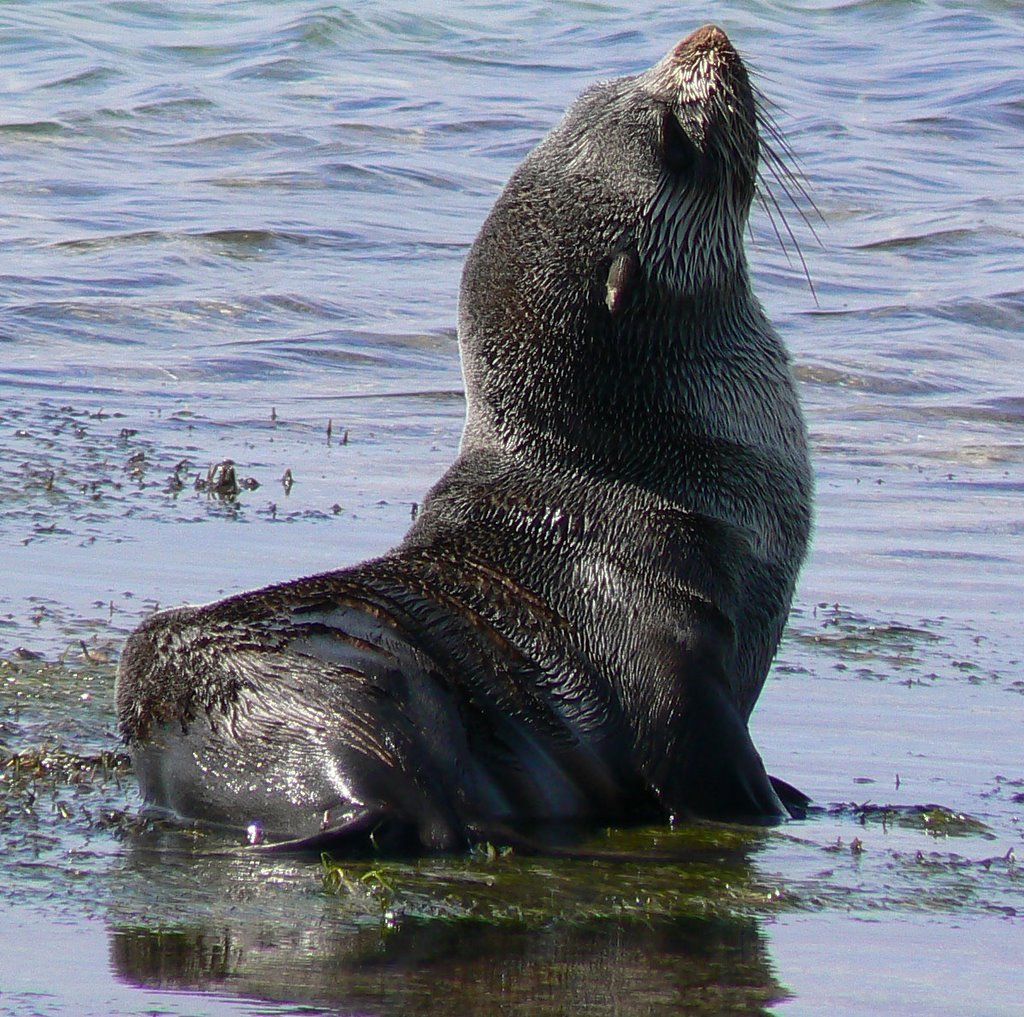
There it was as the tide receded, sitting in the rocky shallows, doing the what sea lions do - basking. He was just a pup.
But what an odd place to find him.
I've seen seals doing the barrel roll swim past when the tide is high along the shoreline of Encounter Bay. But this was the first Australian sea lion I'd seen. Not that they are rare in the area. They have colonies on three of the local islands. It was a little pup astray, a tired little pup.
I went down onto the reef and, keeping a 4-5 metre distance, I took some photos.
Back at the house, I kept an eye on him through the big telescope, watching him roll in the water was the tide come in, then clamber up on the reedy sand islands to bask some more. It is a fantastic telescope. I could just about count his whiskers.
As the morning wore on, walkers started to spot him. It is school holidays and the beach is quite busy - for the old reef shore that it is. It is a walking beach, not for swimmers, so it does not attract surfers and swimmers with their sun-worshipping coteries. Nonetheless, there are holidaymakers, among them packs of young people. And suddenly a group of bourgeois teen boys had spotted the pup, had rolled up their jeans and were picking their way out for, not just a good look, but a thorough poke and provoke. The young sea lion didn't like it and lunged at them, jaws open for a bite. The boys stepped back, but did not leave. They were on their mobile phones, presumably calling their friends. And friends started arriving, along with various other walkers, attracted by the growing crowd around the pup. I got my phone, too. I rang the Environment Department ranger who, fortunately, was near at hand. His arrival brought the crowd off the reef. He inspected the pup and left.
The pup was in peace, but not for long. More people "discovered" him and picked their way out onto the reef to get a close look. Close is the operative word.
People are astonishingly stupid about wildlife. It is one thing to enjoy the treat of a young sea lion basking in proximity but quite another to harass it, to poke or splash it to see a reaction. Why do people have to make things move?
Then the teen boys were back, sucking on cartons of iced coffee, standing right beside the pup in touching range. This was too much for me. I had to hurtle down to the shoreline and tell them to leave the thing alone. I felt like the mad old harridan that I, clearly, am. Fortunately, a council inspector had arrived and was assessing the situation. He went back to report to the council and the Environment blokes. I went back to the house - to watch the assorted reactions of the beach walkers to the sight of the sea lion.
Poor little chap had moved in closer, making himself yet more accessible. The worst sight I witnessed was a dad, towing his large family out to see the sea lion and then being the big brave dad, prodding it to show the kids how it could move. The pup lunged at him. I wished he had made contact.
Later, another family grouped around the creature to take photos of themselves with it. The small children started ripping up sea beads from the reef to throw at the pup. The parents did not reprove them.
There were a few good souls who inspected the pup from a respectful distance and did not try to disturb him. Not everyone is dead stupid. But too many are.
On one occasion, with about 15 people out on the reef looking at the pup, the ranger returned and I saw him sprint down the beach to tell them to keep their distance.
It was a frustrating day.
By afternoon, the pup was lying flat out and not looking too happy, or so one assumed. He had his flippers crossed over his abdomen, like a corpse, except that he was methodically rubbing his tummy with them. I wondered if he was ill.
When the ranger returned again, I went down to ask his opinion. He said he was worried the pup had been rejected by the colony. "It is that time of year," he said, sadly. "The bull sea lions are brutal with the pups and the other mothers with young are very territorial. This pup is probably recently weaned and not skilled at hunting Or he could be sick. There are a number of illnesses they suffer, including tuberculosis."
The ranger was keeping a close eye. He was worried. He already had one dead pup this season and suspected this may end up being another - to go to the museum for an autopsy.
"Some people want us to take them out and give them antibiotics, get them well and return them to the wild," he said. "The RSPCA is the only place that can do this - and we are worried about introducing antibiotics to the wild food chain. If the treated seal is eated by a shark, for instance..." I got the point. One must let nature take its course. Only the fittest survive in the wild. This could be a runty babe.
Then again, sea lions do a lot of lolling about. This also is natural behaviour in the wild.
The ranger said he would be back at first light either to remove a body or to make a decision about moving the pup to a safer place.
I went to bed worrying about the little creature out there on the reef, fearing that maybe he would die in the night.
But when the ranger came in the morning, the pup was gone.
He had returned to the sea. We think his mother came and got him. And, oh, what stories of horrible humans he had to tell her.
marine life
conservation
Thursday, October 05, 2006
Old media versus the new
The delicious switcheroo has come about. I wondered how long it would be before the mainstream media stopped sneering at the contents and activities of the Internet, reporting only the standard campaign negatives of Internet scams and sins.
It has been slow. Media has seen the Internet as a threat to its secure and traditional domination of information and comment - which, indeed, is not wrong.
It has been mystified and frustrated by the difficulty of making quick profits.
It has hired rapacious dotcom coyboys as consultants and tried myriad ventures - which just didn't turn that mighty buck. And it has watched the rising empires of the online population - the free sharing of information, the dazzle of human communications, the rise and rise of individual self expression and the challenge of the new and often expert commentary in the blogsphere.
Rupert Murdoch, used to owning so much of the media, has made assorted unsuccessful forays - most recently in buying the hideous MySpace which seems to have captured a mindless mass of youth. Now we read reports of its rising dollar value as a malleable marketplace. Even the American right and the military are moving in on that territory to push their perspectives into the cracks between the babbling teen titilations. One way or another, there must be a way for the mainstream to dominate the Internet. Or so they and their teams of overpaid consultants all hope.
Meanwhile, they have, at last, started using the Internet as a resource and recognising that it IS news. In fact, they can pad out their services by reporting on what is happening online.
At first it was just columnists plagiarising the email funnies, some of which were terribly old by the time the columnists got to see them. How were these mainstream denizens to know that the Internet had been a happening thing for a decade before they even logged on? They had had their backs firmly turned on the phenomenon.
But now email is ubiquitous - a must-have. Now the world is broadband, cable, wireless...
And it grows exponentially in the sophistication of its content. So the old media now looks to the new media and cannibalises it for its own content.
Which is why we turn on the television and see, several days or weeks after we have been sent it online, the latest brilliant YouTube video or EBay oddity. We now read about bloggers and even quote them.
Ah, yes, if you can't beat it content, make it news.
media
bloggers
It has been slow. Media has seen the Internet as a threat to its secure and traditional domination of information and comment - which, indeed, is not wrong.
It has been mystified and frustrated by the difficulty of making quick profits.
It has hired rapacious dotcom coyboys as consultants and tried myriad ventures - which just didn't turn that mighty buck. And it has watched the rising empires of the online population - the free sharing of information, the dazzle of human communications, the rise and rise of individual self expression and the challenge of the new and often expert commentary in the blogsphere.
Rupert Murdoch, used to owning so much of the media, has made assorted unsuccessful forays - most recently in buying the hideous MySpace which seems to have captured a mindless mass of youth. Now we read reports of its rising dollar value as a malleable marketplace. Even the American right and the military are moving in on that territory to push their perspectives into the cracks between the babbling teen titilations. One way or another, there must be a way for the mainstream to dominate the Internet. Or so they and their teams of overpaid consultants all hope.
Meanwhile, they have, at last, started using the Internet as a resource and recognising that it IS news. In fact, they can pad out their services by reporting on what is happening online.
At first it was just columnists plagiarising the email funnies, some of which were terribly old by the time the columnists got to see them. How were these mainstream denizens to know that the Internet had been a happening thing for a decade before they even logged on? They had had their backs firmly turned on the phenomenon.
But now email is ubiquitous - a must-have. Now the world is broadband, cable, wireless...
And it grows exponentially in the sophistication of its content. So the old media now looks to the new media and cannibalises it for its own content.
Which is why we turn on the television and see, several days or weeks after we have been sent it online, the latest brilliant YouTube video or EBay oddity. We now read about bloggers and even quote them.
Ah, yes, if you can't beat it content, make it news.
media
bloggers
Sunday, September 24, 2006
Get your hands off our water
Beware Australia.
The Business Council has discovered that profits could be made from water. It wants to get its hands on water and make it a commodity - something it can trade. It has appointed a slick, softly-spoken woman to puts its case to the media, with an unctuous superiority which asserts that we, the people, don't really understand the issue the way these business people do. Business could do a lot of good for water supply, they say - if it was allowed to attract investment. It could look at all sorts of "options", it could review "pricing frameworks", it could put summer water restrictions behind us. It is just a matter of people paying the right amount for its water use. If we pay, there is plenty of water and we can use all we like. Well, business people, there is not enough water and you know that damned well. Your long shot here is that very issue. Once you have your corporate hand on water, you can "discover" the shortages and jack up the costs - ever considering the profitable return on investment that your shareholders will demand. But, of course, anything they do will be better than allowing goverments to have control of this important resource, the Business Council purrs. Governments are monopolies, after all. Water management under compeitition, "dis-agregated", would be much better. Or so they claim - so knowingly and so charmingly. This is a massive and dangerous con job by the corporate sector.
The Business Council has discovered that profits could be made from water. It wants to get its hands on water and make it a commodity - something it can trade. It has appointed a slick, softly-spoken woman to puts its case to the media, with an unctuous superiority which asserts that we, the people, don't really understand the issue the way these business people do. Business could do a lot of good for water supply, they say - if it was allowed to attract investment. It could look at all sorts of "options", it could review "pricing frameworks", it could put summer water restrictions behind us. It is just a matter of people paying the right amount for its water use. If we pay, there is plenty of water and we can use all we like. Well, business people, there is not enough water and you know that damned well. Your long shot here is that very issue. Once you have your corporate hand on water, you can "discover" the shortages and jack up the costs - ever considering the profitable return on investment that your shareholders will demand. But, of course, anything they do will be better than allowing goverments to have control of this important resource, the Business Council purrs. Governments are monopolies, after all. Water management under compeitition, "dis-agregated", would be much better. Or so they claim - so knowingly and so charmingly. This is a massive and dangerous con job by the corporate sector.
Wednesday, September 20, 2006
Good onya, Steve
Bloody hell. Who would have thought one would be so touched to the Aussie core by Steve Irwin's funeral? Was there ever a more spectacular production, a media event on the grand scale? No wonder the family rejected the pompous old State Funeral on offer. They knew how to do it - on the stellar MGM scale. A la Steve Irwin.
The problem is, of course, that it still cannot sink in that this indomitable character is dead. His effervescence overwhelms. He was a one-off.
The problem is, of course, that it still cannot sink in that this indomitable character is dead. His effervescence overwhelms. He was a one-off.
Monday, September 18, 2006
Nasty Nanny
The anti-smoking message in Australia has been to deface cigarette packets with the most gruesome and offensive images of diseased lungs, arteries, feet and mouths. They are images so grotesque that smokers cannot bear to look upon them - which is why everyone has returned to the gracious old custom of storing their cigarettes in silver or gold cigarette cases. Suddenly, thanks to the overkill of the health messages, smoking has become rather classy - and someone has become extremely rich on the revival of cigarette cases.
The television advertisments which reiterate the imagery are harder to avoid and it is not only the smokers who are assaulted by them. No one dares eat in front of the television any more in case they have their stomachs turned by this aggressive shock campaign.
I pondered, when they introduced this disgusting health nannying imagery, if there was not cause for the same sort of treatment of alcohol. After all, smokers only harm themselves. Drinkers are responsible for road accidents, domestic violence, general brawling and vandalism and, of course, the damage to their livers potentially caused by overindulgence.
Well, I need wonder no longer. The Salvation Army has begun the push and now the media is leaping about in excitement. Alcohol bottles require anti-cancer warnings, just like cigarettes!
Of course, there is a powerful wine industry here in Australia and it is not going to like this - defacing the bottles with photographs of diseased livers and upstaging the label designs for which they pay top desigers a fortune. Of course drinkers are not going to want to look at filthy, cancerous livers as they sit down to quaff a $30 bottle of lovingly-made fine shiraz. What a turnoff! Photos of sick livers on the dining table in front of them as haut cuisine is served? I don't think so.
Just watch as a new market emerges - providing handsome bottle sheaths, the drinker's equivalent of the gold cigarette case. Come to think of it, I could get in on the ground floor of this one.
There is certainly more cause to deter drinkers from getting sloshed and sleazy than there is to stop smokers puffing, for the aforementioned societal reasons. But this movement of putting offensive graphic material in front of everyone is simply appalling. Distasteful rather than deterrent. It is a grotesque overkill by a self-righteous nanny culture gone mad with power.
tobacco
advertising
wine
The television advertisments which reiterate the imagery are harder to avoid and it is not only the smokers who are assaulted by them. No one dares eat in front of the television any more in case they have their stomachs turned by this aggressive shock campaign.
I pondered, when they introduced this disgusting health nannying imagery, if there was not cause for the same sort of treatment of alcohol. After all, smokers only harm themselves. Drinkers are responsible for road accidents, domestic violence, general brawling and vandalism and, of course, the damage to their livers potentially caused by overindulgence.
Well, I need wonder no longer. The Salvation Army has begun the push and now the media is leaping about in excitement. Alcohol bottles require anti-cancer warnings, just like cigarettes!
Of course, there is a powerful wine industry here in Australia and it is not going to like this - defacing the bottles with photographs of diseased livers and upstaging the label designs for which they pay top desigers a fortune. Of course drinkers are not going to want to look at filthy, cancerous livers as they sit down to quaff a $30 bottle of lovingly-made fine shiraz. What a turnoff! Photos of sick livers on the dining table in front of them as haut cuisine is served? I don't think so.
Just watch as a new market emerges - providing handsome bottle sheaths, the drinker's equivalent of the gold cigarette case. Come to think of it, I could get in on the ground floor of this one.
There is certainly more cause to deter drinkers from getting sloshed and sleazy than there is to stop smokers puffing, for the aforementioned societal reasons. But this movement of putting offensive graphic material in front of everyone is simply appalling. Distasteful rather than deterrent. It is a grotesque overkill by a self-righteous nanny culture gone mad with power.
tobacco
advertising
wine
Friday, September 15, 2006
The old and English
To take Australian citizenship, foreigners will have to pass a test in English - or, so the Government proposes. The Government wants the people to be able to communicate and fit in - so they have three years from arrival in the country to get the language under their belts. That is, if they want to become citizens.
Skilled migrants are tested on English to get their visa. Refugees are not. Of course. Nor are family reunion or family members of a skilled migrant to speak English. There are a lot of grannies in this lot - not all with the advantage of an education, so the idea of forcing them to learn the language would be unkind. We have a very old Chinese grandma living a couple of doors away. She still speaks not a word of English, but she smiles a lot and chugs about the district with her wheeled shopping trolley, picking out the things she needs and then offering the shopkeepers her purse to take what they are due. Everyone loves her and forgives her lack of language. After all, her job here is to look after the younger generation, fluent English-speaking students who will be keeping the country ticking over in a few years, be they scientists or techies.
The old granny darlings will never cope with language testing - so will never gain the citizenship which would give them certain rights - voting and pensions. However, so long as they are Asian or European, their families will take care of their aged needs - which is more than one can say of most Australians.
Skilled migrants are tested on English to get their visa. Refugees are not. Of course. Nor are family reunion or family members of a skilled migrant to speak English. There are a lot of grannies in this lot - not all with the advantage of an education, so the idea of forcing them to learn the language would be unkind. We have a very old Chinese grandma living a couple of doors away. She still speaks not a word of English, but she smiles a lot and chugs about the district with her wheeled shopping trolley, picking out the things she needs and then offering the shopkeepers her purse to take what they are due. Everyone loves her and forgives her lack of language. After all, her job here is to look after the younger generation, fluent English-speaking students who will be keeping the country ticking over in a few years, be they scientists or techies.
The old granny darlings will never cope with language testing - so will never gain the citizenship which would give them certain rights - voting and pensions. However, so long as they are Asian or European, their families will take care of their aged needs - which is more than one can say of most Australians.
Thursday, September 07, 2006
Sweet spring

Spring is in the air. Boronia is in the flower stands.
Beautiful boronia. Well, it is, oddly, one of the least beautiful of flowers - little brown cups with yellow interiors, as it is grown hereabouts. But the fragrance, oh the fragrance!
The scent of boronia is in the city, that perfect scent of spring. It wafts from the flower stands and perfumes the streets and malls, drawing one to the buckets of brown and green. I love it with a passion - so much so that it is the perfume oil essence that I wear on my body every single day.
Perchance my attachment to this fragrance comes from the childhood memories of this seasonal scent - to the rapture which wafts through the city and heralds spring. I've never analysed it - just loved it.
I've tried and tried to grow boronia which grows quite happily in the wild. To no long-term succcess. I've done better with gardenias, and that is not saying much. Boronia seems such a hardy little West Australian native, but it seems very fussy about its soil. So I gave up and let the native flower farms do the work, patiently waiting for this time each year when, for a brief time, we have this aromatic bliss.
And there it sits, a big bunch here in my room - and oh, doesn't the air smell sumptuously divine.
perfume
australia
Wednesday, September 06, 2006
Obesity's new epidemic
The obesity issue rises stridently into international headlines. There are now more overfed people than undernourished. So the powers that be want to tell fat people what not to eat. They want to swamp the media with anti fat food advertising on the assumption that obese people are plain stupid.
How are we going to put up with it? Advertising to counteract advertising?
This is all knee jerk stuff. Research on the obesity phenomenon is emerging with all sorts of answers - not all of them pointed at McDonalds and Coca Cola. One theory points to a virus. There may be other theories linked to food additives and chemicals. Research is scant.
Of course the comfort food/fast food indulgence definitely plays a role in weight gain, as does just eating too much. Sugar drinks are major culprits, and they are not just Coke. Orange juice and milk coffee drinks are right in there.
Indolence is a key player in the weight stakes, too. But we all know all of this. Obese people know this.
So what is a new advertising campaign going to achieve?
It is going to alienate us all. It is going insult us and irritate us. It is going to compound the existing overload of intrusive marketing messages delivered by a rapaciously greedy consumer industry. The advertising world will get fatter on the anti-fat message while our brains shrivel under the repetitive barrage of it all.
If anything is an unhealthy epidemic, it is advertising.
obesity
advertising
How are we going to put up with it? Advertising to counteract advertising?
This is all knee jerk stuff. Research on the obesity phenomenon is emerging with all sorts of answers - not all of them pointed at McDonalds and Coca Cola. One theory points to a virus. There may be other theories linked to food additives and chemicals. Research is scant.
Of course the comfort food/fast food indulgence definitely plays a role in weight gain, as does just eating too much. Sugar drinks are major culprits, and they are not just Coke. Orange juice and milk coffee drinks are right in there.
Indolence is a key player in the weight stakes, too. But we all know all of this. Obese people know this.
So what is a new advertising campaign going to achieve?
It is going to alienate us all. It is going insult us and irritate us. It is going to compound the existing overload of intrusive marketing messages delivered by a rapaciously greedy consumer industry. The advertising world will get fatter on the anti-fat message while our brains shrivel under the repetitive barrage of it all.
If anything is an unhealthy epidemic, it is advertising.
obesity
advertising
Monday, September 04, 2006
Goodbye Steve Irwin
Vale Steve Irwin.
As he lived, so did he die - taking risks with dangerous animals.
A stingray barb in the chest is about as rare and exotic as a dangerouos animal death may be. Stingray barbs in the foot or ankle are not uncommon. But on the chest? We are assuming Irwin was swimming low over the stingray, as they filmed their documentary about dangerous seacreatures, and that the stingray became alarmed and defensive. One imagines the death of Steve Irwin was captured on film, as were the many near-misses of a danger-dotted career.
What is interesting is the effect Irwin's sudden death had in this busy metropolitan newsroom. Nobody had ever bothered to express much of an opinion on Steve Irwin in the daily joust of the work environment. But news of his death sped across the floor producing a current of jaw drops and gasps. When the first report emerged on the television news monitors, people stood at their desks, straining to hear further details. There were none - just the same wire story, embellished with old footage of Irwin among animals. There is no shortage of images of Steve Irwin dicing with danger amid snakes and crocs.
And it seems that we are bonded in sorrow about this 44-year-old enthusiast who, albiet once causing kerfuffle by waving his baby near a croc, had carved a niche as a good-natured, high-spirited Aussie. He was a real life Crocodile Dundee - not an actor. His life was unscripted and his antics ever more dangerous. So there will be no re-take of the stingray scene. It is the final reality - that dangerous animals are really dangerous.
The world's most colourful conservationist is gone - by the world's most extreme and extraordinary freak incident, stabbed in the heart by a stingray. He may be the only person ever to have died that way.
And we are all very sad.
Steve Irwin
stingrays
As he lived, so did he die - taking risks with dangerous animals.
A stingray barb in the chest is about as rare and exotic as a dangerouos animal death may be. Stingray barbs in the foot or ankle are not uncommon. But on the chest? We are assuming Irwin was swimming low over the stingray, as they filmed their documentary about dangerous seacreatures, and that the stingray became alarmed and defensive. One imagines the death of Steve Irwin was captured on film, as were the many near-misses of a danger-dotted career.
What is interesting is the effect Irwin's sudden death had in this busy metropolitan newsroom. Nobody had ever bothered to express much of an opinion on Steve Irwin in the daily joust of the work environment. But news of his death sped across the floor producing a current of jaw drops and gasps. When the first report emerged on the television news monitors, people stood at their desks, straining to hear further details. There were none - just the same wire story, embellished with old footage of Irwin among animals. There is no shortage of images of Steve Irwin dicing with danger amid snakes and crocs.
And it seems that we are bonded in sorrow about this 44-year-old enthusiast who, albiet once causing kerfuffle by waving his baby near a croc, had carved a niche as a good-natured, high-spirited Aussie. He was a real life Crocodile Dundee - not an actor. His life was unscripted and his antics ever more dangerous. So there will be no re-take of the stingray scene. It is the final reality - that dangerous animals are really dangerous.
The world's most colourful conservationist is gone - by the world's most extreme and extraordinary freak incident, stabbed in the heart by a stingray. He may be the only person ever to have died that way.
And we are all very sad.
Steve Irwin
stingrays
Friday, September 01, 2006
Euthanasia Kanckered
The Euthanasia debate has lurched backwards thanks to the misguided efforts of Democrat politician Sandra Kanck. She's an odd bird, Kanck - a Christian of sorts, I believe, with a musical bent. Over the years, I've had cause to love or loathe her, depending on the issue she is embracing. Her stance on euthanasia leaves me fiercely ambivalent. She has chosen to state under Parliamentary privilege the assorted accessible ways in which a dying person may take his or her own life. By law, that which is spoken in Parliament is transcribed and archived for ever in the pages of Hansard - pages which, nowadays, are available to read online. This means that the methods of suicide which are forbidden to be published in the public arena now are there. And, of course, furore has erupted. Rightly so. Kanck has done this to make a brave protest in the cause of euthanasia - but she has done inordinate damage because she has exacerbated the blur between euthanasia and suicide. Now everyone is talking suicide in various forms of strident indignation and the issue of euthanasia has been obscured.
The important thing has always been to make a clear distinction. "Assissted suicide" in the form of euthanasia of those in a terminal state of intolerable suffering is not the same as the suicide committed by the otherwise healthy depressed, disappointed or spiteful.
And it is not "mercy killing" although, good grief, mercy plays a large role in asssissting the suffering. But "mercy killing" has come to mean knocking granny off if she is too old or dependent or turning off the life support. And euthanasia is nothing to do with others making decisions on granny's behalf. Euthanasia has to be a self-made decision acknowledged in its legitimacy by the medical profession. It is between the dying and the doctor - or it should be. But the doctor is forbidden to take any action. Which is were the whole issue becomes so dreadfully messy, becomes an emotive public debate in which suicide gets mixed up with euthanasia.
And, rather like George Bush telling critics of his administration that they are unpatriotic and on the side of terrorists, the anti-euthanasia arguers are telling the pro-euthanasia lobby that it is pro-suicide.
For once and for all, supporting the compassionate measure of allowing those who are dying in pain and loss of dignity to make a graceful exit of their own choosing is absolutely not comparable to condoning lovelorn teens or bankrupt businessmen in cutting off their lives before their time. These are different issues.
Unfortunately, Sandra Kanck, in revealing the not very secret methods by which people may leave this world by their own hand, has thrown the baby of euthanasia out with the bathwater of suicide. And it is all a bloody mess.
Silly woman.
euthanasia
suicide
Sandra Kanck
The important thing has always been to make a clear distinction. "Assissted suicide" in the form of euthanasia of those in a terminal state of intolerable suffering is not the same as the suicide committed by the otherwise healthy depressed, disappointed or spiteful.
And it is not "mercy killing" although, good grief, mercy plays a large role in asssissting the suffering. But "mercy killing" has come to mean knocking granny off if she is too old or dependent or turning off the life support. And euthanasia is nothing to do with others making decisions on granny's behalf. Euthanasia has to be a self-made decision acknowledged in its legitimacy by the medical profession. It is between the dying and the doctor - or it should be. But the doctor is forbidden to take any action. Which is were the whole issue becomes so dreadfully messy, becomes an emotive public debate in which suicide gets mixed up with euthanasia.
And, rather like George Bush telling critics of his administration that they are unpatriotic and on the side of terrorists, the anti-euthanasia arguers are telling the pro-euthanasia lobby that it is pro-suicide.
For once and for all, supporting the compassionate measure of allowing those who are dying in pain and loss of dignity to make a graceful exit of their own choosing is absolutely not comparable to condoning lovelorn teens or bankrupt businessmen in cutting off their lives before their time. These are different issues.
Unfortunately, Sandra Kanck, in revealing the not very secret methods by which people may leave this world by their own hand, has thrown the baby of euthanasia out with the bathwater of suicide. And it is all a bloody mess.
Silly woman.
euthanasia
suicide
Sandra Kanck
Subscribe to:
Posts (Atom)